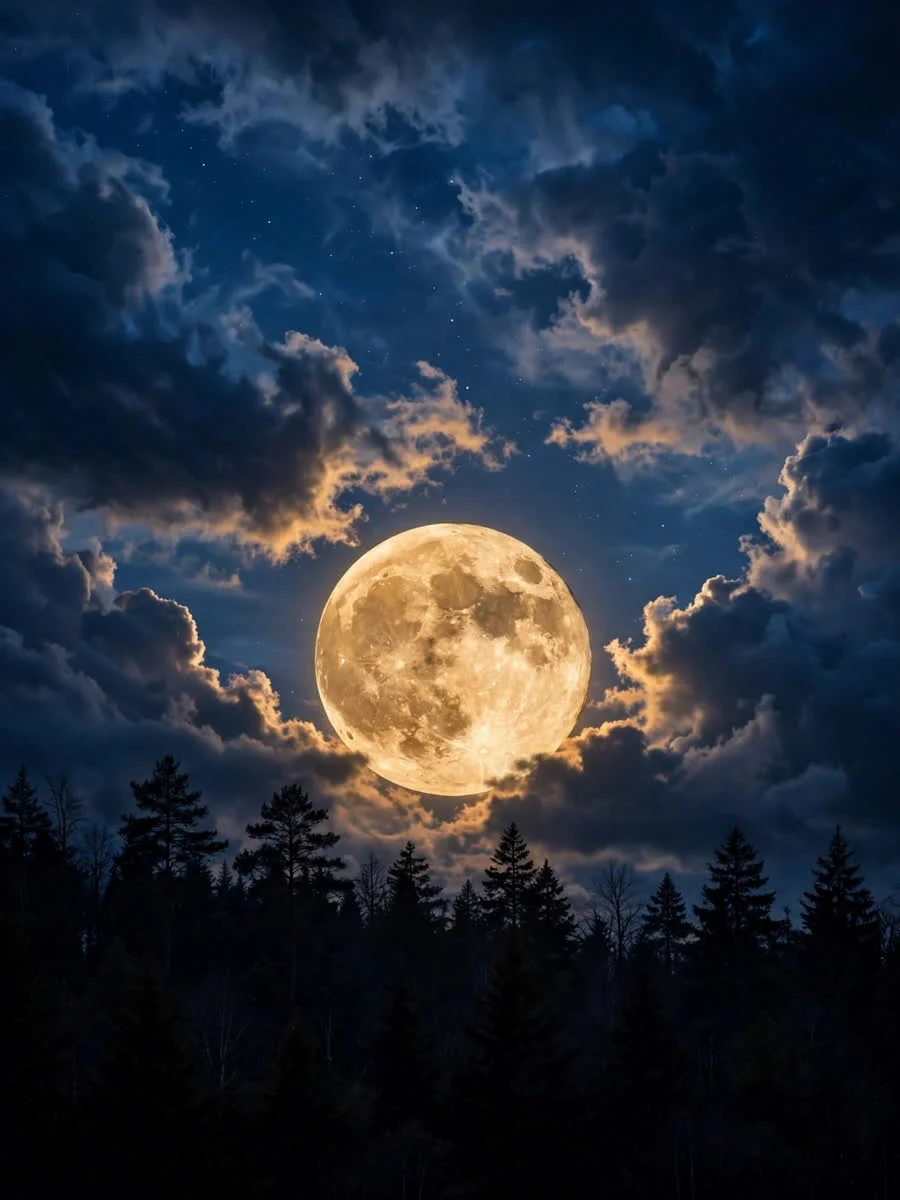
Look up tonight. The biggest and brightest full moon of the autumn is here, and it has a name with centuries of history behind it: the Beaver Moon.
November’s full moon reaches its peak illumination on Tuesday, November 24, 2026, at 2:53 p.m. UTC — that is 9:53 a.m. in New York, 2:53 p.m. in London, and 7:54 p.m. in Pakistan. Because that exact moment falls during daylight hours across much of North America, the best time to see it is after sunset this evening, when it rises in the east looking large, golden and almost impossibly bright. It will also look nearly full on the evening of Monday, November 23, and again on Wednesday night.
Why this moon is special
Not every full moon is a supermoon. A supermoon happens when the full moon lines up with the closest point of the moon’s orbit around Earth, a point astronomers call perigee. At the moment it becomes full, the Beaver Moon will be about 360,765 kilometres from Earth, well inside the usual supermoon range and far closer than the average distance of about 384,400 kilometres.
The moon will not even reach its very closest point until Wednesday, November 25, at 4:15 p.m. Eastern time, when it will be just 359,336 kilometres away. That closeness is what makes a supermoon appear up to 14 percent larger and as much as 30 percent brighter than the faintest full moon of the year, although the difference is hard to spot with the naked eye unless you compare it carefully.
The first of three supermoons
Tonight’s Beaver Moon is the first of three consecutive supermoons, according to NASA. The next one arrives on December 24 — a Christmas Eve supermoon, the Cold Moon — and another follows in January 2027. December’s will be the biggest supermoon of the year, so tonight is really the opening night of a three-month sky show that runs through the holidays.
The moon’s orbit is not a perfect circle, so its distance from Earth changes all month. Across 2026, that distance swings between about 356,660 and 406,435 kilometres — a range of roughly 50,000 kilometres. Tonight’s moon sits near the close end of that range.
Where and when to look
For the best view, step outside around sunset and face east. On November 24, moonrise happens at about 4:17 p.m. in New York, 4:09 p.m. in Chicago, 4:29 p.m. in Denver and 4:44 p.m. in Los Angeles, local time in each case. In Pakistan, the moon will already be high and bright in the evening sky after the full phase at 7:54 p.m. PKT.
As the evening goes on, the moon climbs higher and drifts toward the southeast, where it will sit by around 10 p.m. By midnight, keen-eyed watchers may also spot Mars and Jupiter low in the east, with Saturn low in the southwest.
There is a bonus for stargazers this year. On November 24, the Pleiades star cluster — also known as M45, the Seven Sisters — will be near the moon, and the Hyades cluster will be close by as well. Binoculars or a small telescope will bring out the fainter stars, and a camera on a tripod can capture the moon hanging beside them.
A classic trick makes the moon look even more spectacular at moonrise. When it sits low on the horizon, near trees, buildings or hills, a trick of perspective makes it look abnormally large. That is the famous moon illusion, and it is strongest in the first minutes after moonrise, so get outside early.
Why it is called the Beaver Moon
The name comes from North American seasonal traditions. In November, beavers were busy preparing for winter, retreating to their lodges and building up food stores, and trappers sought the animals for their thick winter pelts at this time of year. The Old Farmer’s Almanac ties the name to that shift into winter and to the fur trade that once shaped life across the continent.
Every full moon has a traditional name — the Wolf Moon in January, the Harvest Moon in autumn — and the Beaver Moon is one of the oldest and best loved of them all.
A night worth stepping outside for
No special equipment is needed. The supermoon is visible with the naked eye from anywhere with a clear sky, and it stays bright all night long. If clouds spoil the view tonight, do not worry — the moon will still look almost completely full tomorrow night, and the even bigger supermoon of December is only a month away.
So tonight, when the porch lights come on, look past them. The Beaver Moon will be waiting, bigger, brighter and closer than usual, opening a season of winter skies that only gets better from here.
Website Disclaimer
The information provided on this website is for general informational and educational purposes only. While we strive to ensure that all content is accurate and up to date, we make no guarantees regarding the completeness, reliability, or accuracy of any information published.
The views and opinions expressed in articles belong to their respective authors and do not necessarily reflect the views of this website. Any action you take based on the information found on this website is strictly at your own risk. We will not be liable for any losses, damages, or inconveniences arising from the use of our content.
Some articles may contain opinions, third-party information, or external links. We do not endorse or guarantee the accuracy of content on external websites and are not responsible for their practices or policies.
All content on this website is provided in good faith and is intended for informational purposes only. Readers are encouraged to verify information independently and seek professional advice where appropriate.