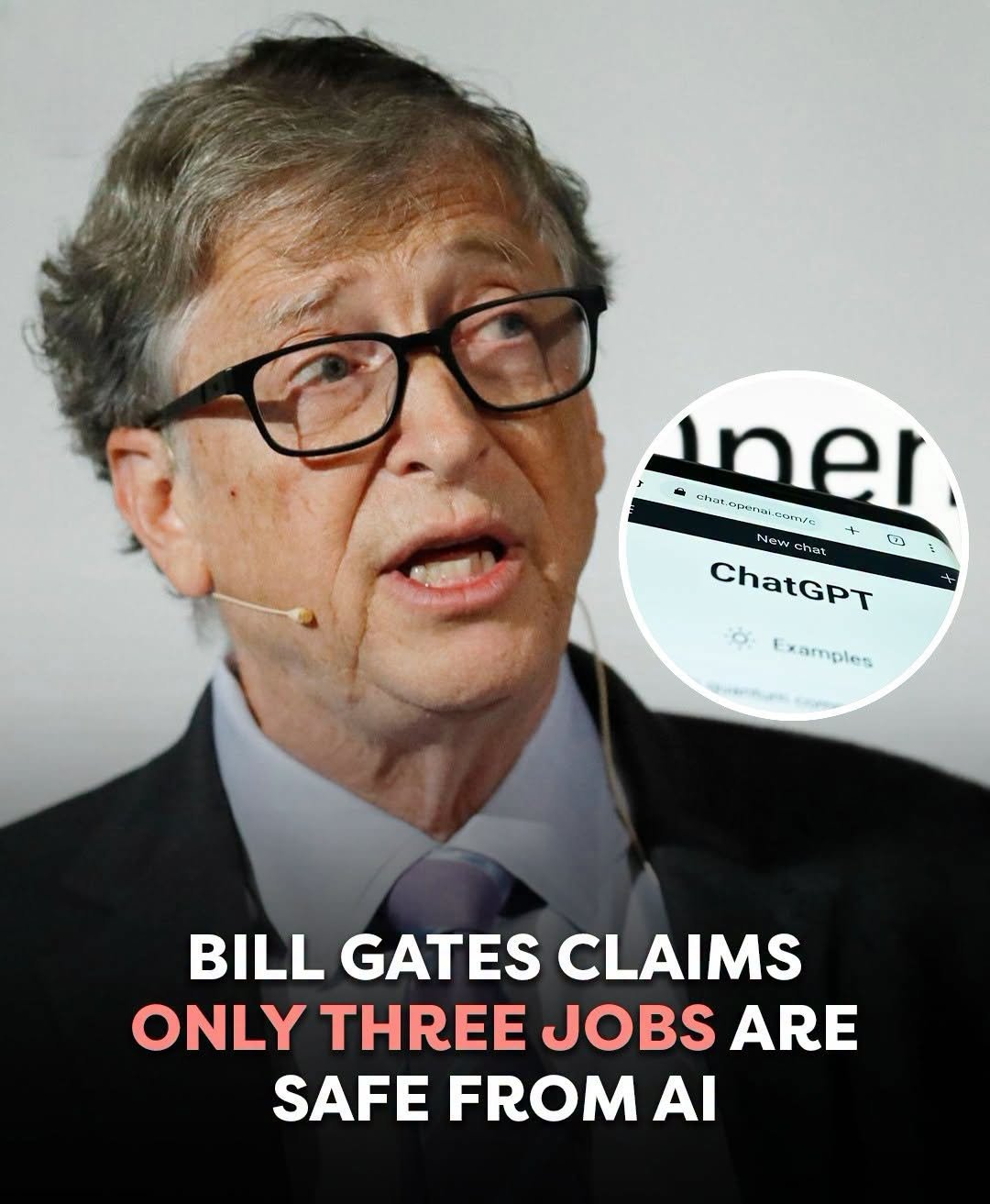
The Microsoft co-founder has made a terrifying prediction about the future of jobs globally amid the explosion of artificial intelligence (AI).
Two years ago, a report by the investment bank Goldman Sachs revealed that AI could replace, or diminish, the equivalent of 300 million full-time jobs.
Such technology, which will also lead to new types of jobs, can already pass the law bar exam, ace the SATs, and produce ‘unique’ artwork, Forbes reports.
It can also help holidaymakers to plan their trips.
Dad Jason Brown, who consulted ChatGPT to prepare an itinerary for his summer holiday to Amsterdam and Ireland, told the BBC: “In the past I have always used sites such as TripAdvisor, but I realized I had all the knowledge at my fingertips [through AI] and it spits it out in 15 seconds.”
He added: “It provided me with a golf itinerary for Dublin, and a four-day itinerary for elsewhere in Ireland.”
There is no question that AI is transforming the world as we know it, and what many people want to know is… what jobs will be safe?
Bill Gates has made a terrifying prediction about the future of AI. Credit: Alamy
It’s set to take over millions of jobs in the coming years, but artificial intelligence could face unbeatable competition from humans in three particular professions.
In an interview with Jimmy Fallon, Bill Gates was asked: “Will we still need humans?”
“Not for most things,” the billionaire replied.
According to the Microsoft co-founder, only coders, energy experts, and biologists will survive the AI revolution.
While other roles become obsolete and the working week is potentially reduced to just two days, this trio of careers is expected to remain unscathed – at least, for now.
And it’s all down to the skills involved (among them: creativity, problem-solving, and strategizing).
Bill Gates says he believes there are only three jobs safe from AI. Credit: Alamy
Appearing on the hit U.S. talk show, The Tonight Show, Gates revealed how AI, though capable of generating code, lacks the abilities required to develop complex software.
These include precision, logical reasoning, and the ability to solve problems.
Therefore, human coders – ironically, including those responsible for developing AI systems – will be needed to advance automation itself, Business Standard reports.
Speaking to host Fallon, Gates said energy experts are also indispensable, especially when it comes to crisis management and sustainable strategizing.
He explained that, while AI can assist with efficiency, the energy sector is too complex for it to handle independently – which is, no doubt, good news for those working in it.
Bill Gates predicts that coding will be one of the jobs safe from the AI takeover. Credit: Adobe Stock
And, referring to the final ‘safe’ job in our ever-changing world, Gates claimed that AI has yet to master the skills used by biologists – like intuition and critical thinking.
Intuitive leaps often drive life-changing and life-saving scientific breakthroughs.
So, while AI will likely be used as a tool in the medical and scientific industries (such as to analyse data and diagnose illnesses), it will aid, rather than replace, humans.
Yet the tycoon admits his predictions might be wrong.
Gates suggested public opinion would contribute to how much AI takes over, adding: “You know, like baseball. We won’t want to watch computers play baseball. So, there’ll be some things that we reserve for ourselves, but in terms of making things and moving things and growing food, over time, those will be basically solved problems.”
As for what it will be capable of in the future, watch this space…
Website Disclaimer
The information provided on this website is for general informational and educational purposes only. While we strive to ensure that all content is accurate and up to date, we make no guarantees regarding the completeness, reliability, or accuracy of any information published.
The views and opinions expressed in articles belong to their respective authors and do not necessarily reflect the views of this website. Any action you take based on the information found on this website is strictly at your own risk. We will not be liable for any losses, damages, or inconveniences arising from the use of our content.
Some articles may contain opinions, third-party information, or external links. We do not endorse or guarantee the accuracy of content on external websites and are not responsible for their practices or policies.
All content on this website is provided in good faith and is intended for informational purposes only. Readers are encouraged to verify information independently and seek professional advice where appropriate.