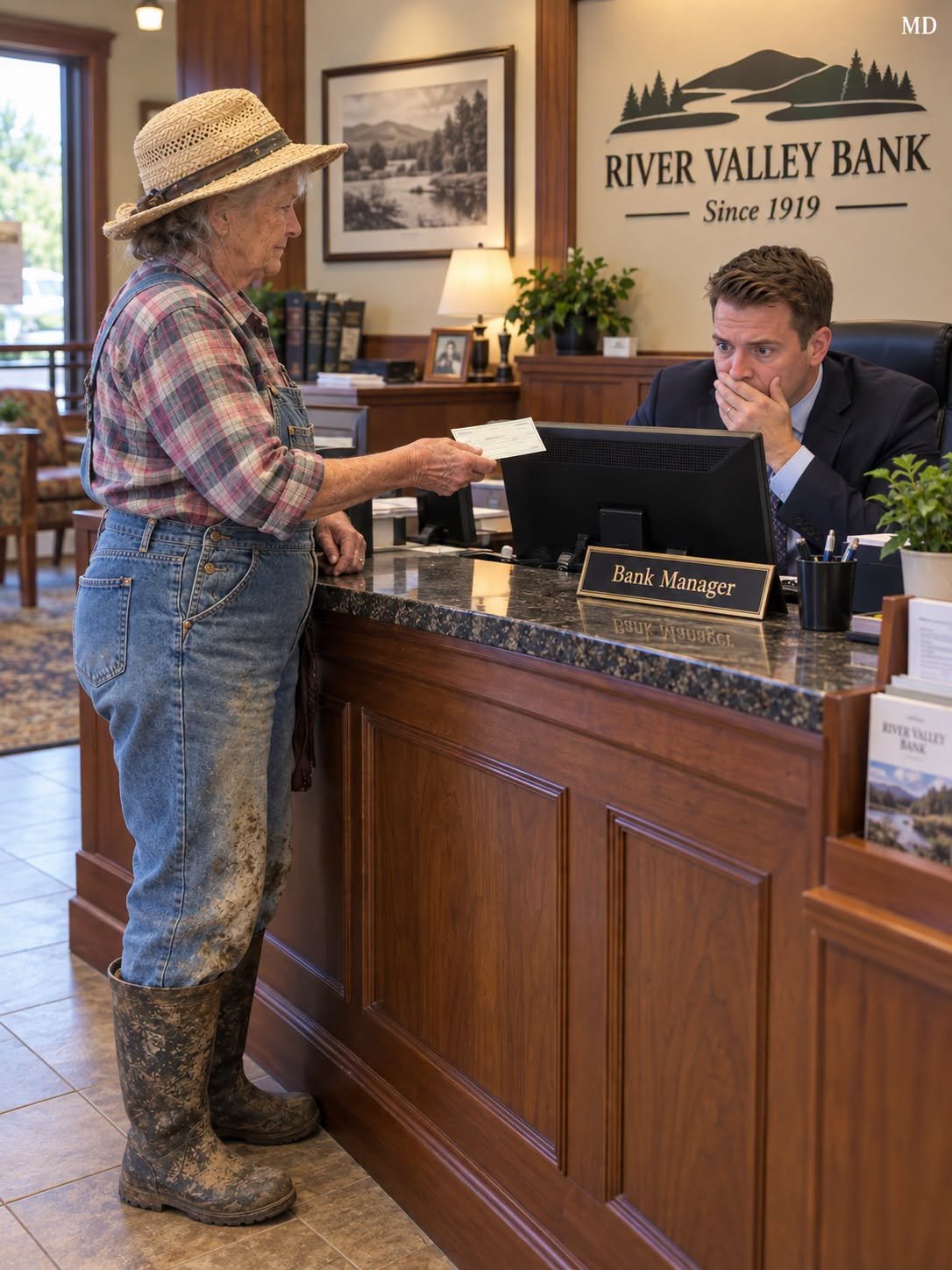
The bank fell silent when Brandon Pierce looked at my muddy boots, dirt-stained hands, and George’s old straw hat before telling me he needed more identification to cash a simple $40 check. I was 79, dressed in my gardening clothes, and had walked four blocks to the Farmers & Merchants Bank in Millbrook, Iowa, to collect payment for four rhubarb pies I had made for the Methodist church bake sale. I had been banking there for 58 years, so the young branch manager’s suspicious stare caught me completely off guard. When he told me the bank had to be careful about suspicious transactions, I politely reminded him that I had cashed checks there since before he was born.
“I understand the rules, young man,” I said, resting my hands on the counter. “But I’ve been a customer here for nearly six decades. My husband, George, opened our first account in this very building when we were newly married.”
Brandon barely looked up from his computer.
“Ma’am, I’m not questioning your age or your story. But appearances can be deceiving, and we’ve had incidents involving fraudulent checks. I need another form of identification before I can approve this transaction.”
I reached into my faded purse and handed him my driver’s license. He examined it, compared the photograph with my face, and then shook his head.
“This license doesn’t match the signature on file closely enough. Do you have anything else?”
I stared at him in disbelief. My hands had grown crooked with arthritis, and my signature had changed over the years. But the account was mine, and the money I was trying to collect had been earned honestly.
Behind me, a man in a business suit sighed impatiently. A woman holding a toddler glanced at my muddy boots and whispered something to the person beside her. I could feel their eyes on me, and for the first time in years, I felt embarrassed about something as ordinary as the clothes I wore to work in my own garden.
I had spent the morning pulling weeds, gathering rhubarb, and baking pies in the same little kitchen where George and I had raised our three children. My old hat had belonged to him. I wore it because the Iowa sun was unforgiving, and I had never seen any reason to replace something that still served its purpose.
I wasn’t trying to borrow money or withdraw a fortune. I simply wanted the forty dollars I had earned.
“Could you please ask someone to look at my account history?” I asked quietly. “There must be a record of all the years I’ve banked here.”
Brandon folded his arms.
“I’m the branch manager. I’m telling you what we need.”
His tone was calm, but there was something in it that made me feel as though I were being accused of a crime I hadn’t committed.
For a moment, I considered walking away. I could have returned home, put the check in a drawer, and forgotten about the whole thing. Forty dollars wasn’t going to change my life.
But then I remembered George.
He had always told me that dignity wasn’t something other people gave you. It was something you refused to surrender, even when standing up for yourself was uncomfortable.
So I straightened my shoulders.
“Then I’d like to speak with someone who can review my account records and explain what other identification you require.”
Brandon exhaled sharply before turning toward the computer again. He asked for my account number, which I recited from memory. He typed it in, frowned, and began clicking through several screens.
Then his expression changed.
He looked at the monitor, glanced at me, and looked back at the screen.
“Mrs. Pierce,” he said, his voice suddenly less confident, “how long did you say you’ve been a customer here?”
“Fifty-eight years. My husband opened the account in 1968.”
He stopped typing.
A few seconds later, he picked up the telephone and called someone in the bank’s administrative office. He spoke in a low voice, occasionally glancing in my direction.
I couldn’t hear every word, but I caught my name, the phrase long-standing account, and something about archived records.
When he hung up, he asked me to wait while he contacted the bank’s senior operations officer.
I sat down in a chair near the entrance, holding my purse in my lap. I watched customers come and go, some carrying briefcases, others wearing work clothes much like mine. Nobody else seemed to have any trouble completing their business.
After nearly twenty minutes, an older woman hurried out of an office in the back. Her name tag read Margaret Ellis, Senior Operations Officer.
She approached me with a warm smile.
“Mrs. Pierce? I’m Margaret. I’m sorry you’ve had such a difficult experience today. May I ask you a few questions about your account?”
I answered everything she asked. I told her about George, our original savings account, the mortgage we had paid off, and the small certificates of deposit we had opened for our children. I remembered the names of two employees who had worked at the bank decades earlier, including one who had helped us save for our first family car.
Margaret listened carefully.
Then she returned to her office and pulled up additional records.
When she came back, she was carrying a folder.
“Mrs. Pierce,” she said, “your account history goes back much further than our current computer records. We’ve located archived documents confirming your identity and your relationship with this bank.”
She paused before continuing.
“Your account has been in good standing for decades. I can see why you expected this transaction to be straightforward.”
I nodded, trying not to let my frustration show.
“I’m not asking anyone to bend the rules,” I told her. “I only want the same respect I’d expect to give another person.”
Margaret’s expression softened.
“You’re absolutely right.”
She turned toward Brandon and explained that identity verification was important, but so was treating customers respectfully. If additional documentation was genuinely necessary, the bank should explain the requirement clearly and help the customer understand how to satisfy it.
Brandon looked uncomfortable.
“Mrs. Pierce, I apologize,” he said. “I was trying to follow our procedures, but I should have handled this differently.”
I studied his face for a moment. He was young enough to be my grandson, and I suspected he had spent so much time learning the bank’s rules that he had forgotten the people those rules were meant to serve.
“I appreciate the apology,” I replied. “Just remember that you never know what someone has been through before they walk through those doors.”
Margaret helped complete the verification process, and after confirming that everything was in order, the teller cashed my forty-dollar check.
I placed the money carefully inside my purse.
Before leaving, I turned back toward Brandon.
“May I give you a little advice?”
He nodded.
“Never judge a person’s circumstances by their clothes. Those muddy boots have carried me through thousands of mornings of honest work. These hands have raised children, cared for my husband, fed neighbors, and helped keep our church running. They may not look impressive, but they’ve earned every line on them.”
The lobby had grown quiet again.
I continued, my voice gentle but firm.
“And that old straw hat belonged to my husband. He wore it while building our home, tending our garden, and working until his back hurt so badly he could hardly stand. I wear it because it reminds me of him. So when you look at me, please don’t see a poorly dressed old woman. See a person who has lived a whole life before you ever learned to balance a checkbook.”
Brandon lowered his eyes.
“I will remember that,” he said.
I walked home beneath the afternoon sun, my purse holding forty dollars and my heart feeling considerably lighter.
That evening, I told my daughter what had happened. She was furious and immediately offered to call the bank’s corporate office. I thanked her, but I asked her to wait.
“I don’t want anyone punished just because I had a bad afternoon,” I explained. “I want them to learn something from it.”
The following week, Margaret called to tell me that the bank was reviewing how employees handled identification concerns and customer complaints. She also invited me to attend a community meeting where the bank planned to discuss ways to make its services more welcoming to older customers.
I agreed to attend.
When I arrived, I wore my usual gardening clothes and George’s straw hat. I wasn’t interested in dressing differently to prove that I belonged. I had belonged long before anyone in that room knew my name.
Margaret introduced me and invited me to share my experience. I spoke about the importance of security, but I also spoke about patience, compassion, and the danger of making assumptions about people based on their appearance.
I told them that a person wearing an expensive suit could make an honest mistake, just as someone wearing muddy boots could be perfectly trustworthy. Neither clothing nor age could replace proper verification, and neither should be used as a shortcut for judging someone’s character.
When I finished, several people applauded.
Brandon was sitting near the back. After the meeting, he approached me and thanked me for speaking honestly.
“I’ve been thinking about what you said,” he admitted. “I realized I was so focused on protecting the bank that I forgot the importance of making people feel respected while doing it.”
I smiled.
“Protecting people and respecting them aren’t opposite things, Brandon. A good bank should do both.”
Months later, I still visited the Farmers & Merchants Bank whenever I needed to. The procedures hadn’t disappeared, nor should they have. But employees had become more willing to explain them, listen to customers, and help resolve problems without making people feel ashamed.
And every autumn, when the rhubarb was ready and the church held its annual bake sale, I continued making pies.
One afternoon, I even brought Brandon a freshly baked rhubarb pie.
He looked surprised when I placed the box on his desk.
“What’s this for?” he asked.
“Because everyone deserves a second chance to do better,” I told him.
He thanked me, his eyes shining with embarrassment and gratitude.
As I left the bank that day, I thought about how easily a few careless words could make someone feel small—and how much difference a little kindness could make.
At seventy-nine, I had learned that respect shouldn’t depend on how much money someone has, what kind of clothes they wear, or how important they appear to be.
Sometimes, the person standing quietly in front of you has spent a lifetime working hard, keeping promises, and helping others without ever asking for recognition.
And sometimes, all it takes is one uncomfortable moment to remind us of something we should have known all along:
Treat people with dignity before you know their story. By the time you discover who they are, you’ve already shown them who you are.
Website Disclaimer
The information provided on this website is for general informational and educational purposes only. While we strive to ensure that all content is accurate and up to date, we make no guarantees regarding the completeness, reliability, or accuracy of any information published.
The views and opinions expressed in articles belong to their respective authors and do not necessarily reflect the views of this website. Any action you take based on the information found on this website is strictly at your own risk. We will not be liable for any losses, damages, or inconveniences arising from the use of our content.
Some articles may contain opinions, third-party information, or external links. We do not endorse or guarantee the accuracy of content on external websites and are not responsible for their practices or policies.
All content on this website is provided in good faith and is intended for informational purposes only. Readers are encouraged to verify information independently and seek professional advice where appropriate.