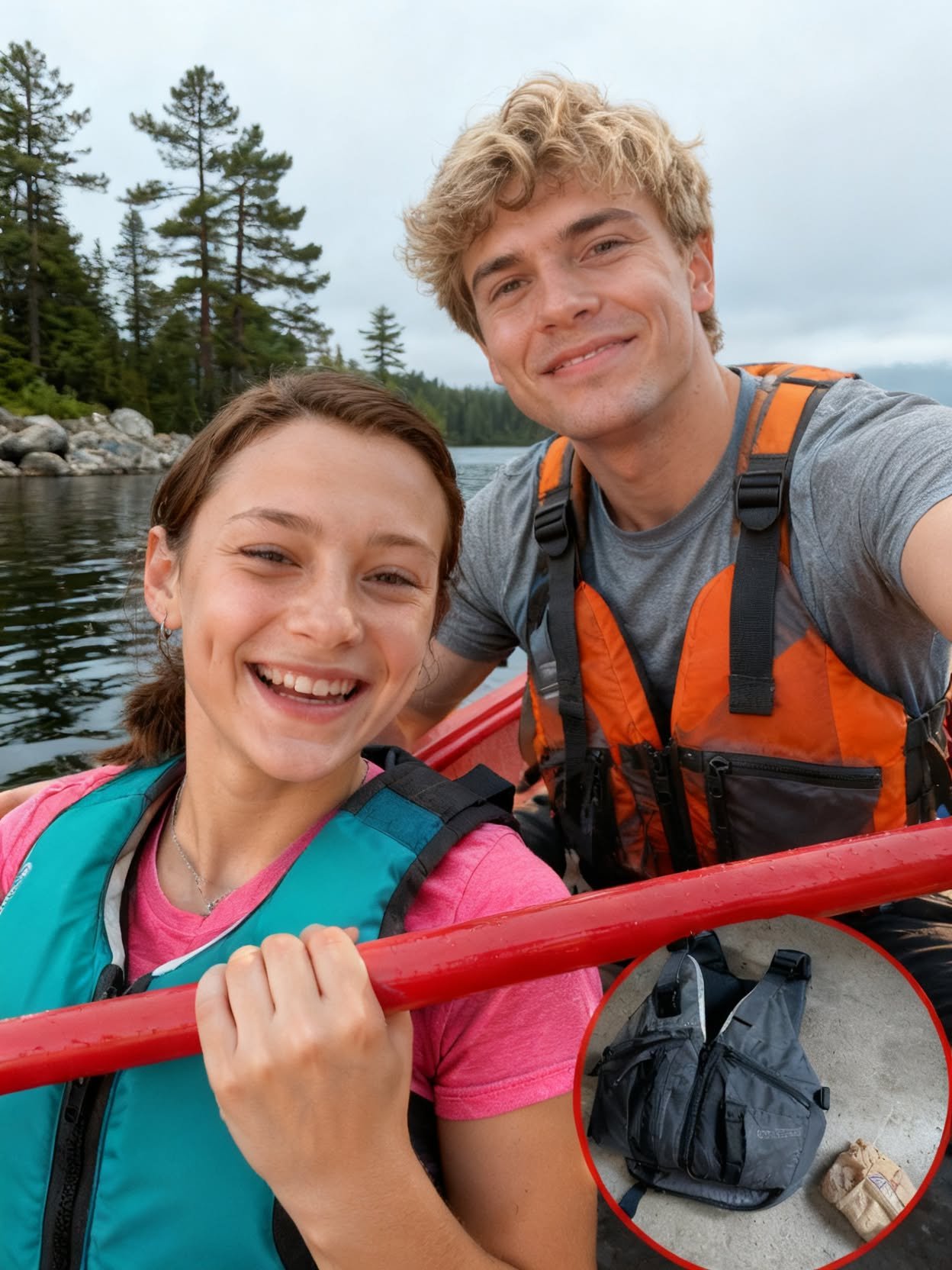
Maya did not look at me when she slid the metal zipper shut on her blue nylon backpack.
I was slicing yellow apples at the kitchen counter, keeping the paring knife close to my thumb.
She tugged at her left earlobe, her fingers red from the morning chill.
“You need to eat something before you and your uncle get on the water,” I said.
She did not answer, only pushed a stray lock of brown hair behind her ear.
I set three slices of apple on a cracked ceramic saucer and pushed them toward her across the clean oilcloth.
“Maya.”
She stopped moving.
“Look at me for a second, sweetheart.”
Slowly, she lifted her eyes. They were the same gray-blue as her mother’s, but there was something in them that made my stomach tighten. Fear, perhaps. Or the exhaustion of a child who had spent too many nights pretending everything was fine.
“Did you sleep last night?” I asked.
She shrugged.
“Did you have another nightmare?”
“No.”
The answer came too quickly.
I put down the knife.
For six months, Maya had been living with me in the little house near the lake. Her mother, my younger sister, had died unexpectedly the previous spring, leaving behind a nine-year-old daughter and a family full of questions nobody seemed willing to answer. Maya’s father had been absent from her life for years, so when my brother-in-law, Daniel, offered to take her fishing on weekends, I had been grateful. I thought a few hours outdoors might help her feel like a child again.
But lately, something had changed.
Every Friday evening, Daniel arrived with the same cheerful smile and the same promises of adventure. Every Saturday morning, Maya packed her blue backpack without speaking. And every Saturday afternoon, she returned home quieter than before.
At first, I blamed grief.
Then I noticed the small things.
She stopped asking when Daniel would visit. She began checking the locks on the doors before going to bed. Whenever his truck pulled into the driveway, her shoulders stiffened, and she found excuses to stay in the bathroom or hide in her bedroom.
Last Tuesday, I had found her sitting on the floor beside her bed, still wearing her shoes, with the backpack clutched against her chest.
When I asked what was wrong, she whispered, “Nothing. Please don’t make me go.”
I had asked her where she didn’t want to go.
She had started crying before she could answer.
Now, standing in my kitchen, watching her stare at three slices of apple as though they were something dangerous, I realized I had spent too much time explaining away what my instincts had been trying to tell me.
“Sweetheart,” I said gently, “you don’t have to go fishing today.”
Her fingers stopped worrying at her earlobe.
For the first time that morning, she looked directly at me.
“Really?”
The single word nearly broke my heart.
“Really. If you want to stay home, we’ll stay home. You don’t have to explain anything right now.”
She glanced toward the window. Daniel’s truck was parked beside the mailbox, its engine still running.
“He’s going to be mad,” she whispered.
“That’s not your responsibility.”
“But he said you promised.”
“I can handle that.”
Maya swallowed hard. Her eyes filled with tears, but she fought them back with the determination of someone much older than nine.
Then she reached into the front pocket of her backpack and pulled out a folded piece of paper.
“I was going to show you this last night,” she said. “But I was scared you wouldn’t believe me.”
My hands went cold.
I didn’t reach for the paper immediately. Instead, I pulled out the chair beside her and sat down so we were at the same level.
“You can tell me anything, Maya. I’ll listen.”
She placed the folded paper between us.
It was a small sheet torn from a notebook. On it, in Daniel’s unmistakable handwriting, were several sentences about our Saturday fishing trips. The words were ordinary enough at first glance, but the last line made my breath catch.
Don’t tell your aunt what happens at the lake. She wouldn’t understand, and she’d only ruin everything.
I read it twice.
“Did Daniel write this?” I asked.
Maya nodded.
“When?”
“Yesterday. He put it in my backpack when he came to see me.”
“Did he tell you not to show me?”
Another nod.
I forced myself to remain calm, even as a dozen frightening possibilities crowded my mind.
“Maya, I need to ask you something important. Has anyone hurt you or made you feel unsafe?”
Her face crumpled.
“He says I’m supposed to keep our trips a secret,” she whispered. “He says it’s our special thing, and that grown-ups always make everything worse.”
I reached for her hand.
“You are never in trouble for telling me something that makes you uncomfortable. Never.”
She began to cry then, quietly at first, then with the desperate sobs of a child who had been holding too much inside for far too long.
I wrapped my arms around her and let her cry against my shoulder.
Outside, Daniel honked the truck horn once.
Maya flinched so violently that the chair scraped against the floor.
That was the moment my uncertainty disappeared.
I wasn’t going to send her anywhere with him.
I wasn’t going to dismiss her fear because he was family, because he had always been charming in public, or because asking difficult questions might create an uncomfortable scene.
I locked the front door and called Daniel from my phone, telling him Maya wouldn’t be going fishing.
His response was immediate.
“What did you tell her?” he demanded.
“Nothing. She’s staying home.”
“You’re making a huge mistake. You have no idea what she’s been telling people.”
I looked at Maya, who was watching me with wide, frightened eyes.
“Then perhaps you should explain why a nine-year-old child is afraid to get into your truck.”
The silence on the other end lasted only a second.
Then Daniel’s voice hardened.
“Don’t you dare turn this into something it isn’t.”
He hung up.
I called a trusted friend and asked her to come over. Then I contacted the appropriate child-protection authorities to explain what Maya had shown me and what I had observed. I kept the note, wrote down the details of our conversation while they were fresh, and made sure Maya understood that she would not be left alone with Daniel while the concerns were being addressed.
I didn’t interrogate her or demand every detail. She had already done something difficult by speaking up, and she deserved patience, reassurance, and professional support.
By lunchtime, Daniel’s truck was gone.
The house grew quiet again, but it was a different kind of quiet. Maya sat beside me on the sofa, wrapped in her favorite blanket, eating the apple slices she had refused that morning.
After a while, she leaned her head against my arm.
“Are you mad at me?” she asked.
I turned toward her.
“Not even a little.”
“Even if Uncle Daniel says I’m lying?”
I held her small hand between both of mine.
“Sweetheart, you don’t have to convince me of everything today. It’s my job to listen, keep you safe, and get the right people involved when something doesn’t feel right.”
She studied my face for a long moment, searching for some sign that I might change my mind.
Then she whispered, “I thought you would make me go anyway.”
Those words stayed with me long after she fell asleep beside me.
I had believed that protecting a child meant providing food, warmth, clean clothes, and a stable home. I had believed that keeping family relationships peaceful was a kindness. But I was beginning to understand that a child could have all those things and still be terrified of speaking.
Sometimes, the warning signs aren’t dramatic. They are a hand tugging repeatedly at an earlobe. A backpack packed too carefully. A child who stops asking questions, who flinches at a familiar voice, or who seems more afraid of disappointing an adult than of being unhappy.
And sometimes, the most important thing an adult can do is stop explaining those signs away.
In the weeks that followed, Maya received support from professionals trained to help children who may have experienced frightening or inappropriate situations. The concerns were taken seriously, and the adults responsible for investigating them were given the information they needed. I made no promises about what the investigation would uncover, but I promised Maya that she would be heard and that her safety would come first.
We began rebuilding ordinary mornings together.
We made pancakes on Sundays. We walked along the lake without getting into a boat. She started leaving her backpack unzipped beside the door, as though she were slowly learning that she no longer needed to be prepared to run.
One morning, she asked if we could go fishing together.
I told her we could, whenever she felt ready.
She smiled—not the polite smile she had been wearing for months, but a small, genuine smile that reached her eyes.
Then she asked me to cut her an apple.
I took the same cracked ceramic saucer from the cupboard, sliced a yellow apple into thin pieces, and placed it in front of her.
This time, she ate every slice.
And as I watched her sitting peacefully at the kitchen table, I understood something I wished I had understood sooner: children don’t always know how to explain fear, but they often show us what they cannot yet put into words.
We owe them the patience to notice.
We owe them the courage to ask.
And above all, we owe them the kind of love that makes telling the truth safer than keeping a secret.
Website Disclaimer
The information provided on this website is for general informational and educational purposes only. While we strive to ensure that all content is accurate and up to date, we make no guarantees regarding the completeness, reliability, or accuracy of any information published.
The views and opinions expressed in articles belong to their respective authors and do not necessarily reflect the views of this website. Any action you take based on the information found on this website is strictly at your own risk. We will not be liable for any losses, damages, or inconveniences arising from the use of our content.
Some articles may contain opinions, third-party information, or external links. We do not endorse or guarantee the accuracy of content on external websites and are not responsible for their practices or policies.
All content on this website is provided in good faith and is intended for informational purposes only. Readers are encouraged to verify information independently and seek professional advice where appropriate.