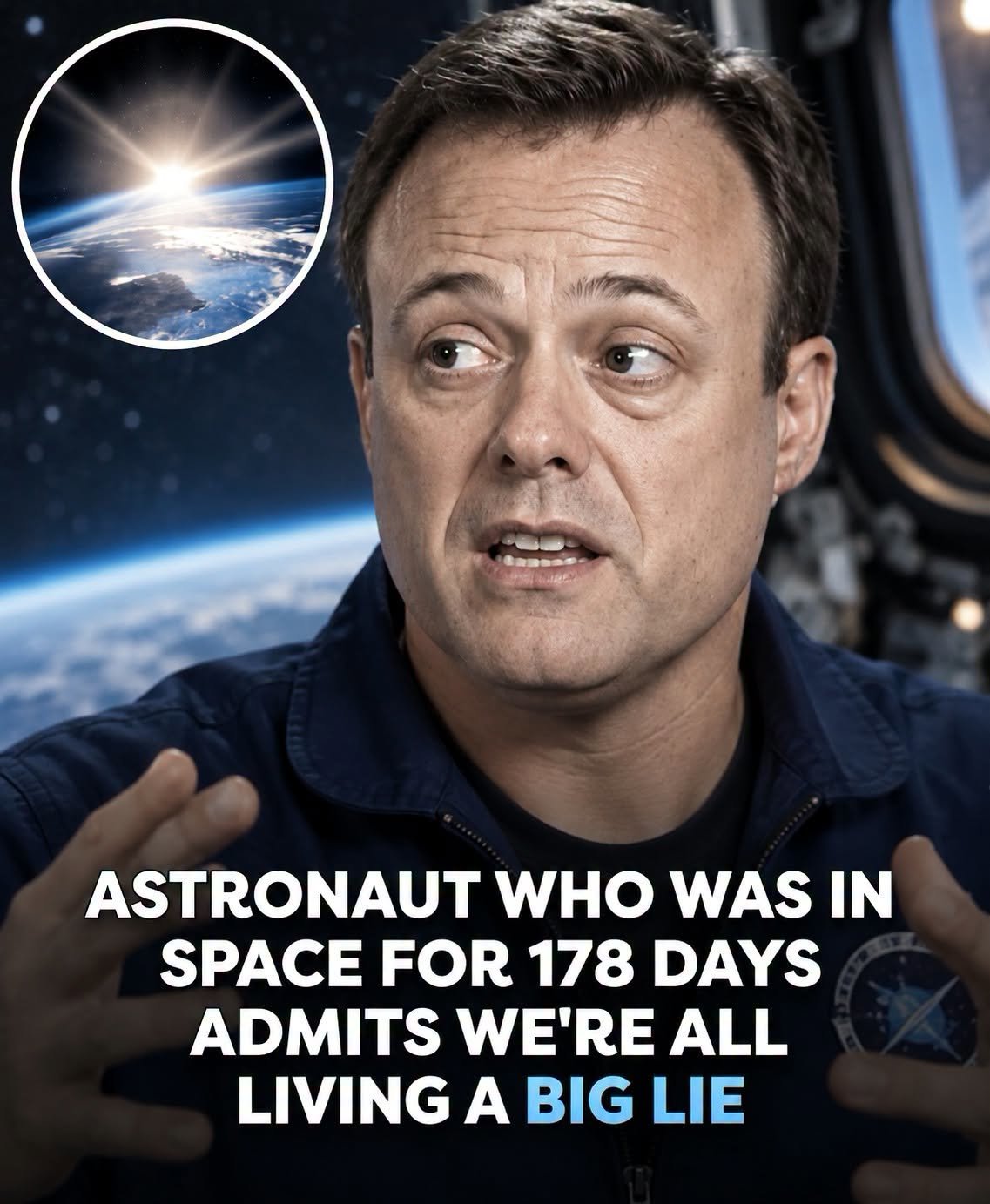
Seeing Earth from space shattered him.
Ron Garan left Earth as an astronaut and returned with a message that challenged the way humanity sees itself. From hundreds of miles above the surface, he witnessed something most people will never experience firsthand: a world without visible borders, divided nations, or the artificial lines that dominate our lives. From orbit, Earth appeared breathtakingly beautiful, yet remarkably fragile.
As he watched the planet move silently beneath him, one detail became impossible to ignore. Our atmosphere, the thin layer of gases surrounding Earth, looked like a delicate blue line against the endless darkness of space. That narrow shield protects life from harmful radiation, helps regulate temperatures, and makes our existence possible. Everything humanity has built, every city, every nation, and every civilization, depends on that remarkably thin layer.
The experience helped shape Garan’s perspective on what he calls the orbital perspective. It is the realization that Earth is not simply a collection of separate countries competing for resources and influence. It is one interconnected system, and every living thing depends on its continued health.
From space, the problems that dominate everyday headlines can seem strangely different. Political disagreements, economic competition, and national rivalries lose some of their significance when viewed against the vastness of the universe. Meanwhile, the atmosphere, oceans, forests, and ecosystems that sustain life become impossible to dismiss as background scenery.
Garan has spoken about how humanity often treats economic growth as the ultimate measure of progress, even when that growth comes at the expense of the natural systems that make life possible. He argues that we must recognize the connections between the environment, society, and the economy rather than treating them as separate concerns.
His message is not that economic development is inherently wrong. It is that prosperity cannot be sustainable if it destroys the very foundation on which it depends. A society may measure its success through production, profits, and financial markets, but those numbers cannot fully capture the value of clean air, safe drinking water, healthy soil, and a stable climate.
The challenge is that most people never get the opportunity to see Earth from orbit. We experience the planet from the ground, surrounded by buildings, roads, borders, and the immediate pressures of daily life. It is easy to forget the larger picture when our attention is constantly pulled toward the next deadline, the next bill, or the next political argument.
Yet we do not need to travel into space to understand what Garan experienced. We can begin by recognizing that environmental problems do not respect national boundaries. Pollution travels through the air and water. Climate change affects communities across continents. The destruction of forests and natural habitats can have consequences far beyond the places where it begins.
Our choices are connected, too. The energy we consume, the products we buy, the food we waste, and the policies we support all contribute, in different ways, to the future we are creating.
Garan’s perspective invites us to reconsider a fundamental question: What does it mean to be successful as a civilization?
If we continue pursuing short-term benefits while ignoring long-term consequences, we risk undermining the very systems that allow humanity to thrive. But if we begin thinking in terms of shared responsibility, cooperation, and long-term well-being, we have a better chance of building a future that works for more than just the present generation.
Perhaps the most powerful lesson of seeing Earth from space is not simply that our planet is beautiful. It is that we have nowhere else to go.
There is no second atmosphere waiting for us, no replacement ocean ready to provide clean water, and no spare planet that can immediately take the place of the one we have damaged. For all our scientific achievements and technological advances, humanity remains dependent on this single, extraordinary world.
And that reality makes our divisions seem less important than our shared responsibilities.
We may speak different languages, follow different traditions, and live under different governments, but the air we breathe and the planet beneath our feet connect us all. We are not merely individuals competing for space on a planet. We are members of the same human community, living aboard the same fragile home.
Ron Garan’s experience offers a perspective worth remembering: the future of humanity depends not only on what we can achieve, but also on what we choose to protect.
The question is no longer whether Earth is worth saving. The question is whether we can learn to live as though its survival matters to every one of us.
Website Disclaimer
The information provided on this website is for general informational and educational purposes only. While we strive to ensure that all content is accurate and up to date, we make no guarantees regarding the completeness, reliability, or accuracy of any information published.
The views and opinions expressed in articles belong to their respective authors and do not necessarily reflect the views of this website. Any action you take based on the information found on this website is strictly at your own risk. We will not be liable for any losses, damages, or inconveniences arising from the use of our content.
Some articles may contain opinions, third-party information, or external links. We do not endorse or guarantee the accuracy of content on external websites and are not responsible for their practices or policies.
All content on this website is provided in good faith and is intended for informational purposes only. Readers are encouraged to verify information independently and seek professional advice where appropriate.