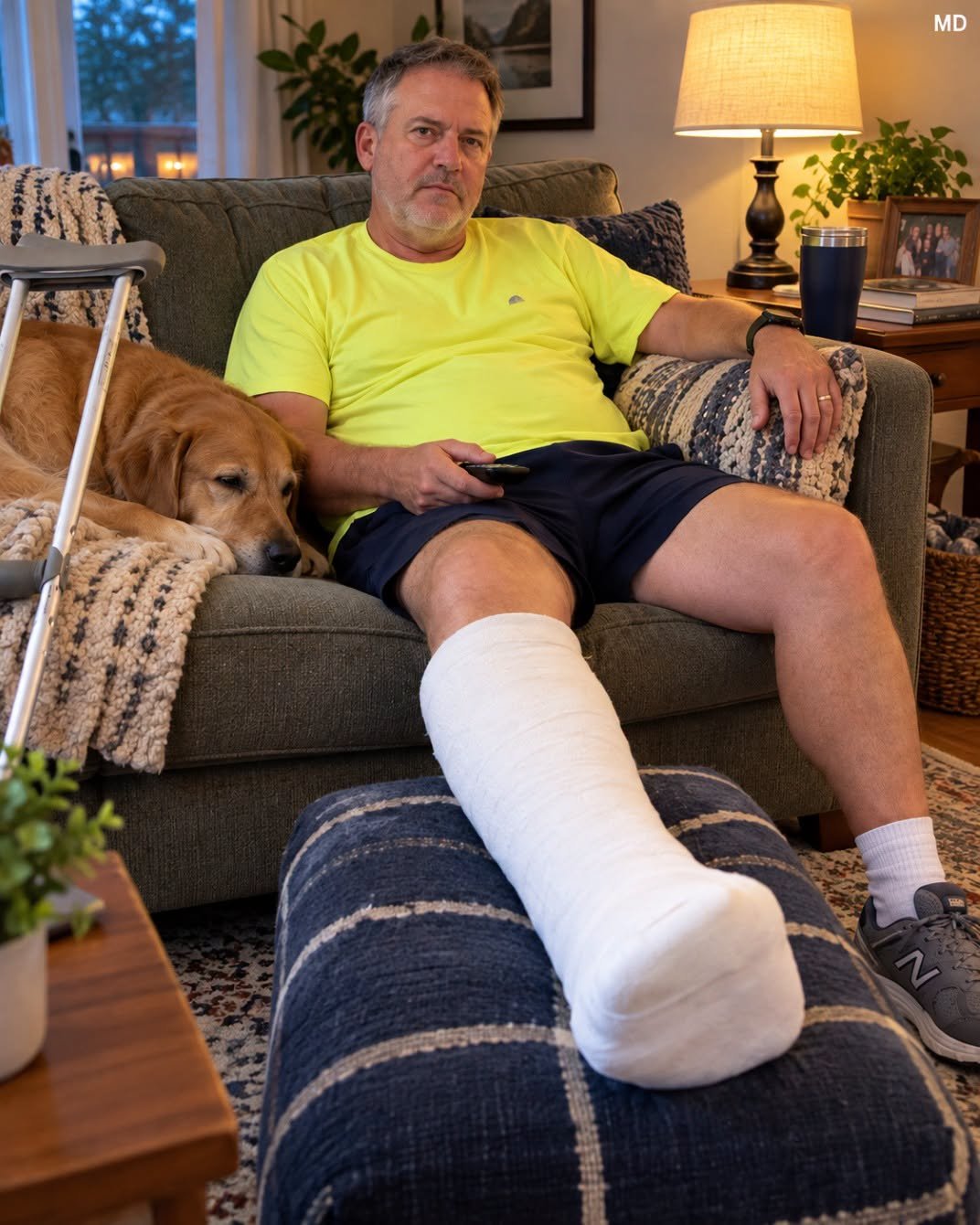
Instead, Conor began treating Cynthia like a stranger in their own home. He refused to let her help him change his bandages, insisted on keeping the bathroom door locked, and became unusually defensive whenever she asked about his injury. At night, he kept his phone beneath his pillow, answering messages only when he thought she was asleep. Whenever Cynthia offered to accompany him to a follow-up appointment, he found a reason to go alone.
At first, Cynthia blamed the pain medication and the frustration of being unable to move around freely. After all, her husband had always been independent, and perhaps needing help made him feel vulnerable. But the more she tried to care for him, the more determined he became to keep her at a distance. He even accused her of treating him like a helpless child when she brought him breakfast in bed.
One afternoon, Cynthia noticed something that made her stop in the hallway. Conor was standing beside the kitchen counter, putting weight on his injured leg while he thought she was outside. He moved carefully, but he wasn’t behaving like someone with a serious fracture. The moment he noticed her watching, he grabbed the counter and began pretending to struggle.
“Conor, what are you doing?” she asked quietly.
He turned pale. “Nothing. I was just trying to see if I could stand.”
“But you were walking perfectly well a minute ago.”
“I told you, Cynthia! Stop watching everything I do!”
His reaction frightened her more than the injury itself. Thirty-two years together had taught her the difference between her husband’s ordinary irritation and the kind of panic that made him unable to look her in the eye.
That evening, Cynthia waited until Conor fell asleep before gathering the laundry. When she lifted his trousers from the bedroom floor, she noticed a folded sheet of paper sticking out of the pocket. She knew she shouldn’t read something that might be private, but the words visible through the fold caught her attention: follow-up examination and previous injury.
Her hands began to tremble as she unfolded the paper. It wasn’t a hospital discharge note for a new fracture. It was an appointment reminder from an orthopedic clinic, dated several months earlier.
Before she could read further, Conor appeared in the doorway.
“Give me that!” he demanded, snatching the paper from her hands.
Cynthia stepped back, stunned. “Why do you have an appointment from months ago? And why are you pretending you can’t walk?”
For a long moment, Conor said nothing. Then he lowered himself onto the edge of the bed and covered his face with both hands.
“The accident with Nathan wasn’t the whole story,” he finally admitted.
Cynthia sat across from him, her heart pounding. Conor explained that he had been dealing with a leg problem for months. He had ignored the pain until a minor accident at work gave him an excuse to stop working temporarily. Nathan had helped him get home, but the story about a serious fracture had grown into something Conor couldn’t easily take back.
There was more, however, and that was what had truly frightened him.
During his earlier medical appointments, Conor had received news that he hadn’t known how to share with his wife. He had been hiding his symptoms, missing appointments, and convincing himself that if he avoided the subject long enough, everything might somehow resolve itself. The cast had become his shield—a way to explain his limitations without admitting what he feared most.
“Why didn’t you tell me?” Cynthia whispered, tears filling her eyes. “After thirty-two years, did you really think you had to face this alone?”
Conor looked down at his hands. “I didn’t want you to look at me differently. I didn’t want to become another problem you had to take care of.”
Cynthia reached for his hand, but this time she waited until he allowed her to hold it.
“You were never a problem,” she told him. “But shutting me out has hurt more than the truth ever could.”
The next morning, they called the clinic together and arranged a proper medical evaluation. Cynthia made it clear that she wouldn’t force Conor to discuss everything at once, but she wouldn’t help him hide from the truth either. Whatever the doctors discovered, they would face it with honest conversations instead of excuses.
As they prepared to leave, Conor paused beside the front door.
“I’m sorry I told you not to touch the cast,” he said softly.
Cynthia squeezed his hand. “I’m not asking you to be fearless, Conor. I’m asking you to trust me enough to let me stand beside you when you’re afraid.”
For the first time in weeks, he didn’t pull away.
Their marriage wasn’t suddenly perfect, and the questions surrounding his health still needed answers. But something important had changed: Conor finally understood that protecting the person you love doesn’t mean keeping every painful truth a secret.
Sometimes, the hardest part of marriage isn’t caring for someone when they’re injured. It’s finding the courage to tell them what you’re afraid of—and allowing them to love you through it.
Because after thirty-two years together, Cynthia wasn’t asking her husband to be strong every moment. She was simply asking him to stop fighting the one person who had never stopped standing by his side.
Website Disclaimer
The information provided on this website is for general informational and educational purposes only. While we strive to ensure that all content is accurate and up to date, we make no guarantees regarding the completeness, reliability, or accuracy of any information published.
The views and opinions expressed in articles belong to their respective authors and do not necessarily reflect the views of this website. Any action you take based on the information found on this website is strictly at your own risk. We will not be liable for any losses, damages, or inconveniences arising from the use of our content.
Some articles may contain opinions, third-party information, or external links. We do not endorse or guarantee the accuracy of content on external websites and are not responsible for their practices or policies.
All content on this website is provided in good faith and is intended for informational purposes only. Readers are encouraged to verify information independently and seek professional advice where appropriate.