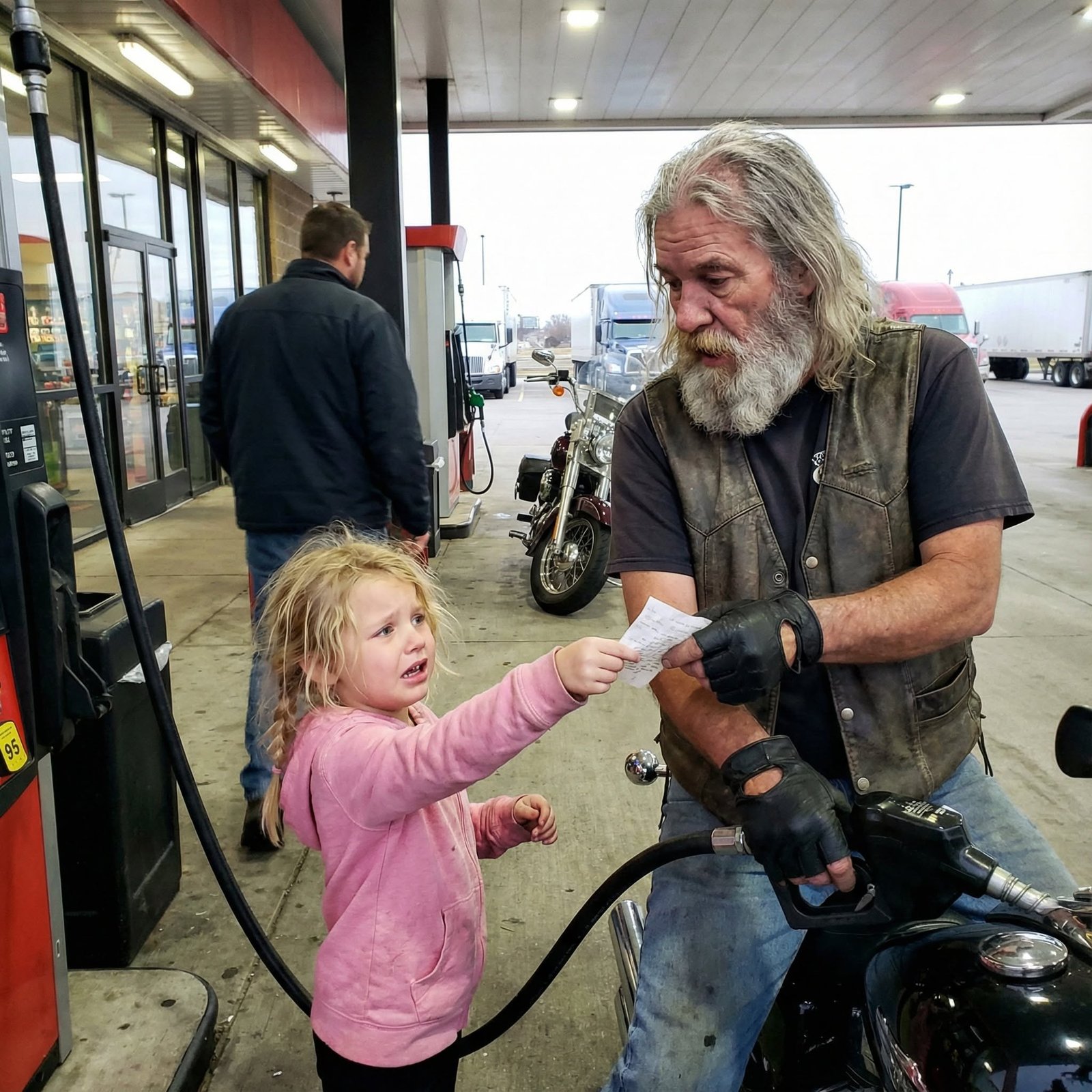
The little girl handed me a note saying, “He’s not my daddy, please help,” while I was pumping gas at a truck stop off Route 41. She couldn’t have been older than six. Blonde pigtails. Pink sneakers. Eyes that had seen too much for someone so small.
For a moment, I simply stared at the piece of paper in my hand. The girl stood beside my truck, pretending to look at the candy display near the convenience store. Every few seconds, she glanced over her shoulder toward a black SUV parked near the diesel pumps.
A man stood beside it, talking on his phone. He was tall, wore a gray hoodie, and kept looking around as though he were searching for someone. When his eyes landed on the girl, she immediately lowered her head.
My stomach tightened.
I crouched beside her and whispered, “Sweetheart, what’s your name?”
“Emily,” she murmured.
“Are you here with your mom?”
Her lower lip trembled. She shook her head and slipped her tiny hand into mine.
“He said my mommy told him to take me home,” she whispered. “But I don’t know him. Mommy said never to go with strangers.”
Before I could ask another question, the man ended his phone call and started walking toward us.
“There you are!” he called, forcing a smile. “I’ve been looking everywhere for you.”
Emily squeezed my hand so tightly that her little fingernails pressed into my skin.
“That’s him,” she whispered. “Please don’t let him take me.”
I had no idea whether the man was a stranger, a relative, or someone who had been given permission to care for her. But I knew one thing: a frightened child shouldn’t be forced into a situation she clearly didn’t understand.
I stood up and positioned myself between them.
“Is everything all right?” I asked.
The man’s smile disappeared for just a second.
“She’s my daughter,” he replied sharply. “She gets confused sometimes. Now move aside.”
Emily immediately shook her head.
“He’s not my daddy!”
Several people near the pumps turned to look. A truck driver filling his tank stopped what he was doing. Inside the convenience store, a cashier came to the window.
The man noticed the attention and quickly changed his tone.
“Look, she’s tired. We’ve been traveling all morning. I don’t have time for this.”
“What’s her full name?” I asked.
He hesitated.
It lasted only a second, but it was enough to make me more concerned.
Then he gave a name that didn’t match what Emily had whispered to me moments earlier. When I asked him where her mother was, he said she was waiting at home. When I asked him to call her, he claimed his phone battery was dead.
Yet the phone he’d just been using was still in his hand.
I didn’t argue with him. I didn’t threaten him or try to grab him. Instead, I calmly told him that we needed to clear up the confusion before anyone went anywhere.
Then I turned toward the truck driver.
“Could you ask the cashier to call 911?”
The man took a step forward.
“You have no right to interfere in my family business,” he snapped.
“Then you won’t mind waiting for the police to verify everything,” I replied.
For the first time, he looked genuinely worried.
He glanced toward the black SUV, then toward the highway entrance. Without another word, he turned around and hurried back to his vehicle.
The engine started almost immediately.
“Don’t let him leave!” someone shouted.
But I knew chasing a vehicle with a frightened child beside me would only make things more dangerous. I stayed with Emily while the truck driver wrote down the SUV’s license plate number and the cashier called emergency services.
Within minutes, a patrol officer arrived. Another unit was dispatched to look for the vehicle.
Emily sat inside the convenience store with a bottle of water, wrapped in a jacket someone had offered her. An officer knelt beside her and spoke gently, allowing her to explain what had happened in her own words.
What she told us made the entire room go quiet.
Emily said she had been with her mother at a grocery store earlier that morning. While her mother was paying, the man approached her and claimed he had been sent to pick her up. He knew her first name and had told her that her mother was waiting for her somewhere else.
When Emily refused to leave, he became angry and told her that her mother would be upset if she didn’t listen.
She had followed him only because she was frightened and confused. At the truck stop, she noticed a family getting out of another vehicle and managed to slip away while the man was distracted.
She had seen me pumping gas and decided to take her chance.
The note was the only way she could think of asking for help without alerting him.
As officers continued their investigation, they contacted child-protection services and worked to identify and locate Emily’s mother. They also began checking the man’s identity and the information he had provided.
I stayed until an officer assured me that Emily was safe and that the proper authorities were handling the situation.
Before I left, she walked over and tugged gently on my sleeve.
“Are you going now?” she asked.
“I have to, sweetheart,” I said softly. “But there are people here who are going to help you.”
She looked down at her pink sneakers before asking a question I’ll never forget.
“Did I do something wrong?”
My heart broke.
“No,” I told her. “You did exactly the right thing by asking for help.”
She wrapped her arms around me for a brief hug, then returned to the officer waiting beside her.
I drove away that afternoon, but I couldn’t stop thinking about the little girl with blonde pigtails and the note that had changed everything.
We often imagine that emergencies announce themselves with shouting, flashing lights, or obvious signs of danger. Sometimes, they arrive quietly in the form of a frightened child who doesn’t know whom to trust.
Emily hadn’t needed a hero who could fight a stranger or solve every mystery. She needed an adult who would take her fear seriously, remain calm, and involve the people equipped to protect her.
And that day, a few handwritten words were enough to make someone stop and listen.
If a child ever tells you they’re afraid of an adult, don’t dismiss them or promise to keep it secret. Stay calm, keep the child in a safe public place, and contact emergency services or the appropriate authorities. You don’t need to investigate the situation yourself to take a child’s request for help seriously.
Sometimes, the smallest voice in the room is the one we most need to hear.
Website Disclaimer
The information provided on this website is for general informational and educational purposes only. While we strive to ensure that all content is accurate and up to date, we make no guarantees regarding the completeness, reliability, or accuracy of any information published.
The views and opinions expressed in articles belong to their respective authors and do not necessarily reflect the views of this website. Any action you take based on the information found on this website is strictly at your own risk. We will not be liable for any losses, damages, or inconveniences arising from the use of our content.
Some articles may contain opinions, third-party information, or external links. We do not endorse or guarantee the accuracy of content on external websites and are not responsible for their practices or policies.
All content on this website is provided in good faith and is intended for informational purposes only. Readers are encouraged to verify information independently and seek professional advice where appropriate.