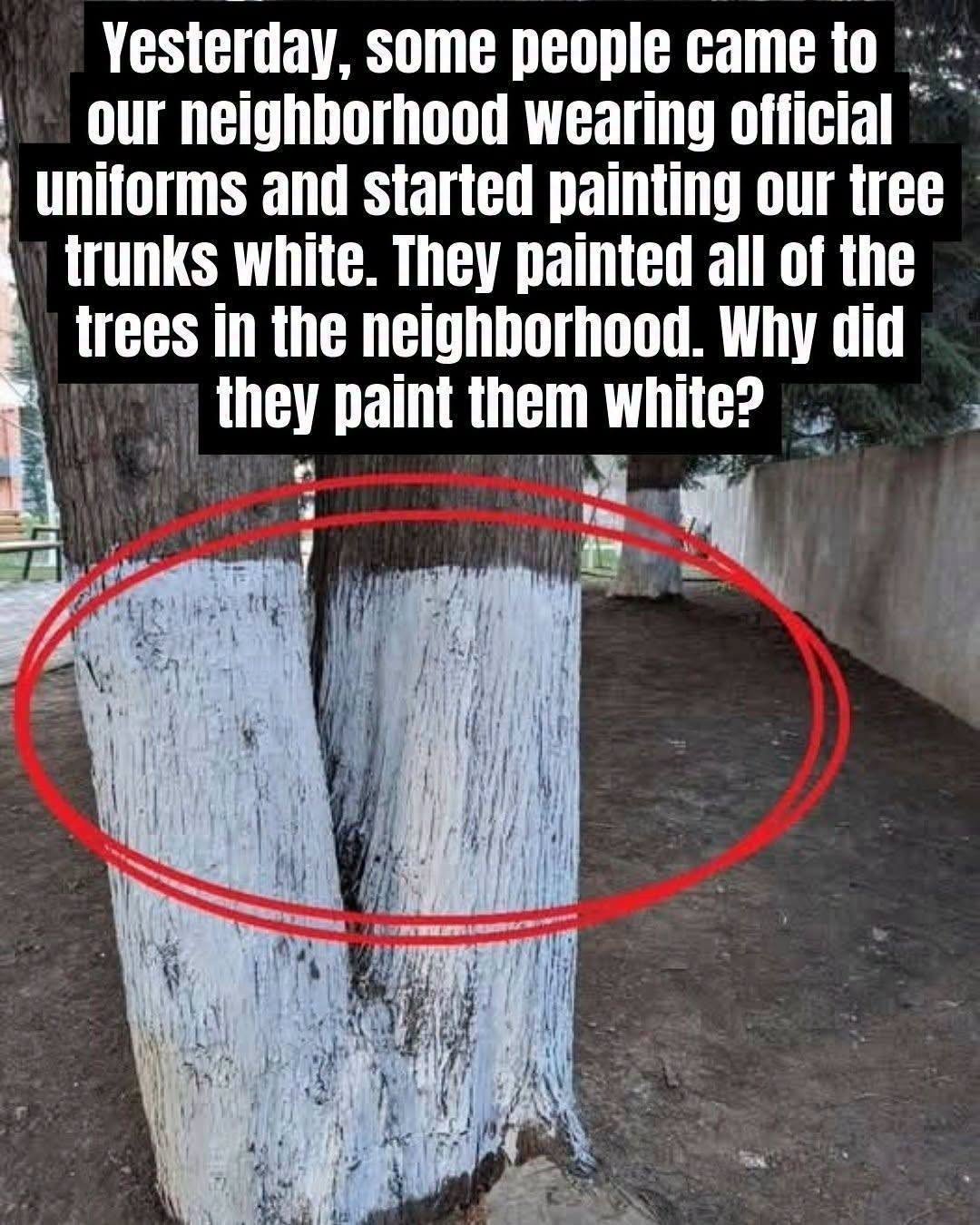
Many people are surprised the first time they see rows of trees with their lower trunks painted white. At first glance, it can look like a decorative project or even something done for appearance alone. In reality, this long-standing practice serves several practical purposes and is commonly used in parks, orchards, and residential neighborhoods.
One of the main reasons for painting tree trunks white is to protect the bark from extreme temperature changes. During sunny winter days, dark bark can warm up quickly, only to cool rapidly after sunset. These sudden temperature swings can cause the bark to crack, a condition known as sunscald. The white coating reflects sunlight, helping keep the trunk at a more stable temperature.
The coating can also provide an extra layer of protection against certain insects and pests that are more likely to settle in damaged bark. In addition, it makes it easier for arborists and maintenance crews to spot cracks, wounds, or signs of disease that might otherwise go unnoticed.
In many places, the white coating is made from a diluted, tree-safe whitewash or a specially formulated latex mixture designed for use on trees. Municipal workers often apply it to young or vulnerable trees, especially before seasons when harsh weather conditions are expected. When entire neighborhoods receive the treatment at the same time, it is usually part of a scheduled maintenance program.
Although it may seem unusual at first, painting tree trunks white is a practical method of protecting trees and helping them remain healthy for years to come. What looks like a simple coat of paint is actually a well-established practice aimed at reducing damage and supporting long-term tree care.
Website Disclaimer
The information provided on this website is for general informational and educational purposes only. While we strive to ensure that all content is accurate and up to date, we make no guarantees regarding the completeness, reliability, or accuracy of any information published.
The views and opinions expressed in articles belong to their respective authors and do not necessarily reflect the views of this website. Any action you take based on the information found on this website is strictly at your own risk. We will not be liable for any losses, damages, or inconveniences arising from the use of our content.
Some articles may contain opinions, third-party information, or external links. We do not endorse or guarantee the accuracy of content on external websites and are not responsible for their practices or policies.
All content on this website is provided in good faith and is intended for informational purposes only. Readers are encouraged to verify information independently and seek professional advice where appropriate.