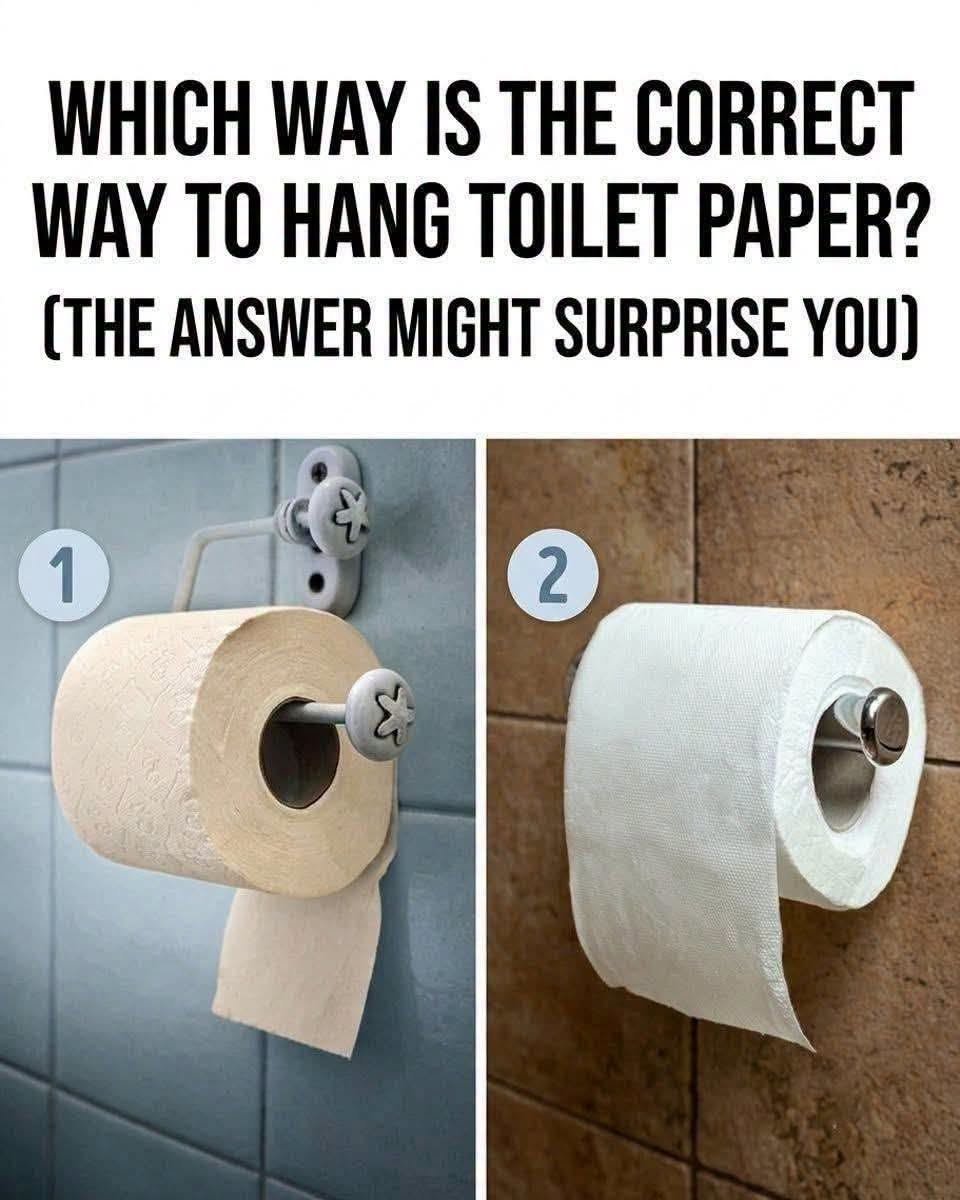
The argument has existed in bathrooms for generations: should toilet paper hang with the loose end falling over the front of the roll, or should it hang underneath against the wall? Both arrangements work, but people can become surprisingly passionate about which one is “correct.”
The answer becomes clearer when looking at the original patent associated with perforated toilet paper rolls. Inventor Seth Wheeler’s 1891 patent illustrations show the paper hanging over the top and down the front of the roll rather than underneath it. That corresponds to option 2 in the picture.
There are practical reasons people prefer this arrangement as well. With the paper hanging over the front, the loose end is easier to see and grab. It also keeps your fingers farther away from the wall while reaching for the paper, something that can make the setup feel cleaner and more convenient.
Still, option 1 has its defenders. Hanging the paper underneath can make it harder for young children or curious pets to unravel an entire roll by spinning it. For some households, that practical advantage matters considerably more than following a century-old illustration.
So if the question is which orientation matches the famous historical patent, the answer is 2 — over the top. Option 1 will still get the job done, but according to the original design illustration, the loose sheet was intended to fall down the front.
Website Disclaimer
The information provided on this website is for general informational and educational purposes only. While we strive to ensure that all content is accurate and up to date, we make no guarantees regarding the completeness, reliability, or accuracy of any information published.
The views and opinions expressed in articles belong to their respective authors and do not necessarily reflect the views of this website. Any action you take based on the information found on this website is strictly at your own risk. We will not be liable for any losses, damages, or inconveniences arising from the use of our content.
Some articles may contain opinions, third-party information, or external links. We do not endorse or guarantee the accuracy of content on external websites and are not responsible for their practices or policies.
All content on this website is provided in good faith and is intended for informational purposes only. Readers are encouraged to verify information independently and seek professional advice where appropriate.