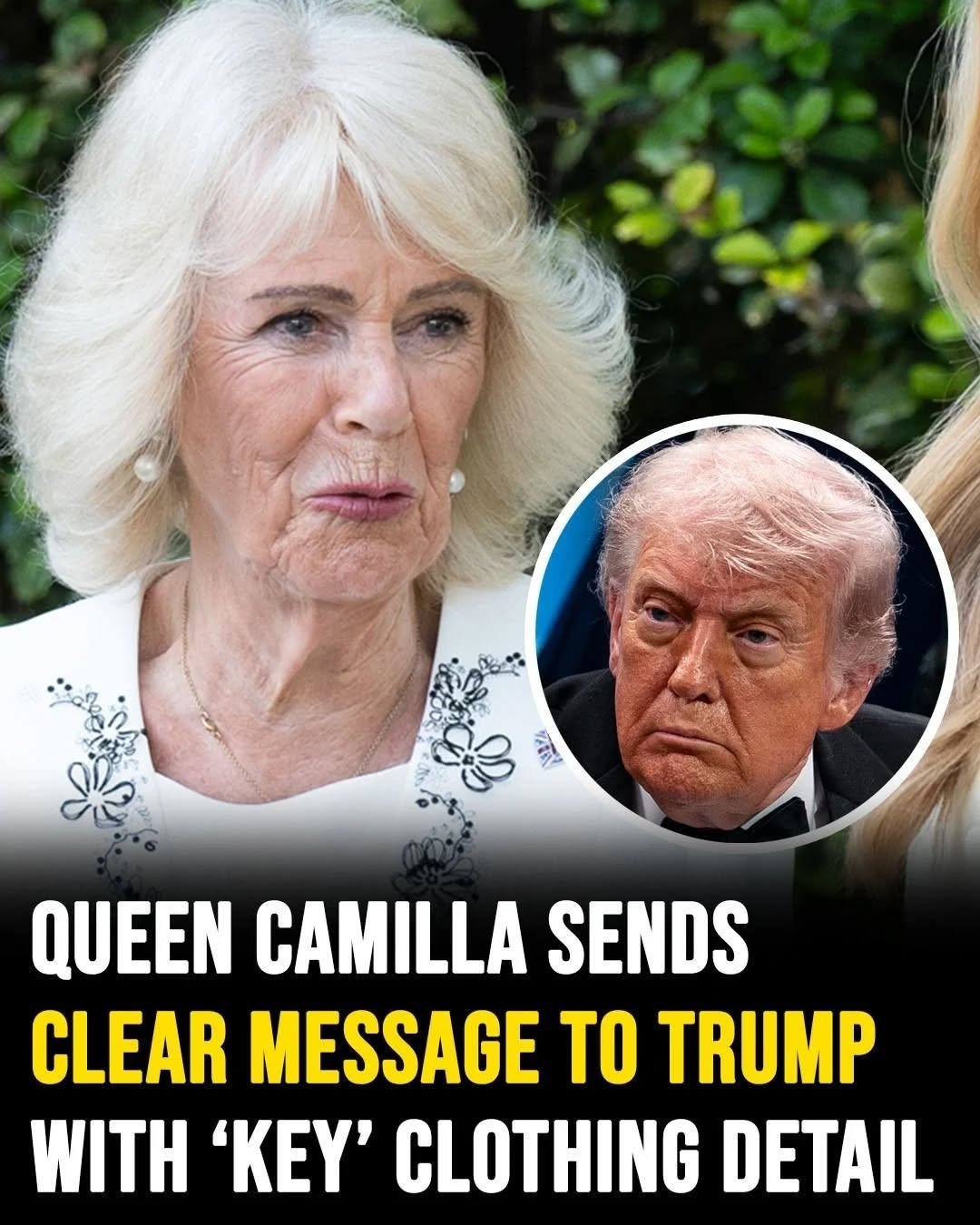
Queen Camilla sends clear message to Trump with ‘key’ clothing detail

The Message Wasn’t Spoken—It Was Worn

The message wasn’t spoken—it was worn.

As King Charles III and Queen Camilla arrived in the United States for their 2026 state visit, attention quickly moved beyond the formal greetings and cameras to one small but unmistakable detail: the brooch pinned to Camilla’s coat.

The jewel featured the Union Jack intertwined with the Stars and Stripes, a historic Cartier piece originally presented to Queen Elizabeth II during her 1957 state visit to the United States. The gift came from New York City Mayor Robert F. Wagner Jr., making the brooch more than an accessory—it was already part of the history of U.S.–U.K. relations.

That history made its appearance in 2026 particularly striking.

Queen Elizabeth’s 1957 visit took place during the Cold War, when the relationship between Britain and America carried enormous strategic importance. Nearly seven decades later, Camilla brought the same piece back into view as she accompanied Charles on his first U.S. state visit as monarch.

The symbolism was simple enough to understand without an explanation: two flags, one piece of jewelry, and a relationship with decades of history behind it.

Charles, meanwhile, emphasized the broader historical connection between the two countries during his public appearances. The royal visit itself was designed around the longstanding relationship between Britain and the United States, while also marking America’s 250th anniversary.

That is where Camilla’s choice became especially interesting.

It would be too strong to claim that the brooch was a direct political message aimed at Donald Trump. There is no public statement from Camilla establishing that intention. But observers and commentators interpreted the historic jewel as a visual reminder of the enduring connection between the two nations.

And perhaps that was precisely the strength of the choice.

There was no speech attached to it. No confrontation. No explicit political statement.

Just a piece of royal jewelry carrying two national symbols.

Throughout the visit, Camilla continued using historically significant pieces, including jewelry associated with Queen Elizabeth II and earlier generations of the royal family. Her choices reinforced a broader tradition of what is sometimes called “diplomatic dressing”—using clothing and jewelry to acknowledge a place, occasion, relationship, or shared history.

The brooch therefore carried several layers of meaning at once.

It remembered Queen Elizabeth II.

It recalled a 1957 American visit.

It connected New York to the British monarchy.

And, most visibly, it placed the American and British flags together.

Whether viewers saw that as nostalgia, diplomacy, tradition, or simply a thoughtful royal fashion choice was left open.

But that ambiguity may be exactly what made it effective.

Diplomacy does not always happen behind a podium. Sometimes it appears in a handshake, a shared ceremony, a carefully chosen gift—or a jewel worn decades after it was first presented.

Camilla’s brooch had already crossed generations.

In 1957, it represented a relationship being reinforced.

In 2026, it appeared again at a moment when that relationship was receiving renewed attention.

The jewel could not negotiate a treaty or settle a disagreement. It could not speak for either government.

But it could remind everyone watching that relationships between nations are built over generations—and that symbols of friendship can survive long after the people who first created them are gone.

The message wasn’t spoken.

It was pinned quietly to a coat—and allowed history to do the talking.

Website Disclaimer

The information provided on this website is for general informational and educational purposes only. While we strive to ensure that all content is accurate and up to date, we make no guarantees regarding the completeness, reliability, or accuracy of any information published.

The views and opinions expressed in articles belong to their respective authors and do not necessarily reflect the views of this website. Any action you take based on the information found on this website is strictly at your own risk. We will not be liable for any losses, damages, or inconveniences arising from the use of our content.

Some articles may contain opinions, third-party information, or external links. We do not endorse or guarantee the accuracy of content on external websites and are not responsible for their practices or policies.

All content on this website is provided in good faith and is intended for informational purposes only. Readers are encouraged to verify information independently and seek professional advice where appropriate.


Related Posts

Leave a Reply

Your email address will not be published. Required fields are marked *