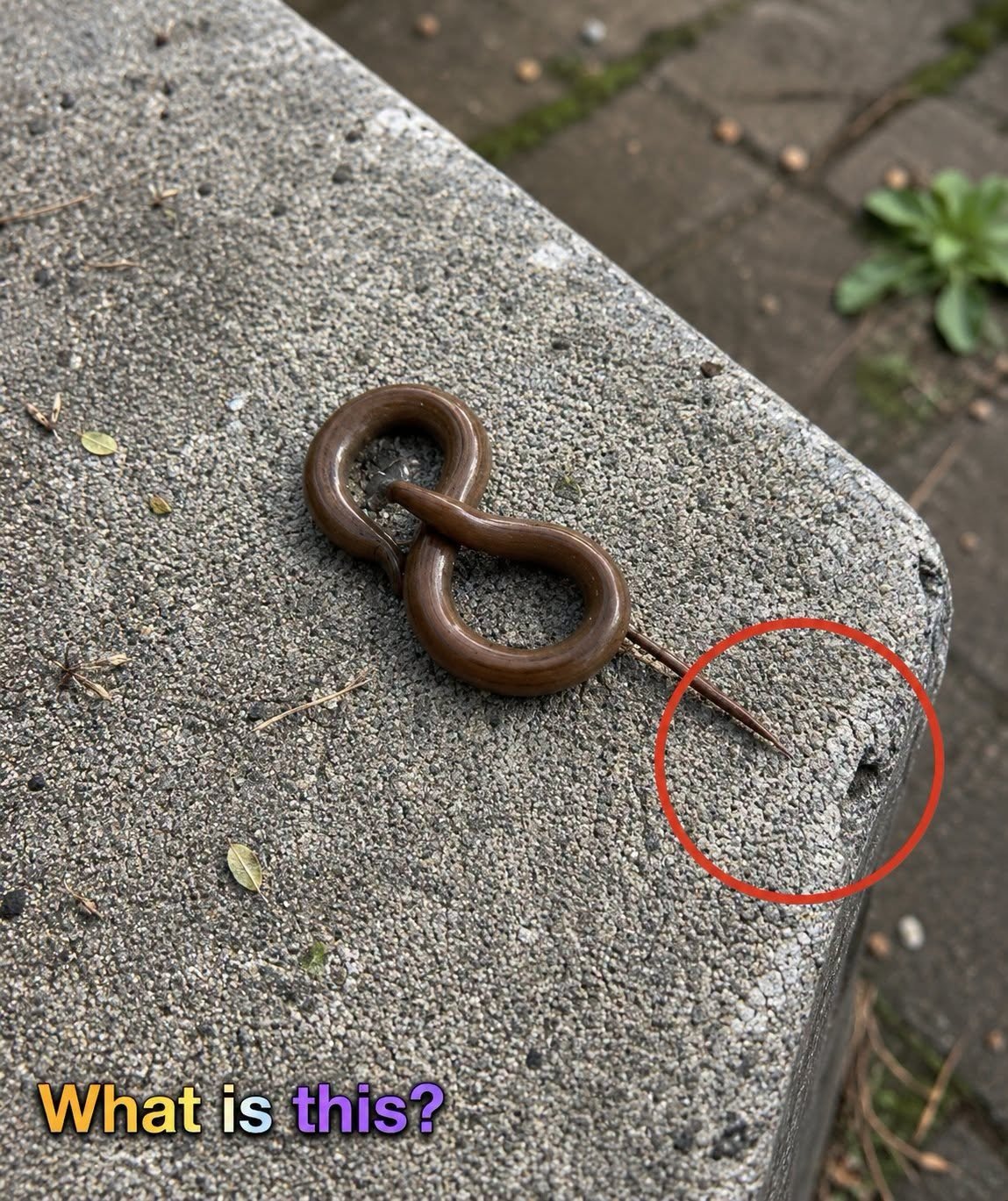
A long, smooth creature moving across wet soil can easily be mistaken for an unusual earthworm. From a distance, the body may appear narrow, soft, and wormlike enough that there seems to be little reason to give it a second look. A closer examination, however, can reveal one feature that changes the identification completely: a broad, flattened head that may resemble a small hammer, shovel, or crescent. Animals with this distinctive appearance are commonly called hammerhead worms or hammerhead flatworms.
They belong to a group of terrestrial flatworms rather than to the same group as familiar earthworms. That biological difference explains why their movement, feeding behavior, body structure, and ecological role can be very different from what a casual observer might initially assume. Hammerhead flatworms belong to the family Geoplanidae, a group generally known as terrestrial planarians or land planarians. The term “hammerhead worm” is commonly applied to members of genera such as Bipalium and related forms that have a noticeably expanded head.
Their bodies are flattened rather than cylindrical, and this shape becomes easier to recognize when the animal is viewed closely. Different species can vary greatly in size, color, striping, head shape, and feeding habits. For that reason, seeing a broad-headed flatworm does not automatically identify the exact species. Reliable identification may require details such as body markings, head coloration, stripes, size, geographic distribution, or even specialist examination. One of the most noticeable differences is the way these animals move.
Earthworms typically use muscular contractions together with tiny bristles called setae to move through or across their environment. Terrestrial flatworms instead travel over surfaces using a combination of muscular activity, mucus, and microscopic cilia on the underside of the body. To an observer, this can create an unusually smooth gliding appearance. The movement may look controlled and almost effortless, especially on a damp surface. That smooth glide is not evidence that the animal is deliberately “stalking” a person or behaving aggressively toward humans. It is simply part of the normal locomotion of a land planarian.
Moisture is especially important to many terrestrial flatworms. They are frequently associated with cool, damp microhabitats such as soil beneath logs, stones, mulch, leaf litter, shrubs, plant pots, and other protected locations. Rainy conditions can make them considerably easier to notice because surfaces that are normally too dry may temporarily become suitable for movement. A person who has never noticed one before may therefore encounter a hammerhead flatworm after rainfall and assume the animal appeared suddenly. In reality, suitable habitat may have been present nearby for some time. The animal simply becomes more visible when temperature and moisture conditions allow it to travel across exposed surfaces.
The unusual head is more than a visual curiosity. Terrestrial planarians possess sensory structures that help them respond to chemical and environmental information around them. Their expanded head region contributes to the characteristic appearance that makes hammerhead flatworms so recognizable. It is tempting to compare the shape directly with the head of a hammerhead shark, but the resemblance is superficial rather than evidence of a close biological relationship. Sharks are vertebrates, while these animals are flatworms. Their similar common names simply describe an outward shape. Even so, the head is often the feature that causes people to stop and realize they are not looking at an ordinary earthworm.
The biggest surprise for many people comes from learning that hammerhead flatworms are predators. Earthworms are often imagined as quiet inhabitants of soil that consume organic material and interact with decomposing matter. Many land planarians occupy a very different feeding niche. They prey on soft-bodied invertebrates, which can include earthworms, snails, slugs, other worms, isopods, and some small insects depending on the species. Several commonly encountered hammerhead flatworms are particularly associated with earthworm predation. This means that two animals that may appear superficially similar can occupy very different roles in a food web.
Earthworm hunting by some Bipalium species has been studied directly. Research has described flatworms following earthworm prey, making contact, and using the body together with mucus during capture. The process is considerably more complex than a simple chase. The flatworm can restrain prey before beginning to feed, and chemical compounds may contribute to subduing the earthworm. This predatory behavior is one reason the animal’s slow movement should not be interpreted as evidence that it is harmless to every organism around it. It may be moving through an environment in which potential prey is present. At the same time, that does not mean every hammerhead flatworm seen crossing the ground is necessarily hunting at that exact moment.Scientific research has revealed another remarkable feature in at least two species. Researchers confirmed tetrodotoxin, commonly abbreviated TTX, in Bipalium adventitium and Bipalium kewense. Tetrodotoxin is a powerful neurotoxin known from several very different groups of organisms. The study found evidence consistent with the idea that these flatworms may use TTX in predation and possibly in defense. Importantly, this finding applies to the species that were studied and should not automatically be generalized to every terrestrial flatworm on Earth. Accurate wildlife information requires distinguishing what has actually been demonstrated from what might merely be assumed.
The presence of tetrodotoxin can make online descriptions sound far more alarming than the evidence supports. Penn State Extension notes that land planarians cannot inject this toxin into people or pets, and it reports no documented cases there of people becoming ill simply from handling one. Nevertheless, the same guidance recommends sensible caution because the mucus is chemically defended and could potentially irritate sensitive areas such as the eyes or mouth. Wearing gloves when handling a flatworm, or washing the hands afterward, is a reasonable precaution. There is little benefit in picking up an unfamiliar animal with bare hands simply to examine it more closely. Observation and photography can usually provide useful information without unnecessary contact.
It is therefore inaccurate to describe a hammerhead flatworm as a creature that will attack a person. Its predatory adaptations are directed toward the small animals it feeds upon, not toward humans. Sensational descriptions can transform an interesting piece of biology into an unnecessary scare story. The more accurate picture is actually more fascinating. A hammerhead flatworm is a relatively small terrestrial predator using sensory information, mucus, muscular movement, and specialized feeding behavior to survive. Understanding those mechanisms gives the animal greater biological significance without requiring exaggeration.
Feeding itself is unlike what most people associate with larger predators. A flatworm does not have jaws and teeth comparable to those of a mammal, reptile, or fish. Planarians possess a muscular pharynx that can extend from the underside of the body and participate in feeding. Prey is restrained before tissues are consumed. The details vary among taxa, but the basic process demonstrates how evolution can produce successful predatory strategies without claws, fangs, or rapid pursuit. What appears visually simple can therefore represent a highly specialized way of life.
The contrast with earthworms is particularly important. Earthworms belong to the annelids, a completely different branch of the animal kingdom. Their bodies are visibly segmented, whereas flatworms lack the same external segmentation. Earthworms also have different internal anatomy, movement mechanisms, feeding patterns, and ecological relationships. Calling a hammerhead flatworm an “earthworm with a strange head” therefore misses most of what makes the animal distinctive. The similarity is mainly in the long, soft-bodied appearance visible to a casual observer.
Earthworms themselves are more complicated ecologically than the simple phrase “good for soil” sometimes suggests. Many earthworms can influence soil structure and decomposition, and several are valued in gardens and composting systems. However, ecological effects depend on species and location. In parts of North America, for example, many earthworms common in lawns and disturbed environments are themselves introduced species. This means discussions about hammerhead flatworms eating “beneficial native earthworms” can become inaccurate if applied universally. Local ecology requires more context than a viral caption normally provides.
The same caution applies to the term “invasive.” Several hammerhead flatworms found outside their ancestral ranges are introduced organisms, and some Bipalium species have spread widely through human activity. Horticultural trade, transported soil, potted plants, and related pathways can move small soil organisms considerable distances. Yet the ecological importance of a non-native land planarian depends on which species is present and where it has become established. Some introduced flatworms cause serious ecological damage, while the effects of others remain uncertain or vary considerably between habitats. A responsible description should therefore avoid claiming that every hammerhead flatworm causes the same level of environmental harm.
Plant pots and landscaping materials can provide useful habitat for terrestrial flatworms because they may retain moisture and contain potential prey. This also helps explain how land planarians can travel beyond the places where they originally evolved. An organism hidden beneath a pot, inside moist soil, or among plant material can be transported without anyone realizing it is present. By the time it is discovered, the plant may be far from its original location. This is a common challenge in the movement of small terrestrial organisms. Human transportation can therefore influence distribution even when there is no deliberate attempt to move wildlife.
Reproduction adds another interesting dimension to hammerhead flatworm biology. Terrestrial planarians are capable of remarkable regeneration, and some reproduce asexually by division or fragmentation. In species using this strategy, part of the body separates and the resulting pieces regenerate missing structures. This is the biological reason extension specialists often warn people not to attempt control simply by chopping a land planarian into pieces. Cutting the animal may fail to solve the problem and can create viable fragments. Some species also reproduce sexually, so reproduction cannot be reduced to a single method that applies identically to every land planarian.
Regeneration is one of the characteristics that has made planarians important subjects in biological research. Their ability to rebuild missing tissues has fascinated scientists for generations. However, a popular statement such as “every tiny piece becomes another worm” should not be applied without qualification. Regenerative capacity depends on species, the part of the animal involved, and biological conditions. The useful practical point is simpler: intentionally cutting an unidentified terrestrial flatworm is not a reliable control method. If management is considered necessary, local extension or agricultural authorities can provide guidance appropriate to the species and region.
This regional element matters because recommendations are not identical everywhere. A species considered introduced and undesirable in one jurisdiction may not even occur in another. Reporting programs also differ between states, provinces, and countries. An article intended for an international audience should therefore avoid telling every reader to contact one specific local agency or follow one jurisdiction’s regulations. The more accurate recommendation is to consult the relevant agricultural, environmental, invasive-species, or university extension authority where the animal was found. This approach informs readers without pretending that the writer is a member of their local community.
Photographs are especially useful when identification is uncertain. A clear picture of the head, entire body, dorsal pattern, and approximate size may allow specialists to narrow down the possibilities. Different Bipalium species can have distinctive stripes or markings, while other terrestrial flatworms may have rounded or pointed heads rather than the classic hammerhead form. Color alone is often insufficient because lighting, age, moisture, and individual variation can influence appearance. An image accompanied by location information can therefore be much more useful than a description such as “long black worm.” Accurate identification should come before strong claims about ecological impact.
Observing the animal without touching it also preserves useful behavioral clues. Its direction of movement, reaction to light, habitat, and nearby environmental conditions may help distinguish it from other organisms. Moving the animal immediately can eliminate that context. The safest general approach with unfamiliar wildlife is often to look first and act only when there is a clear reason. Curiosity and restraint can work together. Learning something about an organism does not require disturbing it.
The mucus produced by terrestrial flatworms is another important adaptation. Mucus assists movement by creating a surface over which the flatworm can glide. It can also participate in interactions with prey and may have defensive functions. This helps explain why the animal can leave a slimy trail and why its movement may appear unusually smooth compared with an earthworm crossing the same surface. The mucus is part of the animal’s biology rather than evidence of disease or decay. Nevertheless, avoiding direct contact remains sensible when the species is unknown.
The presence of predators in soil ecosystems can surprise people because the most familiar predators are often large and visible. Hawks, wolves, sharks, snakes, and spiders fit easily into the popular image of an animal actively hunting another. Soil and leaf litter contain predation on a much smaller scale. Mites, beetles, centipedes, nematodes, flatworms, spiders, and numerous other organisms can feed on neighboring animals. Many of these interactions happen beneath leaves or within soil where people never see them. A hammerhead flatworm simply makes one of those hidden relationships unusually visible.
That is what makes an encounter with one scientifically interesting. The animal serves as a reminder that a garden is not merely a collection of plants. Soil and litter contain communities of organisms competing for resources, consuming organic material, hunting one another, reproducing, and altering their surroundings. Some organisms are microscopic, while others are large enough to notice after rain. Their relationships can affect decomposition, nutrient movement, prey abundance, and many other ecological processes. Even a few square meters of damp ground can contain far more biological activity than its surface appearance suggests.
It is also worth resisting the tendency to divide every organism into a simple category of “good” or “bad.” Ecology rarely works so neatly. An animal may be a predator, prey, competitor, introduced species, or food source depending on the relationship being examined. Even the consequences of its presence can change between ecosystems. Describing hammerhead flatworms as predators is factual. Declaring every individual universally destructive without species and location information would be a much broader claim.
The shape of the hammerhead flatworm nevertheless makes it one of the easier land planarians to notice. Once a person has seen the broad head clearly, the feature can be difficult to forget. It transforms what initially looks like a familiar worm into something obviously unusual. Combined with the smooth gliding motion and often striped or darkened body, the shape provides a useful starting point for identification. It should be considered a clue rather than a complete diagnosis. Exact species identification may require more information.
Rainy mornings and damp evenings are especially likely times for terrestrial flatworms to become visible in places where suitable species occur. Their dependence on moist conditions limits how comfortably they can travel across dry exposed surfaces. Moist pavement, patios, garden beds, mulch, and paths may temporarily provide suitable routes. As conditions dry, the animals are more likely to seek protected microhabitats again. This connection with moisture explains many reports of apparently sudden appearances following rainfall.
Finding one does not mean a home is dirty or unsanitary. These are outdoor organisms associated with suitable habitat, moisture, prey, and transported plant material. Their presence should not automatically be interpreted as evidence of a household hygiene problem. Likewise, the animal is not a human intestinal parasite simply because it is called a worm. “Worm” is an informal term applied to many unrelated elongated animals. Hammerhead flatworms are free-living terrestrial predators.
That distinction is particularly important online, where unusual creatures can quickly become associated with frightening claims. Photographs sometimes circulate alongside statements that a hammerhead worm will poison anyone who touches it, deliberately chase humans, infect people, or destroy an entire ecosystem immediately. Such claims go beyond available evidence. Tetrodotoxin has indeed been scientifically confirmed in particular Bipalium species, making sensible handling precautions appropriate. But accurate risk communication should explain what is known without transforming biological facts into sensational warnings.
The scientific finding of tetrodotoxin is fascinating precisely because it does not need exaggeration. Researchers studying B. adventitium and B. kewense detected TTX and examined its distribution within the animals. Their results provided evidence that the compound may contribute to subduing prey and may also have defensive significance. The study represented the first confirmation of tetrodotoxin in terrestrial invertebrates reported by those researchers. That alone makes these small flatworms scientifically remarkable. A careful explanation is more informative than a dramatic claim that leaves out the context.
The prey relationship is equally interesting. Research on Bipalium has documented sophisticated interactions with earthworms rather than random feeding on whatever happens to be nearby. Chemical sensing helps predatory flatworms locate suitable food, after which physical restraint and secretions can contribute to capture. The process illustrates that complex behavior does not require a large brain or large body. Natural selection can produce effective hunting strategies in organisms many people would overlook entirely. This is one reason a slow-moving flatworm can be biologically more interesting than its simple appearance suggests.
For a person who encounters an unfamiliar hammerhead-shaped animal, identification should therefore come before intervention. Taking several photographs from a safe distance and recording the general location can preserve useful evidence. If the species is potentially introduced or subject to local management recommendations, the appropriate regional authority can provide further instructions. Gloves are sensible if physical handling becomes necessary. Hands should be washed afterward, and contact with the eyes or mouth should be avoided.
Control advice found online also deserves careful evaluation. Penn State Extension notes that individual land planarians can be killed through methods such as freezing or alcohol and warns against cutting them because of their regenerative abilities. Other extension services may publish recommendations specific to particular regions or species. Applying salt around vegetation can damage plants, so even apparently simple methods can have unwanted consequences. Management should therefore be proportional to the situation rather than based on fear. Advice from an appropriate local authority is preferable when invasive-species concerns are involved.
There is also no need to turn every sighting into a confrontation with wildlife. Sometimes the most useful response is observation. A person can notice the broad head, smooth locomotion, body pattern, and moist habitat without touching or disturbing the animal. That information may be enough to begin identification. If no management action is required, the encounter can remain what it originally was: a brief opportunity to notice a normally hidden part of terrestrial ecology.
The lesson extends well beyond hammerhead flatworms. Human perception relies heavily on familiar categories, and unfamiliar animals are often interpreted through the closest known comparison. A flatworm becomes “a strange earthworm,” an unfamiliar insect becomes “some kind of beetle,” and an unusual harmless animal may be labeled dangerous before anyone identifies it. These shortcuts are understandable, but they can also produce mistakes. Careful observation followed by reliable research is a better route to understanding.
The hammerhead flatworm demonstrates how dramatically that additional information can change an interpretation. At first there is only a long body moving across wet soil. Then the flattened head becomes visible. Identification reveals a terrestrial planarian. Further investigation reveals predatory behavior, specialized movement, regeneration, unusual feeding biology, and—in at least two studied species—the presence of tetrodotoxin.
None of these facts require the animal to be portrayed as a monster. It is not remarkable because it looks frightening. It is remarkable because such a small organism participates in biological relationships that are easy for people to miss. Its prey may live beneath the same leaf litter. Its movement depends on surfaces most people walk over without examination. Its chemistry remained unknown to most observers until researchers investigated it directly.
The ground beneath a garden, forest edge, greenhouse, or landscaped area is therefore not an empty background. It is habitat. Earthworms, insects, molluscs, mites, microorganisms, flatworms, and numerous other organisms may all occupy parts of the same environment. Some cooperate indirectly through ecological processes, some compete, and some consume one another. Much of this activity occurs unnoticed. A hammerhead flatworm crossing an exposed surface gives observers a rare glimpse into that hidden community.
For anyone encountering such an animal for the first time, curiosity is a reasonable reaction. The unusual shape is genuinely striking. The smooth movement can look unlike that of the worms most people recognize. Learning that some hammerhead flatworms prey on earthworms makes the observation even more interesting. The appropriate conclusion, however, is not panic but identification, caution, and context.
A strange-looking organism can be both biologically impressive and easy to misunderstand. Hammerhead flatworms are an excellent example. They are terrestrial flatworms rather than earthworms, many are predators of small invertebrates, and several species have become established outside their ancestral ranges. At least B. kewense and B. adventitium have been scientifically demonstrated to contain tetrodotoxin. Those verified facts are more than enough to make the animals worth learning about without adding unsupported claims.
The most useful response to an unfamiliar creature is often the simplest one: observe carefully, avoid unnecessary handling, document what is visible, and obtain reliable identification before drawing conclusions. That approach protects both the observer and the accuracy of the information being shared. It also prevents a small wildlife encounter from becoming distorted into a misleading story. What initially appears to be “just a strange worm” can turn out to represent an entirely different branch of animal life. Sometimes the most surprising discoveries begin with nothing more dramatic than noticing what is moving across the wet ground.
Website Disclaimer
The information provided on this website is for general informational and educational purposes only. While we strive to ensure that all content is accurate and up to date, we make no guarantees regarding the completeness, reliability, or accuracy of any information published.
The views and opinions expressed in articles belong to their respective authors and do not necessarily reflect the views of this website. Any action you take based on the information found on this website is strictly at your own risk. We will not be liable for any losses, damages, or inconveniences arising from the use of our content.
Some articles may contain opinions, third-party information, or external links. We do not endorse or guarantee the accuracy of content on external websites and are not responsible for their practices or policies.
All content on this website is provided in good faith and is intended for informational purposes only. Readers are encouraged to verify information independently and seek professional advice where appropriate.