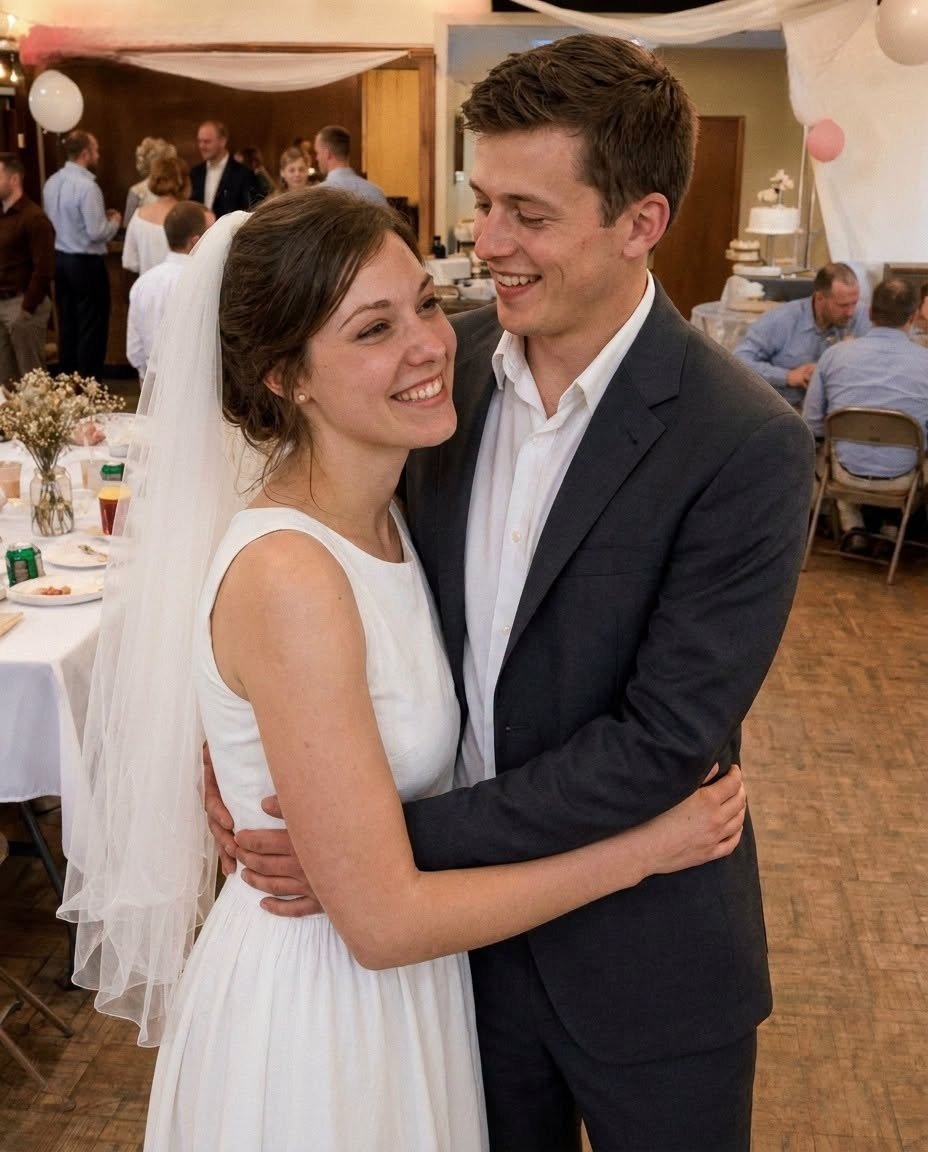
My father stood on our doorstep eight months after refusing to attend my wedding, his good coat buttoned to the throat and a thick folder tucked under one arm. He did not smile or say hello. Instead, when my husband Andrew appeared from the kitchen with a dish towel over his shoulder, Dad looked straight at him and asked, “Does my daughter know what you did to that family?” The words landed so hard that for a moment I could hear nothing but the hum of our refrigerator. Then he named two people I had never heard of—Isaac and Amira—and laid papers across our living-room table showing that Andrew was listed as a beneficiary of their trust. My husband’s face went still. After three years together and eight months of marriage, I suddenly found myself wondering whether my parents had been right to mistrust him after all.
My parents had always measured people by achievement, income, and status. Dad built a successful business from nothing; Mom came from money and believed just as strongly that I should marry “someone with a name.” Andrew had none of that when I met him in university. He waited tables at night to support himself, wore one pair of shoes until the soles nearly gave out, and took me for coffee on our first date because coffee was all he could afford. What he did have was patience, humor, and a habit of treating me as though I did not have to earn affection. When he proposed three years later, my parents reacted exactly as I expected. Dad told me I was “throwing my life away on a waiter,” and both of them refused to attend the wedding. Two empty chairs sat in the front row while my friend walked me down the aisle. I married Andrew anyway and spent the next eight months building a life with him while pretending the loss of my parents did not hurt nearly as much as it did.
Then Dad admitted he had hired someone to investigate Andrew after the wedding. The records led him to Isaac and Amira, an elderly couple who had been longtime customers at the restaurant where Andrew worked, and to a trust naming Andrew as a beneficiary. Dad’s conclusion was immediate: Andrew had somehow exploited two vulnerable people and positioned himself to inherit their money. Andrew did not argue. He simply told us to come meet them. Fifteen tense minutes later, we pulled up outside a modest house with an old garden and a crooked porch light. Isaac opened the door, saw Andrew, and immediately pulled him into a hug. Inside, over lemon tea, the truth came out. Andrew had spent years visiting them on his breaks, delivering groceries, fixing things around the house, and refusing payment. They had no children of their own and had created the trust themselves. Isaac said Andrew resisted for a year and agreed only after making it clear he would never touch a cent while they were alive. Dad’s evidence was real. His interpretation of it had been completely wrong.
The trust documents were not proof of fraud; they were evidence of a lawful estate-planning decision made voluntarily by two competent adults who considered Andrew family. Isaac and Amira explained that he had helped them long before any inheritance was discussed and that the beneficiary designation was their way of recognizing the person who had shown up consistently when no one else did. Dad stood near the doorway and looked smaller with every sentence. On the drive home, he finally apologized—first to Andrew, then to me—and admitted that his investigation had come from fear disguised as judgment. I told him the apology mattered, but it did not erase the wedding or the months of silence. Trust would have to be rebuilt slowly. For once, he did not argue. He simply nodded and said he understood.
Months later, my parents came to dinner at our apartment for the first time. Andrew served a roast that was slightly burnt, Mom called it “characterful charcoal,” and Dad laughed into his napkin instead of finding fault. At one point he asked whether Isaac and Amira might like to join us the following Sunday. I looked around our small table and realized how much had changed without anyone making a grand speech about it. My parents had spent years believing that a résumé, bank balance, or family name could tell them everything important about a person. Andrew had shown them otherwise by doing the least impressive-looking things imaginable—carrying groceries, fixing a leaking sink, sitting with two lonely people on Friday afternoons. I used to think choosing him had cost me my family. In the end, choosing him forced all of us to learn what family was actually supposed to mean.
Website Disclaimer
The information provided on this website is for general informational and educational purposes only. While we strive to ensure that all content is accurate and up to date, we make no guarantees regarding the completeness, reliability, or accuracy of any information published.
The views and opinions expressed in articles belong to their respective authors and do not necessarily reflect the views of this website. Any action you take based on the information found on this website is strictly at your own risk. We will not be liable for any losses, damages, or inconveniences arising from the use of our content.
Some articles may contain opinions, third-party information, or external links. We do not endorse or guarantee the accuracy of content on external websites and are not responsible for their practices or policies.
All content on this website is provided in good faith and is intended for informational purposes only. Readers are encouraged to verify information independently and seek professional advice where appropriate.