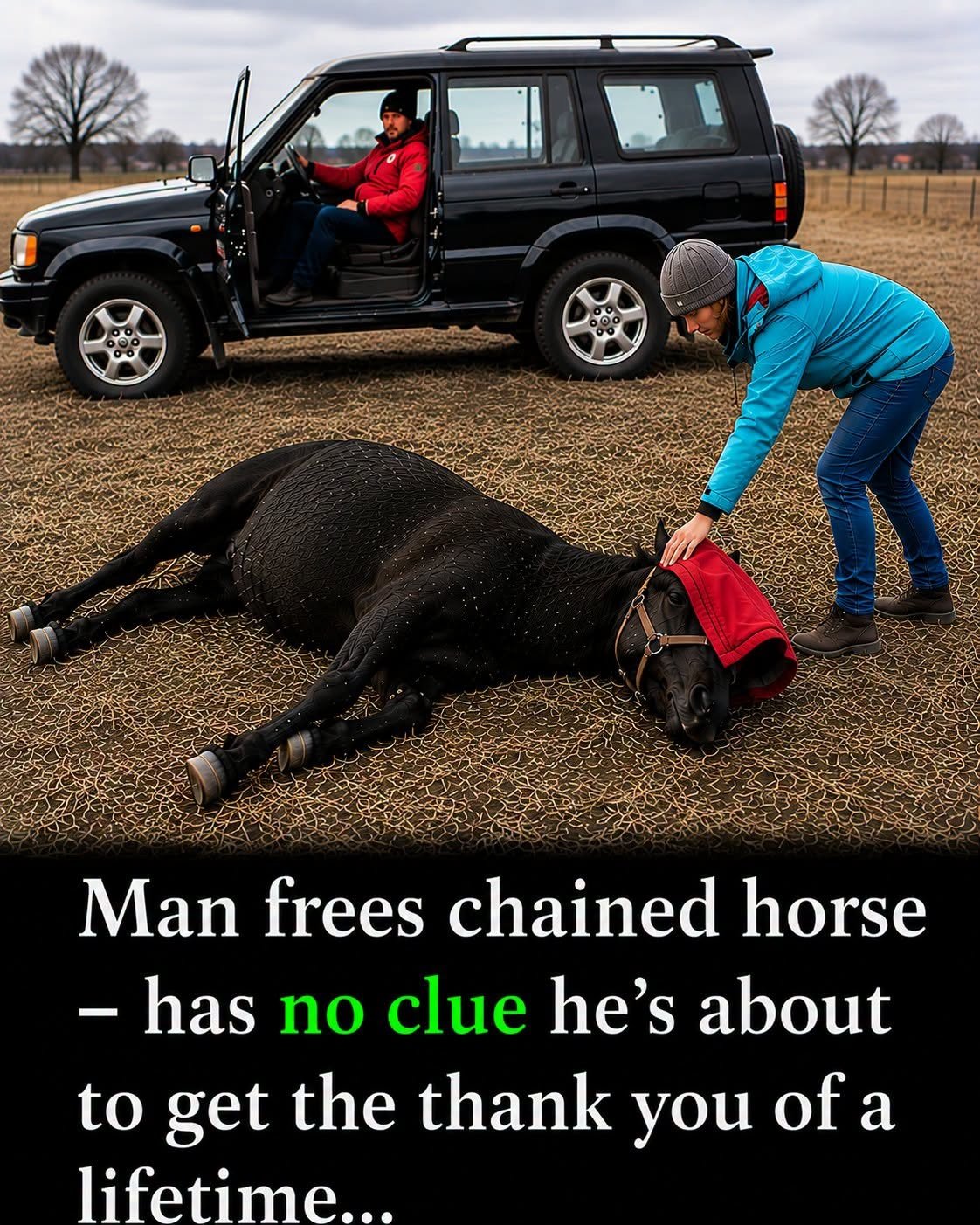
A widely shared encounter involving veterinarian Dr. Ovidiu Roșu and free-roaming horses in Romania’s Danube Delta became memorable because of a remarkably simple moment. During veterinary fieldwork, Roșu encountered a mare whose legs had been restrained, a practice that animal-welfare teams have documented among some horses in the region. Such restraints were not part of the official population-management program developed for the Danube Delta horses.
According to information associated with the project, chains had sometimes been used informally in an attempt to limit how far individual horses could travel. Veterinary teams considered the restraints a welfare problem because they could affect the horses’ legs and restrict normal movement. When teams encountered affected animals during their work, they attempted to remove the restraints safely whenever circumstances allowed.
The mare involved in the memorable footage had to be approached carefully because free-roaming horses are not accustomed to routine human handling in the way many domestic horses are. Working with a nervous animal requires veterinarians to consider both the horse’s safety and the safety of the people nearby. A frightened horse can react suddenly, particularly when it feels trapped or restricted. Roșu’s work with the Danube Delta population gave him extensive experience handling horses under challenging field conditions.
His involvement with these horses extended well beyond the removal of a single set of restraints. He had participated for years in veterinary and population-management work connected with the Letea horse population. Scientific publications also list Roșu as a researcher involved in the study of immobilization techniques used on free-ranging feral horses in Romania. After the restraint was removed, another horse was seen moving toward the veterinarian and making calm physical contact with him.
That brief interaction became the emotional focus for many people who watched the footage. It is understandable that viewers described the gesture as though the second horse were thanking the veterinarian for helping its companion. However, there is no scientific way to determine precisely what the animal intended at that moment. The horse may have been curious, relaxed, socially attentive, or responding to some other stimulus that cannot be established from the footage alone.
The most accurate description is therefore much simpler: another horse voluntarily approached Roșu and made gentle contact with him after he had been working with the restrained mare. The source material itself makes this important distinction between what viewers interpreted and what could actually be observed. That distinction does not make the scene less memorable. Animal behavior can be compelling without assigning human motives to it, and the quiet interaction drew attention precisely because the approaching horse did not appear to respond aggressively.
For viewers, the image of a free-roaming horse calmly coming close to a veterinarian offered an unusually intimate glimpse into fieldwork that is normally conducted far from public attention. Much of conservation medicine involves procedures, measurements, population estimates, veterinary examinations and repeated monitoring rather than dramatic rescues. A short interaction between a horse and a veterinarian is much easier to understand visually than years of population data. The scene therefore became a doorway into a much more complicated story about animal welfare, reproduction, habitat pressure and long-term management in one of Europe’s most distinctive wetland landscapes.
The Horses of the Danube Delta Have a Complicated History
The free-roaming horses associated with Letea did not suddenly appear in recent decades. FOUR PAWS states that historical documents connect horses in the region with events dating back roughly 700 years, when Tatars traveling and fighting through the area brought horses with them. According to the organization’s historical summary, some animals were left behind and found conditions in which populations could continue reproducing. The modern population was also influenced by a much more recent historical change. Following the collapse of Romania’s communist system in 1989, agricultural cooperatives changed dramatically and many horses previously used for work were left without the same owners or working roles. Some eventually became part of free-ranging populations in the Danube Delta.
During the following two decades, roughly between 1990 and 2010, horse numbers increased substantially in parts of the delta. The animals were able to move and reproduce in a landscape that provided large open areas and access to vegetation. Although people frequently describe them as “wild horses,” organizations working with them also use terms such as free-roaming, feral or semi-feral because their history includes domesticated working animals. FOUR PAWS itself describes the Danube Delta animals as semi-feral in some of its current material. This distinction is useful because these horses are not a completely isolated prehistoric wild-horse population untouched by human history. They represent generations of animals whose relationship with people, agriculture and the delta changed considerably over time.
Their increasing numbers eventually created a difficult management problem around Letea Forest. Horses need food, and large free-ranging populations can place considerable grazing and browsing pressure on vegetation. Letea is not simply an unused forest where unlimited numbers of large animals can feed without ecological consequences. FOUR PAWS describes the forest as a protected landscape of approximately 2,800 hectares and one of Romania’s oldest natural reserves. The wider Danube Delta is internationally important and was inscribed on UNESCO’s World Heritage List in 1991. UNESCO describes the delta as an immense wetland system containing lakes, channels, reedbeds and forest habitats of exceptional ecological importance.
As horses entered Letea Forest in search of food, concern grew about their effects on protected trees and other vegetation. Large herbivores can damage young growth by eating plants before they mature, and repeated browsing can interfere with forest regeneration. Conservation managers therefore faced an uncomfortable situation. The horses had become a familiar and visually striking part of the delta landscape, yet their population could not simply grow indefinitely if the surrounding habitat was being damaged. Protecting the horses and protecting the ecosystem were both legitimate objectives, but the two goals could come into conflict when animal numbers exceeded what sensitive areas could sustain. This tension eventually pushed Romanian authorities and animal-welfare organizations to search for management options.
The Crisis Became Especially Serious in 2011
By 2011, concerns about the growing horse population had reached a critical point. FOUR PAWS reports that more than 70 horses were rounded up in May of that year and were intended for transport to a slaughterhouse. The organization intervened and says it was able to stop the transport and rescue more than 40 of the animals. Those horses were temporarily taken to a farm in Urleasca, where they were cared for for more than six months. They were later returned to the Danube Delta. The episode made clear that simply allowing the situation to continue without a management strategy was unlikely to provide a sustainable solution for either the animals or the protected environment.
The central question became how to limit long-term population growth without repeatedly removing or killing large numbers of horses. A rapid reduction through lethal methods could lower numbers quickly, but animal-welfare advocates strongly opposed that approach. On the other hand, allowing reproduction to continue without intervention risked recreating the same ecological pressure. FOUR PAWS therefore proposed a population-management program based on controlling reproduction rather than eliminating existing animals. The organization describes this as an animal-friendly alternative intended to gradually bring horse numbers toward a level the habitat could support. The approach required considerably more patience than a one-time removal operation because its effects would develop over multiple breeding seasons.
Beginning in the following period, veterinary teams used immunocontraception in mares as part of the management strategy. The treatment involved a contraceptive vaccine known as PZP, or porcine zona pellucida. Rather than permanently removing all reproductive capacity through surgery, the vaccine temporarily reduced fertility in treated mares. FOUR PAWS material describing fieldwork in 2019 explains that a treated mare could remain infertile for approximately one year and later require additional treatment. Because the effect was temporary, veterinarians had to return to the area and identify horses that required treatment or booster doses. That made the program an ongoing veterinary and scientific project rather than a single intervention.
Veterinary Work in Letea Required Much More Than Giving an Injection
Managing free-ranging horses in a large wetland landscape is considerably more complicated than treating animals in a clinic. Veterinarians first have to locate suitable horses across a broad area where animals can travel freely. Individual animals must then be identified so teams can determine whether they have already received treatment. In some circumstances, horses are remotely immobilized using veterinary drugs so examinations and procedures can be performed safely. Scientific research involving Roșu and other veterinarians has evaluated anesthesia protocols specifically for free-ranging feral horses from the Romanian Danube Delta. One published study examined a medetomidine-ketamine protocol used for immobilization during procedures including health assessment, translocation and contraceptive immunization.
Once safely immobilized, horses could undergo additional veterinary assessments rather than receiving only reproductive treatment. The project material describes physical examinations, collection of biological information and the identification of individual animals for later monitoring. Teams needed to know which mares had already received contraception and which would need further attention in later seasons. The work therefore combined population management with individual animal care. Injuries, poor condition and other welfare problems could also be noticed during field visits. Restraints such as the chains seen on some horses represented one of those additional problems encountered during the broader veterinary project.
Roșu’s association with this work was not limited to appearing in a popular video. FOUR PAWS identified him as one of the veterinarians repeatedly working with the Letea horses, and its earlier project materials state that his doctoral research examined reproductive management and the effectiveness of PZP-based contraception. Romanian veterinary literature also identifies him as a researcher working on contraception methods for free-ranging horses around Letea. A 2012 veterinary publication listed him as a doctoral researcher in reproduction, obstetrics and reproductive pathology at the Faculty of Veterinary Medicine in Bucharest. His later scientific work continued to address veterinary procedures involving free-ranging horses. That background helps explain why the footage of him working calmly with a restrained mare represented only a small portion of a much larger professional involvement.
Population Management Required Years Rather Than Days
One advantage of fertility control is that existing horses can remain within their environment while the number of new animals born gradually decreases. The limitation is that population reduction does not happen immediately. Adult horses continue living for years, and therefore managers must maintain long-term monitoring while the age structure of the population slowly changes. Contraceptive programs also require repeated access to animals, trained veterinarians and reliable records. If treatment is temporary, previously treated mares may eventually become fertile again unless follow-up doses are administered. For these reasons, non-lethal management can require substantial planning, funding and scientific supervision.
The approach used in Romania was designed to address both animal welfare and ecological protection. Protecting horses alone could not be the only objective if uncontrolled grazing was damaging a protected forest. Protecting the forest alone did not necessarily require treating the horses as disposable animals. The contraception strategy attempted to occupy a middle position by reducing future population growth while allowing existing horses to continue living in the landscape. FOUR PAWS describes the program as an effort to control numbers over the long term while avoiding a return to slaughterhouse removals. According to the organization, Romanian veterinary teams continued implementing the strategy for more than a decade.
Scientific monitoring was essential because managers needed evidence showing whether the approach was actually changing population dynamics. Research presentations and project records describe repeated aerial horse counts and hundreds of veterinary immobilization events during the program. A conference report concerning the program between 2011 and 2021 describes seven aerial counts and hundreds of remote chemical immobilizations connected with its implementation. These types of measurements matter because conservation decisions cannot responsibly depend only on impressions of whether fewer or more horses appear to be present. Population trends need to be documented over time. The data also help veterinarians evaluate whether contraception is practical in a free-ranging population that cannot be handled like domestic livestock.
The Chains Represented a Different Problem
The restraints encountered on some horses were separate from the official fertility-control program. According to the source material, chains had been used informally by some people attempting to prevent animals from moving too far. Such a restraint can interfere with normal movement and may cause visible marks or injuries, particularly if it remains in contact with an animal’s legs over time. Veterinary teams encountering horses in that condition therefore had an immediate welfare problem to address in addition to their longer-term population work. The mare shown in the widely circulated footage was one example of an individual animal affected by this practice.
Handling a restrained free-roaming horse is not risk-free. An animal that cannot move normally may panic when approached, and sudden movement can worsen an injury or endanger nearby people. Veterinarians consequently have to balance the urgency of removing the restraint with the need to avoid increasing the animal’s stress. This is one reason the calmness visible in the footage mattered. The scene was not a theatrical rescue involving a chase or a dramatic confrontation. Instead, viewers saw careful veterinary work carried out close to an animal whose behavior could not be fully predicted.
After the mare was helped, the second horse’s approach became the scene that many viewers remembered. The animal came close to Roșu and touched him gently. People online naturally interpreted the behavior through a human emotional lens, often describing it as gratitude. Yet responsible reporting cannot establish that the horse understood the veterinarian’s actions in the same conceptual way a human observer might. Animal cognition and social behavior are complex, and a few seconds of video cannot reveal an animal’s precise mental state. The observable behavior is already noteworthy without adding an unprovable explanation.
The Viral Moment Made a Technical Conservation Project Easier to Understand
Population management is normally communicated through statistics, scientific papers and management reports. Those materials are essential for professionals but can seem distant from the experience of individual animals. A photograph or short video can change that perspective immediately. Instead of thinking about hundreds of horses as numbers in an aerial survey, viewers could see one mare affected by a physical restraint. They could watch a veterinarian working beside her and then see another horse approach. The encounter gave an individual face to an issue that had been developing for years.
That does not mean a viral video can explain the entire conservation problem. A viewer seeing only the rescue could easily conclude that protecting every horse from any form of intervention is the obvious answer. Yet unlimited population growth can also create serious ecological and eventually animal-welfare problems if food and habitat become insufficient. Conversely, someone focused only on vegetation damage might underestimate the ethical consequences of harsh population-reduction methods. The history of the Letea horses demonstrates why wildlife and feral-animal management rarely provides simple choices. Decisions have consequences for animals, habitats and the people responsible for both.
Letea Forest has its own conservation value independent of the horses. It contains distinctive vegetation within the larger Danube Delta ecosystem and has long received protected status. The Danube Delta itself is one of Europe’s most extensive wetland systems and supports extraordinary ecological diversity. UNESCO documentation describes a landscape composed of interconnected freshwater lakes, narrow channels, immense reedbeds and forested areas. Protecting such an environment requires attention to the cumulative effects created by large animal populations as well as other ecological pressures. The horses may be among the delta’s most photogenic inhabitants, but they share the landscape with many other species whose habitats also require protection.
The Project Also Shows Why Long-Term Conservation Requires Cooperation
FOUR PAWS did not carry out the Romanian horse program completely independently. Its project descriptions refer to cooperation with Romanian authorities and veterinary specialists. Managing a free-roaming population requires permissions, scientific knowledge, field teams and continued access to the landscape. Individual rescue work may be performed by veterinarians, but long-term population management depends on institutions remaining involved over many years. The objective was therefore broader than treating individual horses whenever problems appeared. It was to create a system capable of maintaining both the horse population and the protected habitat more sustainably.
The program also included animal-care measures beyond contraception. FOUR PAWS states that veterinary teams treated horses that were ill, injured or old and could provide hay when natural forage became scarce. Scientific monitoring of population size was another stated part of the work. These measures show why describing the effort simply as “birth control for horses” misses much of its purpose. Fertility control was the central population-management method, but veterinary welfare and monitoring remained part of the project. The repeated field visits that made contraception possible also created opportunities to identify individual animals requiring direct attention.
Conditions in the delta could make those visits particularly demanding. FOUR PAWS has described teams traveling through remote terrain to reach the horses, including difficult winter conditions. In its account of fieldwork, Roșu explained that winter temperatures and frozen waterways could complicate access to Letea. Veterinarians therefore returned repeatedly to an environment very different from a controlled clinical setting. Horses first had to be located in wide open areas, evaluated from a distance and then safely handled when treatment was necessary. Each successful intervention represented only one small stage in a program that had to continue from season to season.
The Program Eventually Reached a New Stage
FOUR PAWS remained involved with Romanian equine welfare for more than a decade. In its updated 2025 material, the organization announced that responsibility for its equine programs in Romania and Jordan had been handed over to the respective national authorities. That included work associated with the semi-feral horses of the Danube Delta. The transition did not mean that population management or horse welfare suddenly became irrelevant. Instead, it marked the movement of responsibility from a long-running international program toward the authorities expected to continue the work locally.
Such a transfer is important for the durability of conservation projects. An international organization can introduce expertise, funding and technical approaches, but a population living permanently within one country ultimately requires ongoing local management. Horse numbers can change again, reproductive rates can shift and environmental conditions can vary from year to year. A strategy that worked during one decade therefore still requires monitoring in the next. Long-term success depends less on a single rescue or vaccination campaign than on whether institutions continue collecting information and responding when conditions change.
The Romanian experience also illustrates the difference between rescuing an individual animal and managing a population. Removing a chain from one horse can provide immediate relief and can often be completed during a single veterinary intervention. Changing the growth trajectory of hundreds of free-ranging horses requires years of repeated work. The first action is visible and emotionally direct. The second involves planning, scientific evidence, reproductive biology and institutional cooperation that rarely produces a dramatic image. Both, however, address different dimensions of animal welfare.
Dr. Roșu’s Role Connected the Individual Horse With the Larger Project
The famous footage concentrated attention on a single veterinarian and a single mare, but Roșu’s documented professional involvement reaches much further. He participated in research involving reproduction and veterinary management of the free-ranging Letea horse population. His name appears in scientific work examining methods for safely immobilizing these horses for procedures such as health assessments and contraceptive treatment. FOUR PAWS also featured him repeatedly in descriptions of its long-running field program. This background places the brief rescue scene within a broader career involving wildlife medicine and conservation work.
The veterinary procedures used in the field also reflect how seriously safety had to be considered. Remote immobilization allows specialists to work with animals that may not permit close human approach while fully conscious. Published research involving the Danube Delta horses evaluated drug combinations and monitored physiological parameters during anesthesia. Researchers looked at measures such as heart rate, respiratory rate, temperature and oxygen saturation as part of assessing the procedure. Such technical details are rarely visible in a short social-media video, but they demonstrate that working with free-ranging horses requires specialized veterinary preparation.
The contraception work similarly required knowledge extending beyond simply administering medication. Veterinarians had to understand reproductive biology, determine which animals should be treated and return for follow-up work because PZP contraception is temporary. Maintaining individual identification helps avoid unnecessary treatment and allows researchers to follow changes over time. These procedures transformed the program into an ongoing combination of veterinary medicine and population science. The horses remained free-ranging, but their numbers and health could be monitored more systematically than before.
Protecting Horses and Protecting Habitat Are Not Opposing Ideas
The Letea situation is sometimes presented as though people must decide whether to care about horses or forests. The actual challenge is more complicated. A healthy ecosystem can support free-ranging animals, but every habitat has limits. If the number of large grazing animals rises faster than vegetation can recover, ecological damage can eventually affect both the habitat and the animals depending on it. Population management therefore does not necessarily mean treating animals as unwanted. In this case, fertility control was introduced precisely as an alternative intended to reduce pressure without resorting to repeated lethal removal.
Animal welfare also involves more than preventing deliberate harm. Adequate food, freedom of movement, health and the absence of avoidable injury all contribute to an animal’s condition. A horse restrained by a chain may face an immediate welfare problem, while a population that grows beyond available resources can face a slower and less visible one. Conservation planning has to consider both types of risk. That is why the Romanian program combined treatment of individual animals with an effort to manage reproduction across the larger population.
At the same time, contraception is not automatically a perfect solution for every free-ranging population. It requires repeated access, technical expertise and long-term investment, and its suitability depends on local circumstances. The significance of the Letea project is not that it provides a universal answer for every horse population around the world. Rather, it demonstrates one approach used in a specific Romanian conservation context where managers were searching for an alternative to large-scale removal. Describing those limits is important because conservation methods should be evaluated on evidence rather than presented as simple slogans.
The Horse’s Gentle Approach Remains the Image Many People Remember
Years of veterinary work, scientific monitoring and policy discussions can be difficult to communicate in a few seconds. A horse quietly touching a veterinarian is much easier to remember. That contrast helps explain why the brief encounter attracted so much attention. People did not need detailed knowledge of immunocontraception or habitat management to recognize that they were watching an unusual interaction between a human and a free-roaming animal. The emotional response to the video then created an opportunity for people to learn about the larger circumstances surrounding the horses.
Still, calling the interaction a confirmed expression of gratitude would go further than the evidence allows. We cannot ask the approaching horse why it moved closer, and body language seen in a video cannot provide a precise verbal translation of an animal’s thoughts. What can be stated confidently is that the horse approached voluntarily and made calm contact with Roșu. That observation is meaningful on its own. It does not require a fictional explanation to become memorable.
The distinction is especially important when animal stories spread online. Emotional descriptions can make wildlife content appealing, but they can also transform interpretation into supposed fact. Saying that viewers interpreted the gesture as gratitude accurately reports the public reaction. Saying that the horse definitely understood the rescue and intentionally thanked the veterinarian would claim knowledge that the available evidence cannot provide. Keeping those statements separate allows the story to remain moving without becoming misleading.
One Mare Helped Make a Much Larger Issue Visible
The restrained mare represented only one animal within a much larger population, yet individual stories often help people understand broad conservation problems. Statistics can tell researchers how populations are changing, but they cannot show exactly what one horse experiences when its movement is restricted. Conversely, focusing exclusively on one horse cannot explain the ecological consequences created by hundreds of animals grazing in a protected landscape. Both perspectives are necessary. The viral footage provided the individual perspective, while the Danube Delta management program supplied the wider context.
The mare’s release was immediate and visible. The reproductive-management project was gradual and largely invisible. Removing restraints could change one animal’s circumstances within minutes, whereas altering population growth required repeated interventions over many years. These two forms of work nevertheless shared a common principle: attempting to reduce avoidable animal suffering while recognizing the ecological realities of the environment. The goal was not simply to make compelling videos but to create conditions in which the horses and the protected landscape could coexist more sustainably.
That larger story continued long after the camera stopped recording. Veterinarians returned to the delta, mares received contraceptive treatment, populations were monitored and animals requiring care were examined. Scientific work evaluated procedures used in the field, while organizations and authorities worked on longer-term management. By 2025, FOUR PAWS had transferred responsibility for its Romanian equine programs to Romanian authorities after more than a decade of involvement. The famous contact between Roșu and the horse therefore represents only a brief moment within a project spanning many years.
The Quietness of the Scene May Be Exactly Why It Endured
There was no spectacular chase in the encounter that captured public attention. There was no carefully staged performance and no way to know beforehand that another horse would walk toward the veterinarian. The lasting image came from something much quieter: one animal had been helped, another approached, and calm contact followed. For many viewers, those few seconds were enough to create an emotional connection with horses living thousands of kilometers away.
Behind that simple scene, however, was a story shaped by centuries of history and decades of changing human relationships with horses in the region. Agricultural changes after 1989 helped expand the free-ranging population. Growing numbers created concern about Letea Forest. The crisis of 2011 brought the possibility of slaughter into sharp focus, and subsequent years brought a non-lethal fertility-control program supported by veterinary monitoring. These developments cannot be reduced to a single emotional video, but the video gave the public a reason to discover them.
The horses of the Danube Delta remain remarkable partly because their story resists simple categories. They are connected with human history yet live largely free-ranging lives. They are admired as part of the landscape yet can also create ecological pressure when populations grow. They require protection from harmful practices while simultaneously requiring responsible management. Those facts can exist together without contradiction.
The same is true of the moment involving Dr. Ovidiu Roșu. No one can prove that the second horse approached specifically to express gratitude. There is no need to make that claim. A free-roaming horse came voluntarily toward a veterinarian who had been helping another horse and made calm physical contact with him. Behind those few seconds stood years of veterinary fieldwork, scientific study and efforts to manage a complex population without returning to large-scale lethal removal.
The encounter became memorable because it gave an enormous conservation issue a small and understandable human scale. One veterinarian was beside one horse. Another horse stepped closer. The contact lasted only briefly, but it drew attention toward a project that had been unfolding for more than a decade. Sometimes conservation becomes visible through scientific reports and population surveys; at other times, people first notice it because of one quiet interaction captured on camera.
What happened afterward is therefore more important than assigning a human emotion to the horse. The footage helped people notice animals whose future depended on careful decisions involving welfare, veterinary science and habitat protection. The history of the Danube Delta horses shows that protecting animals can require more than rescuing individuals, while protecting nature can require more than simply leaving everything untouched. Sustainable management is often slower, more complicated and less dramatic than a viral moment.
The image of the horse approaching Roșu may remain the part people remember most easily. Yet the larger story is about years of work aimed at allowing free-ranging horses to remain part of a remarkable landscape without overwhelming the ecosystem around them. It involves veterinarians, researchers, authorities, animal-welfare organizations and the animals themselves. The challenge has never been merely deciding whether the horses deserve protection or whether Letea Forest deserves protection. Both have value, and the difficult task has been finding ways to respect both at the same time.
Website Disclaimer
The information provided on this website is for general informational and educational purposes only. While we strive to ensure that all content is accurate and up to date, we make no guarantees regarding the completeness, reliability, or accuracy of any information published.
The views and opinions expressed in articles belong to their respective authors and do not necessarily reflect the views of this website. Any action you take based on the information found on this website is strictly at your own risk. We will not be liable for any losses, damages, or inconveniences arising from the use of our content.
Some articles may contain opinions, third-party information, or external links. We do not endorse or guarantee the accuracy of content on external websites and are not responsible for their practices or policies.
All content on this website is provided in good faith and is intended for informational purposes only. Readers are encouraged to verify information independently and seek professional advice where appropriate.