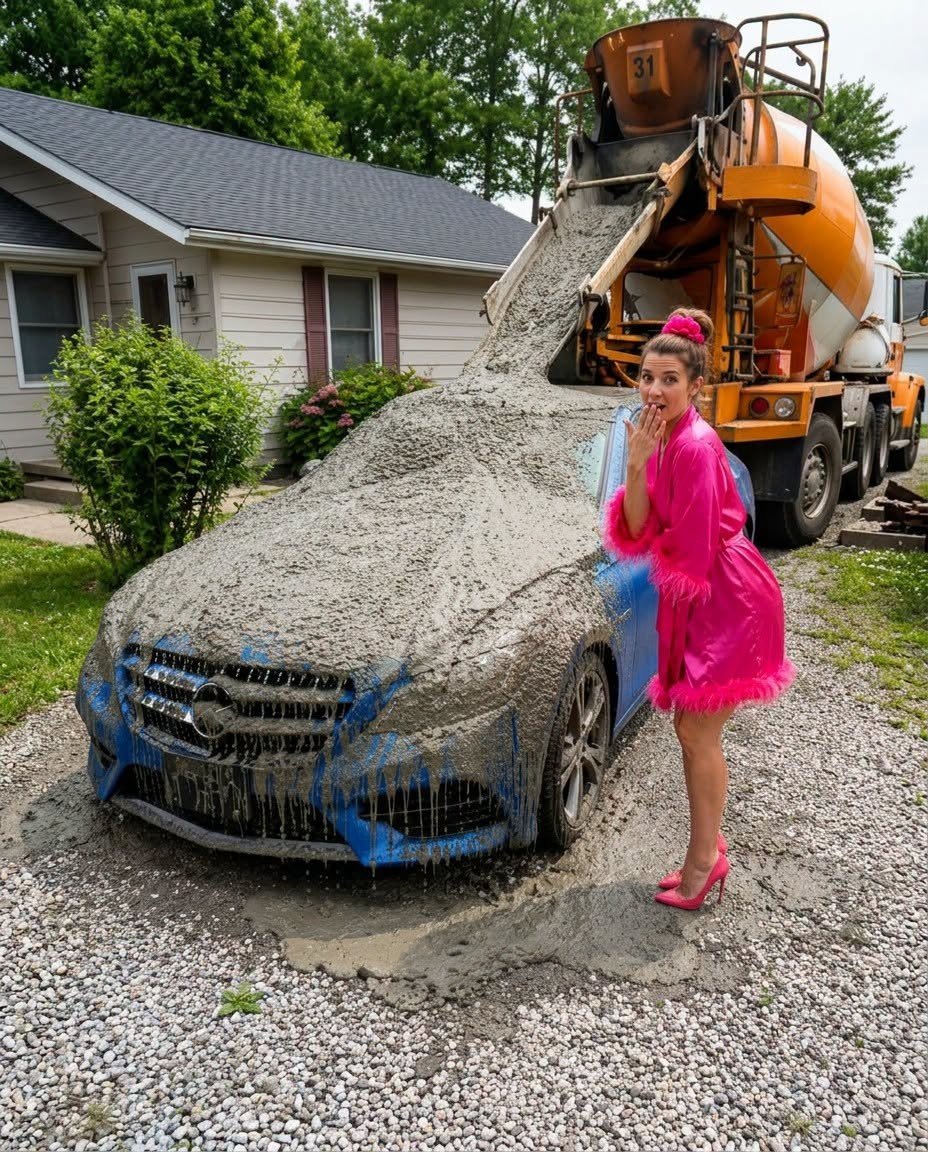
Wet concrete rolled over the hood of my old blue Chevrolet while my neighbor Valerie stood beside the truck in a cashmere robe, laughing into her coffee. Her husband Greg controlled the chute, pouring the mixture through the open windows as though destroying my only car were ordinary construction work. I was still fumbling with my phone when my eight-year-old daughter Olivia came down the porch steps and calmly told Valerie that something had appeared outside her house. On Valerie’s welcome mat lay a timestamped photograph showing her directing the entire operation, weighted beneath a stone so the wind could not carry it away. Olivia then pointed out the four security cameras my late father had installed around our property and explained, with perfect politeness, that each one had recorded what happened. Valerie’s smile vanished before the police had even arrived. My daughter had understood what I had not: the most powerful person in the argument was no longer the wealthiest one, but the person holding the evidence.
Olivia and I had moved into the small lake house after my father died and left it to me. The paint peeled, the porch sagged, and the narrow gravel driveway beside the house was the only place available for parking. Valerie lived next door in a large home overlooking the water and immediately complained that my car spoiled her balcony view. Her remarks soon became notes, insults, and suggestions that a single mother driving an old vehicle did not belong in a wealthy neighborhood. What she never mentioned was that she and Greg had repeatedly tried to buy my father’s shoreline lot while he was alive. He had refused and warned me shortly before his death that people would attempt to pressure me into selling because the land had become far more valuable than the aging house standing on it.
The police initially heard Valerie describe the incident as a minor dispute involving an abandoned vehicle and a hostile neighbor. Then Doris, the retired woman who watched Olivia after school, played the recordings from four separate camera angles. The footage showed Greg operating the commercial truck, concrete entering the vehicle, and Valerie clearly saying that I had finally learned my lesson. Olivia had noticed the truck before I returned from work, opened the camera application on Doris’s phone, preserved each feed, captured a still image, and placed it where Valerie would immediately see it. Once officers viewed the recordings, the story shifted from competing accusations to documented intent. What Valerie had expected to become her word against mine became an act of deliberate property destruction committed on camera by a licensed contractor using company equipment.
Greg was arrested and later faced regulatory scrutiny because the truck had been used outside any authorized work order to commit criminal damage. Valerie was charged for directing the act, while civil claims resulted in restitution exceeding the market value of the Chevrolet. Investigators also uncovered possible licensing, permitting, insurance, labor, and tax violations connected to Greg’s construction company after former contractors and subcontractors came forward. His professional license was suspended pending review, and the evidence established that the attack had formed part of a broader attempt to intimidate me into selling valuable waterfront property. I cooperated with law enforcement and insurers, retained the original digital files, and allowed the evidentiary record to speak for itself. Eighteen months later, burdened by legal costs and business consequences, Valerie and Greg sold their house and left the neighborhood.
I kept my father’s home, repaired the porch, repainted the exterior, and planted a garden beside the rebuilt driveway. Olivia still knows how to check every camera, though she does it with confidence rather than fear. For a time, I worried that an eight-year-old had become too calculating under pressure, until I understood that she had harmed no one and threatened nothing. She had simply protected the truth before a powerful adult could replace it with a more convenient story. My father believed that ordinary people cannot always fight wealth with influence, but they can preserve dates, images, words, and records beyond anyone’s reach. I once thought the lakefront land was the inheritance he meant to leave me. The greater inheritance was a daughter who knew that when the world is inclined to believe the person in the expensive robe, sometimes the bravest thing you can do is make a picture.
Website Disclaimer
The information provided on this website is for general informational and educational purposes only. While we strive to ensure that all content is accurate and up to date, we make no guarantees regarding the completeness, reliability, or accuracy of any information published.
The views and opinions expressed in articles belong to their respective authors and do not necessarily reflect the views of this website. Any action you take based on the information found on this website is strictly at your own risk. We will not be liable for any losses, damages, or inconveniences arising from the use of our content.
Some articles may contain opinions, third-party information, or external links. We do not endorse or guarantee the accuracy of content on external websites and are not responsible for their practices or policies.
All content on this website is provided in good faith and is intended for informational purposes only. Readers are encouraged to verify information independently and seek professional advice where appropriate.