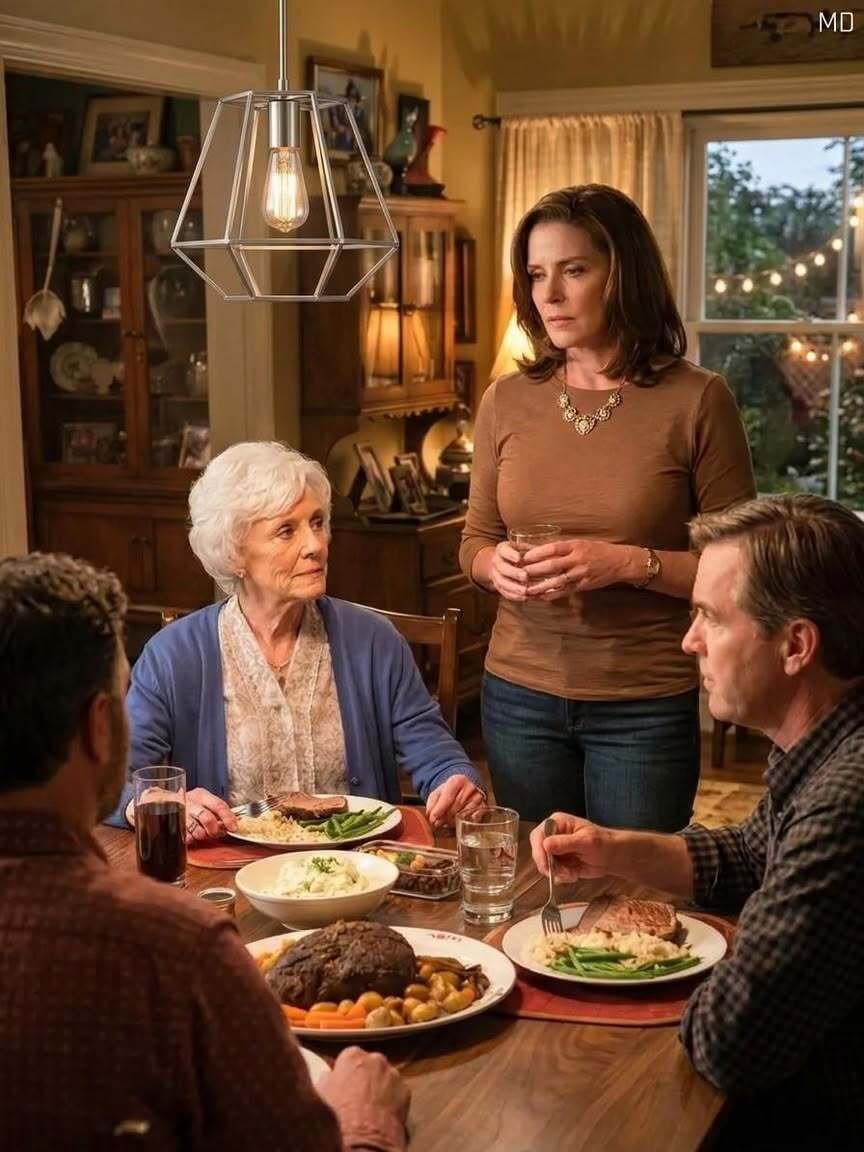
My daughter tapped her water glass with a fork and announced that the stranger beside her had come to decide whether I could still manage my own home. Every chair at my Sunday table was filled, and the pot roast I had cooked since morning sat untouched beneath the chandelier. “It’s for your own good, Mother,” Denise said, wearing the calm expression she used whenever she wanted cruelty to sound responsible. Her brother Gary stared at her in disbelief, while her husband, Kyle, kept his eyes fixed on his plate. Dr. Okafor, the evaluator, looked almost as surprised as I felt. I did not shout or ask anyone to leave. I simply offered her dinner and agreed to complete every test she had brought.
I was seventy, widowed for three years, and still living independently in the Nebraska house my husband, Elden, and his father had built. The property was worth about $385,000, and Denise had spent months suggesting assisted living, downsizing, and selling “unused space.” Meanwhile, Kyle’s mortgage business was struggling, and they had fallen four months—nearly $14,000—behind on their own home payments. After overhearing Denise discuss selling my house without telling me, I contacted family attorney Howard Lindqvist. He placed the property, my savings, and Elden’s pension benefits into a revocable trust with a bank serving as corporate co-trustee. My physician also completed a written cognitive assessment confirming that my memory and judgment were excellent.
During the evaluation, Denise repeatedly interrupted and tried answering questions for me. Dr. Okafor finally ordered her out of the room, then tested my memory, reasoning, finances, and ability to manage daily life. I recalled every word, explained my tax account, and showed her the earlier medical report. She found no sign of impairment, but she did recognize warning signs of possible financial pressure and said she was required to document them. After she left, I asked Gary and my granddaughter Sophie to step outside. Then I placed the trust documents on the table beside my phone and told Denise there was one more evaluation she needed to hear—then I pressed play.
The recording captured Denise saying that once I was declared incompetent, a guardianship could give her control over my estate. She discussed power of attorney, selling the house, and hiding the true numbers from Gary and Faith until everything was finished. My attorney had already protected the property from any unauthorized mortgage, transfer, or investment scheme, and the bank’s co-trustee meant even a court petition could not easily reach it. Denise turned pale while Kyle admitted their financial trouble had driven them into panic. I told them the house, insurance benefits, and estate were permanently off the table. However, I offered a properly documented loan through the trust—complete with repayment terms and financial counseling—rather than handing them my home as an escape route.
Denise and Kyle accepted the loan and began counseling, but forgiveness did not arrive with the paperwork. Eleven days later, Denise called and asked whether she and Sophie could help me can tomatoes, as they had before everything went wrong. She also asked me to show her how I balanced my ledger instead of assuming I could not. I agreed, not because the betrayal had disappeared, but because accountability had finally entered the relationship. I still live on Larkspur Lane, climb my stairs, and manage every bill myself. The next time my daughter wonders whether I am capable of running my home, she will not need to hire a stranger—she will only need to ask me.
Website Disclaimer
The information provided on this website is for general informational and educational purposes only. While we strive to ensure that all content is accurate and up to date, we make no guarantees regarding the completeness, reliability, or accuracy of any information published.
The views and opinions expressed in articles belong to their respective authors and do not necessarily reflect the views of this website. Any action you take based on the information found on this website is strictly at your own risk. We will not be liable for any losses, damages, or inconveniences arising from the use of our content.
Some articles may contain opinions, third-party information, or external links. We do not endorse or guarantee the accuracy of content on external websites and are not responsible for their practices or policies.
All content on this website is provided in good faith and is intended for informational purposes only. Readers are encouraged to verify information independently and seek professional advice where appropriate.