PART 2 — MISUNDERSTANDING GETS WORSE
By that evening, the first clip had already spread across the Maple Street parent group.
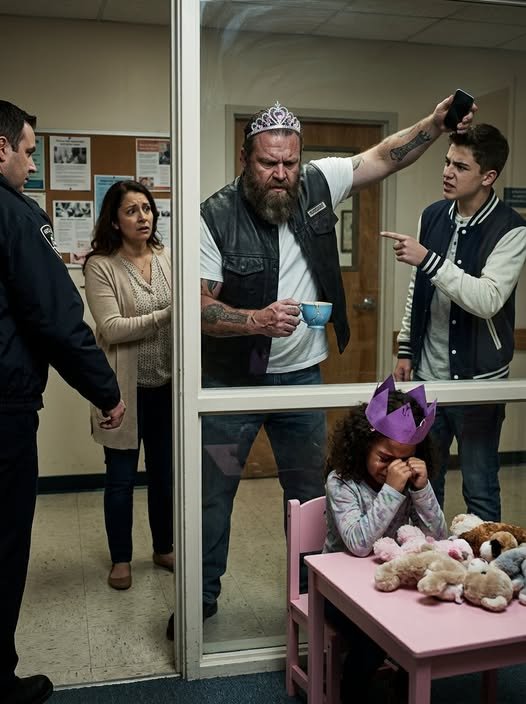
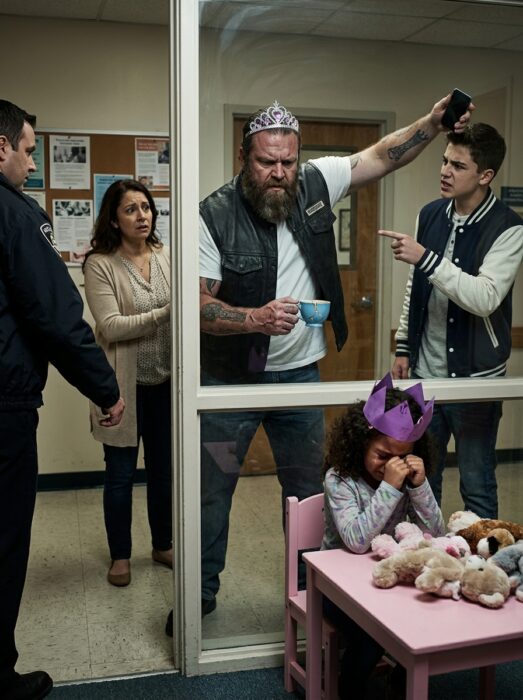
It was only seventeen seconds long, but that was enough time to make Raymond Callahan look like every judgment people had ever carried about bikers. The video began after Tyler had already laughed, after Harper had gone silent, after Raymond had asked him twice to stop filming her. It showed only the worst angle: a massive tattooed man closing a playroom door, taking a teenager’s phone, and speaking in a strange royal voice while a little girl sat at a toy table with tears in her eyes.
The caption turned fear into certainty.
Biker locks child in playroom and refuses to answer his real name.
People reacted exactly the way frightened people do when a video feels complete because it is short.
Some called him unstable. Some called the tea party disturbing. A few said no grown man should sit in a children’s room for hours, especially one who looked like that. Others asked why his daughter looked so upset if nothing was wrong. One person wrote that “men in motorcycle clubs normalize criminal behavior,” though nobody had mentioned any crime beyond a phone being taken from a teenager who had been recording a crying child.
Raymond did not respond.
That made people trust the clip more.
The next morning, Harper refused to go to school.
She sat at the kitchen table in their small rented house outside Briar Falls, wearing pajama pants and her purple dress over them because she said the queen had not officially ended yesterday. The twelve stuffed animals were lined up beside her cereal bowl. Raymond stood near the sink, leather vest hanging on a chair, coffee untouched in his hand. He looked too big for the kitchen and too helpless for a father who could lift a motorcycle off its kickstand with one hand.
“You can stay home,” he said.
Harper shook her head.
“Then we go?”
She shook her head again.
“Then what are we doing, Your Majesty?”
She looked at the cereal, not him. “Queens don’t go where kingdoms get laughed at.”
That hit him harder than the online comments.
Raymond had been called worse things than strange. Dangerous. Criminal. Deadbeat. Animal. He had heard them at gas stations, parent pickup lines, court offices, and hospital parking lots. Words thrown at him usually hit the leather first. But Harper had built the kingdom out of safety, and now the world had reached inside it.
At 9:14 a.m., Mrs. Naomi Price, a Black American elementary school counselor in her early forties with short curls, warm eyes, and a careful voice, called Raymond. She said the school had seen the video. She said they needed to discuss Harper’s absence. She said she was not accusing him of anything, which always sounded like the first step toward an accusation.
Raymond agreed to come in.
But he did not explain on the phone.
He never explained Harper without her permission.
At Lincoln Pines Elementary, the office went quiet when he walked in. He wore the black leather vest because he had come straight from his repair shop. His tattooed arms were visible. Grease was still tucked into the lines around his fingernails despite two washes. The receptionist glanced at his vest before she looked at his face.
Mrs. Price led him into a conference room where Principal Helen Ward, a white American woman in her late fifties with silver hair and a navy blazer, sat with printed screenshots from the video. Darnell Price, the same security guard from the community center and no relation to the counselor, stood near the door because the center had filed an incident report about the phone.
Raymond lowered himself into a small plastic chair.
It groaned.
Nobody smiled.
Mrs. Price began gently. “Mr. Callahan, Harper’s teacher says she has been using imaginary play more heavily since her mother passed. We understand that can be part of grief. But the video raises concerns about boundaries, distress, and whether Harper felt free to leave.”
Raymond looked at the screenshots.
Harper’s face was turned down in every one.
That was the part he could not forgive himself for.
“She was free to leave,” he said.
“Then why did you say the queen had requested privacy?”
“Because she had.”
Principal Ward leaned forward. “Mr. Callahan, do you understand how that sounds?”
“Yes, ma’am.”
“Then why not say that in plain language?”
Raymond looked down at his huge hands.
“Because plain language was what hurt her first.”
No one knew what to do with that answer.
Then Mrs. Price slid one screenshot closer.
In the corner of the image, barely visible on the tea table, was the chipped blue cup.
Raymond reached toward it before stopping himself.
Mrs. Price noticed.
“What is the cup?” she asked.
Raymond’s face hardened again.
“Not mine to explain,” he said.
That silence made the misunderstanding worse.
But it also became the first crack in it.
PART 3 — FIRST HIDDEN CLUE
The first hidden clue came from a stuffed giraffe.
Not from Raymond.
Not from the video.
From Harper’s backpack.
Mrs. Price found it after Harper finally came to school two days later, silent and pale, carrying the giraffe under one arm. The toy had long legs, a bent neck, and a faded hospital bracelet tied around its middle like a sash. During morning check-in, Mrs. Price asked if the giraffe had a name.
Harper did not answer.
Instead, she opened her backpack and pulled out a folded piece of purple construction paper.
It was written in a child’s careful handwriting.
Royal Court Attendance
Beneath the title were twelve names.
Sir Buttons.
Lady Waffles.
Captain Snout.
Professor Pickles.
Marshal Moonbear.
Sir Crumb.
Daisy the Brave.
Lord Pancake.
Miss Velvet.
Commander Giraffe.
Bishop Bunny.
And Duchess Sparklebottom.
Mrs. Price almost smiled at the last name, then stopped when she saw the handwriting beside it.
Duchess Sparklebottom had not been written by Harper.
It was adult handwriting, rounded and gentle, in purple marker.
The same handwriting appeared on the back of the paper.
If Daddy forgets the voice, remind him the duchess is fancy but loyal.
Mrs. Price stared at the note.
“Who wrote this, Harper?”
Harper held the giraffe tighter.
“My mom.”
It was the first thing she had said at school all morning.
Mrs. Price sat very still.
Harper’s mother, Grace Callahan, had died nine months earlier from cancer. The school knew the basic facts. They knew Harper had missed two weeks. They knew Raymond had become a single father overnight. They knew Harper had sometimes asked to eat lunch alone and sometimes insisted stuffed animals needed chairs. What they had not known was that the imaginary kingdom was not random. It had been built in hospital rooms, waiting areas, and late nights when adults whispered in kitchens while a little girl needed the world to remain magical enough to survive.
Mrs. Price asked Harper if she wanted to tell more.
Harper shook her head.
That should have ended it.
But then a boy at the next table whispered, “Duchess Sparklebutt.”
He said it quietly, but not quietly enough.
Harper went rigid.
Mrs. Price turned at once, but Raymond’s shadow had already appeared in the office doorway. He had come to drop off Harper’s lunchbox because she had forgotten it. He heard the word. He saw Harper’s hand tighten around Commander Giraffe. He saw her face close like a door.
He moved fast.
Too fast.
He crossed the counseling room, stepped between the boy and Harper, and said in a voice that sounded low and dangerous, “That title belongs to the court.”
The boy’s eyes widened.
Mrs. Price stood. “Mr. Callahan.”
Raymond stopped immediately.
He had scared the child.
He knew it the second he saw the boy’s face.
Raymond stepped back, hands open. “I apologize.”
The boy looked ready to cry anyway.
Harper looked ready to disappear.
This was what made Raymond difficult for people to understand. His instinct was protective, but his body translated protection into a language that looked like threat before his heart arrived to correct it.
Mrs. Price saw that for the first time.
Not because he was harmless.
Because he knew he was frightening and hated that he had frightened the wrong child.
He knelt slowly beside Harper, making himself smaller than his knees allowed.
“Your Majesty,” he said softly, “permission to speak plainly?”
Harper looked at the giraffe.
Then nodded.
“I am sorry I made the room too loud.”
She looked at him with wet eyes. “You broke character.”
Raymond flinched as if the words had struck him.
“No,” Mrs. Price said gently.
Both of them looked at her.
She picked up the purple attendance paper and touched the line Grace had written.
“I think he was still protecting the kingdom,” she said. “He just forgot the duchess is fancy.”
For the first time, Harper looked at Mrs. Price as if an adult outside her family had learned the map.
That was when the counselor knew the tea party was not the problem.
It was the bridge.
PART 4 — TRUTH BEGINS TO TURN
The truth began to turn when Mrs. Price asked to see the full video.
Tyler’s mother resisted at first. Karen Whitlock said her son had been frightened and that people were focusing too much on context when the biker had clearly taken a phone that did not belong to him. That part was not false. Raymond had taken the phone. He had placed it on a shelf instead of handing it back. He had frightened people who could not see what came before.
But full stories are often built from the parts people cut away.
The community center camera showed the wider angle.
It showed Harper setting up the tea party at noon in the children’s room while Raymond sat on the floor beside her, knees nearly to his chest, carefully placing stuffed animals where she directed. It showed her crowning him with a plastic tiara, then correcting his posture. It showed Raymond bowing to a stuffed rabbit with absolute seriousness. It showed him lifting the tiny blue cup with both hands as if it were fine porcelain.
It also showed children drifting in and out, curious at first, then bored.
It showed Tyler entering with two friends at 3:51 p.m. It showed him raising his phone before Raymond took it. It showed Harper covering the blue teacup with both hands when Tyler zoomed in on it. It showed him laughing, not loudly, but enough. It showed his mouth form the words “Sparklebottom freak show.”
That was when Raymond stood.
Not when he was mocked.
When Harper was.
Mrs. Price watched the footage twice.
Karen watched it once and looked away.
Principal Ward, who had joined from the school because Harper’s absence had become a student concern, folded her hands on the conference table and said nothing for a full minute.
Raymond sat at the end of the table with Harper beside him. He did not look victorious. He looked exhausted.
Mrs. Price turned to Harper. “Did you want your dad to stay at the tea party all four hours?”
Harper nodded.
“Could you tell him to leave?”
Harper looked insulted. “Duchesses don’t leave before the queen says.”
Karen rubbed her forehead.
Principal Ward asked carefully, “Harper, why four hours?”
Harper’s eyes moved to the blue teacup, which sat on the table now inside a padded lunchbox. Raymond had brought it because Harper insisted the court needed representation.
She answered in a whisper.
“Because Mom did three hours once, and Daddy said he could beat her record if I needed him.”
The room changed.
Not dramatically.
Quietly.
As if everyone had leaned back from judgment at the same time and found grief sitting where suspicion had been.
Mrs. Price asked if the cup was special.
Harper touched the chipped rim.
“Mommy had tea with us in the hospital when the medicine made her tired. She said if she could not go to the castle, the castle could come to her.”
Raymond looked down.
His scarred thumb rubbed the edge of his vest.
Harper continued, braver now because nobody laughed.
“The cup broke when Mommy’s hands shook. Daddy glued it. He said royal things can be cracked and still count.”
Karen’s face tightened.
Tyler, sitting beside her, looked at the floor.
The first apology came from him, awkward and small.
“I didn’t know.”
Harper’s reply came sharp, and she had earned it.
“You didn’t ask.”
Raymond almost smiled at that, then didn’t.
Because his daughter was right, and because being right did not erase how hurt she had been.
Mrs. Price looked at Raymond. “Why didn’t you explain at the center?”
He looked at Harper.
Then back at the adults.
“Because her mother’s cup is not a defense exhibit.”
That sentence silenced the room completely.
The truth had turned.
But not into a simple story where Raymond was perfect and everyone else was cruel. He had scared people. He had taken a phone. He had let his size speak before his words caught up.
But he had also stood guard over a child’s fragile world when everyone else saw only a ridiculous game.
PART 5 — BIKER’S PAST / DEEPER TWIST
Raymond Callahan had not always known how to play.
As a boy in rural Pennsylvania, he learned early that big bodies were expected to be useful, not tender. His father hauled scrap metal and believed softness invited trouble. Raymond grew fast, broad, and quiet. By thirteen, he looked sixteen. By sixteen, he looked like a man people blamed before asking questions. Teachers moved him to the back of classrooms because he made smaller kids nervous. Police asked him what he was doing outside convenience stores where he had only gone to buy soda.
He learned to become what people already feared.
Not criminal.
Not cruel.
Just hard enough that nobody saw the boy underneath and aimed for him.
Then he met Grace.
Grace Bennett was a white American pediatric nurse with warm brown eyes, curly auburn hair, and a habit of humming while she cleaned wounds. She met Raymond after a charity ride brought stuffed animals to the children’s hospital where she worked. He stood in the hallway holding a box of teddy bears like someone had handed him explosives. Grace laughed and said, “You look like you are afraid one of them will judge you.”
“I don’t trust anything with button eyes,” he said.
She handed him a plush giraffe. “Start with this one. He is emotionally stable.”
That giraffe became Commander Giraffe years later.
Grace taught Raymond that play was not childish. It was language. Children used it to tell adults what they could not say directly. A tea party could mean I am scared. A kingdom could mean I need control. A stuffed animal trial could mean somebody hurt my feelings and I do not know how to ask for justice.
When Harper was born, Grace built little worlds around her daughter the way some parents built routines. Bedtime was a train station. Brushing teeth was a dragon treaty. Sick days were royal quarantines. Raymond pretended to grumble, but he always joined once Grace assigned him a title.
The first time Harper called him Duchess Sparklebottom, he nearly refused.
Grace gave him a look across the living room.
Raymond bowed so low his back cracked.
Harper laughed until she fell over.
That was the sound Grace later said she wanted him to remember if things got hard.
Things got hard three years later.
Grace found the lump in February. By April, the hospital where she had comforted other people’s children had become the place where Harper learned grown-ups whisper near vending machines. Grace lost weight. Her hands trembled. Her hair changed. But she kept the kingdom alive as long as she could.
On bad days, the twelve stuffed animals came to her bed.
Raymond would stand at the doorway, angry at the disease, angry at himself, angry at the useless size of his hands. Grace would point at the tiny chair beside the bed.
“Duchess,” she would say weakly, “the court requires your presence.”
He sat every time.
Even when nurses smiled.
Even when other visitors stared.
Even when his friends from the biker club came by and caught him wearing a plastic tiara while pouring invisible tea for a rabbit.
One of them, a Black American rider named Vernon “Patch” Hayes, only nodded and said, “Good court discipline.”
Raymond never forgot that.
Two nights before Grace died, she made him promise something that seemed small until it became everything.
“Do not let the world embarrass her out of magic,” Grace whispered.
Raymond sat beside the hospital bed holding the chipped blue teacup. Grace’s hand had shaken earlier, and the cup had slipped against the rail. He had glued it badly at first, then carefully, then better. The crack remained, thin and visible, like a line drawn through time.
“She will outgrow tea parties,” he said, because he wanted to believe the future would be ordinary.
Grace smiled, tired but sharp. “Maybe. But she should get to outgrow them, Ray. Not have them laughed out of her.”
After Grace died, Harper stopped speaking for nine days.
The first sentence she said was not “I miss Mommy.”
It was, “Does the kingdom still count?”
Raymond did not know what grief asked of fathers in moments like that. So he answered the only way he could.
He stood, put a bath towel around his shoulders like a royal cape, and said, “Duchess Sparklebottom reports for duty.”
Harper cried for the first time.
Not quietly.
Not prettily.
The kind of cry that returns a child to her body after sorrow has made her float away from it.
That was why Raymond never broke character.
Not because it was funny.
Because sometimes a child’s imaginary kingdom is the last room grief cannot enter without knocking.
PART 6 — PUBLIC REVERSAL / EVIDENCE
The public reversal began with an apology people could not easily share as entertainment.
Mrs. Price wrote it first, then asked Harper and Raymond whether any part of it felt wrong. Raymond said he did not care what people thought about him. Harper said she cared if people still thought Commander Giraffe was weird. Mrs. Price took that seriously.
The community center and the school released a joint statement.
A short video from Saturday’s family event was shared without full context. The child involved was participating in a grief-related imaginative play routine connected to her late mother. Her father intervened after she was filmed and mocked. He returned the phone to a center staff member. We ask families not to record or share children in vulnerable moments.
It did not name Grace.
It did not show the cup.
It did not turn Harper’s grief into proof.
That mattered to Raymond.
Tyler’s mother removed the video. Tyler wrote an apology letter because Principal Ward said public embarrassment should never be the first consequence when private accountability could teach more. His letter was clumsy, but he wrote it himself.
I thought it was funny because I did not understand it. I filmed you when you were upset. I should have stopped when your dad told me. I am sorry I laughed at the name and the tea party.
Harper read it twice.
Then she said, “He forgot to apologize to Lady Waffles.”
Raymond looked very serious. “A grave oversight.”
Mrs. Price, who had come for a home visit with Harper’s permission, wrote a note on the bottom.
Please include the court in your apology.
Tyler did.
That small ridiculous correction did more healing than a polished speech might have done.
The following week, the school held a lesson on dignity and imagination. Mrs. Price brought in a box of books about grief, family, pretend play, and different kinds of courage. She did not mention Harper unless Harper raised her hand. Harper did not. She sat with Commander Giraffe in her lap and listened while other kids slowly began to understand that not every game is only a game.
At the community center, Darnell found Raymond repairing a loose hinge on the children’s room door.
“You know staff could fix that,” Darnell said.
Raymond tightened a screw. “Staff let it squeak during formal court.”
Darnell nodded, accepting the seriousness of the matter. Then his voice softened. “You scared people, Ray.”
Raymond stopped working.
“I know.”
“You scared Tyler too.”
“I know that.”
“You also protected your kid.”
Raymond looked through the glass at the tiny table.
Both things were true, and real life rarely lets people keep only the truth that flatters them.
“I am trying to learn how to be fast without being frightening,” Raymond said.
Darnell smiled faintly. “At your size, that may require paperwork.”
The two men shared the first laugh of the whole story that did not hurt anyone.
Later that afternoon, Karen brought Tyler to the center. Harper was there with Raymond, setting up a much shorter tea party because four hours was apparently reserved for royal emergencies. Tyler stood at the doorway, hands in his hoodie pocket, face red.
“I’m sorry, Lady Waffles,” he said.
Harper looked at the stuffed rabbit.
Then at him.
“Lady Waffles accepts a written apology and one cookie.”
Raymond lifted the tiny blue teacup to hide his mouth.
Tyler blinked. “Do I give the cookie to the rabbit?”
Harper sighed like a queen burdened by fools. “Obviously.”
The cookie was placed on a napkin before Lady Waffles. The court accepted.
Karen watched Raymond answer every command in the formal voice of Duchess Sparklebottom. He poured invisible tea. He consulted Professor Pickles about weather. He bowed to Commander Giraffe. He did not look embarrassed. That was what humbled her most.
She had spent so much energy worrying that the huge biker was inappropriate in a child’s world.
Now she saw he was one of the few adults brave enough to enter it properly.
PART 7 — EMOTIONAL PAYOFF / FINAL TWIST
The final twist was hidden in Lady Waffles.
Nobody expected that.
Lady Waffles was the oldest stuffed animal in the court, a cream-colored rabbit with one floppy ear, a worn pink nose, and a hand-sewn dress made from fabric that had once been part of Grace’s favorite scarf. Harper carried her everywhere during the first months after the funeral, then slowly gave her a place of honor at the tea table. Lady Waffles did not travel anymore unless the kingdom was in crisis.
On the first anniversary of Grace’s passing, Harper asked for a private tea.
Not at the community center.
At home.
Raymond closed the repair shop early. He made grilled cheese cut into tiny triangles because royal sandwiches needed geometry. He lined up the twelve stuffed animals around the kitchen table. He placed the chipped blue teacup at Harper’s seat and used a mug with a motorcycle logo for himself until Harper corrected him.
“Duchess Sparklebottom drinks from the flower cup.”
Raymond looked at the tiny porcelain cup with violets painted around the rim. Its handle barely fit one finger.
“As Her Majesty commands.”
For two hours, they played.
Then three.
Then almost four.
Harper spoke in a royal voice at first, then a normal one, then the smaller voice children use when they are about to ask for something that might break them.
“Daddy?”
Raymond straightened. “The duchess is listening.”
“No. Daddy.”
He set the flower cup down.
Harper picked up Lady Waffles and turned the rabbit over. “Mommy said there was a secret, but I forgot until last night.”
Raymond’s chest tightened.
“A secret?”
“She told me if the kingdom got too sad, look under Lady Waffles’s dress.”
Raymond swallowed hard.
He had repaired motorcycles, broken doors, burned wiring, cracked frames, and engines that would not turn. But he had never learned how to prepare for Grace appearing suddenly inside an ordinary object.
Harper carefully lifted the rabbit’s little scarf-dress.
Under the fabric, sewn against the rabbit’s back, was a tiny envelope.
Raymond did not touch it until Harper handed it to him.
On the front, in Grace’s handwriting, were the words:
For the Duchess, when the Queen forgets she can still rule.
Raymond’s face crumpled before the envelope was even open.
Inside was a folded letter and a small purple ribbon, the same color as Harper’s dress at the community center. Grace had written in shaky lines, the kind a body writes when strength is leaving but love refuses to.
Ray, if you are reading this, it means you stayed ridiculous. Good. Do not underestimate how holy ridiculous can be when a child is grieving. The world will try to make her grow up quickly because sadness makes adults uncomfortable. Do not help them. Sit at the table. Drink invisible tea. Answer to the stupid name. Let her be queen somewhere until she is ready to be a child everywhere again.
Raymond stopped reading.
Harper leaned against his arm.
“Keep going,” she whispered.
He did.
You are going to think you are too rough for this. You are not. Rough hands can hold tiny cups if they decide to learn. You are going to feel embarrassed. Feel it, then bow anyway. Our daughter does not need a perfect father. She needs one who will enter her kingdom without laughing.
The last line was written darker, as if Grace had pressed the pen hard enough to make sure it stayed.
Tell Duchess Sparklebottom I expect honorable service.
Raymond laughed and cried at the same time, which Harper declared “not very duchess-like but acceptable under mourning law.”
Beneath the letter was a photograph.
Grace in a hospital bed, thin and smiling, with a plastic tiara resting crookedly on her auburn hair. Raymond sat beside her in the tiny visitor chair, huge and uncomfortable, holding the chipped blue teacup with a seriousness that made the whole image ache. Harper, younger then, stood between them in a paper crown.
On the back, Grace had written:
The kingdom counts because we counted it together.
Harper touched the photo.
“Mommy was the first queen,” she said.
Raymond shook his head. “No, baby. Your mom was the royal advisor. She always said you were queen.”
“Then what are you?”
He looked at the flower cup, the twelve stuffed animals, the letter, the repaired blue teacup, and the little girl who had survived the worst year of her life without surrendering her magic.
He lifted his chin.
“Duchess Sparklebottom,” he said in full royal voice, “servant of the crown, defender of stuffed citizens, and enemy of under-steeped imaginary tea.”
Harper smiled.
Not the careful smile she used at school.
A real one.
The kind that reached the part of the room where Grace still seemed to be listening.
After that day, the tea parties changed. They became less frequent, not because Harper stopped loving the kingdom, but because the kingdom had done its job. She began inviting real children to shorter royal councils. Tyler came once and was appointed Temporary Cookie Ambassador, a position he accepted with more seriousness than anyone expected. Mrs. Price visited and was named Minister of Listening. Darnell earned the rank of Gatekeeper after fixing the community center door so it no longer squeaked during formal court.
Raymond remained Duchess Sparklebottom.
No term limits.
At the end of the school year, Harper’s class held a family celebration. Each student brought an object that represented courage. Some brought medals. Some brought photographs. One boy brought a soccer cleat. Tyler brought the apology letter, folded neatly, and said courage was admitting when you were mean because you wanted people to laugh.
Harper brought the chipped blue teacup.
Raymond stood at the back of the classroom in his leather vest, arms folded, tattoos visible, beard trimmed, boots cleaned. A few parents still looked at him twice. He no longer shrank from it. When Mrs. Price asked Harper to explain her object, she held the cup with both hands.
“This cup broke when my mom was sick,” Harper said. “My dad fixed it. Then he used it at tea parties even though his fingers are too big. It means something can be cracked and still be royal.”
The room went quiet.
Raymond looked at the floor.
Harper continued. “My dad looks scary, but he is Duchess Sparklebottom. That means he has to be fancy and loyal. He never breaks character unless I say Daddy instead.”
A few parents laughed softly.
This time, nobody laughed at her.
They laughed with tenderness, the way adults do when a child has explained love better than they could.
After the celebration, a mother approached Raymond and said, “You are a good sport.”
Raymond looked at Harper.
Then back at the woman.
“No, ma’am,” he said. “My daughter is queen of her kingdom. I serve the kingdom with honor.”
The woman blinked, unsure whether he was joking.
He was not.
Years later, when people told the story, they always liked the funny part first: the giant tattooed biker sitting at a tiny table, drinking invisible tea, answering to Duchess Sparklebottom for four full hours without breaking character. But Harper always remembered the more important part.
He did not laugh when the world laughed.
He did not explain her grief without permission.
He did not make her kingdom smaller so adults could understand it faster.
He sat down, lifted the chipped blue cup, and served.
And Raymond, if anyone asked why a two-hundred-ninety-pound biker would spend four hours at a tea party with twelve stuffed animals, always gave the same answer Grace had left for him and Harper had made true.
“My daughter is queen of her kingdom,” he said. “I am Duchess Sparklebottom. I serve the kingdom with honor.”
Follow this page for more unforgettable biker stories about misunderstood heroes, quiet kindness, and the rough-looking people who notice what everyone else misses.
Website Disclaimer
The information provided on this website is for general informational and educational purposes only. While we strive to ensure that all content is accurate and up to date, we make no guarantees regarding the completeness, reliability, or accuracy of any information published.
The views and opinions expressed in articles belong to their respective authors and do not necessarily reflect the views of this website. Any action you take based on the information found on this website is strictly at your own risk. We will not be liable for any losses, damages, or inconveniences arising from the use of our content.
Some articles may contain opinions, third-party information, or external links. We do not endorse or guarantee the accuracy of content on external websites and are not responsible for their practices or policies.
All content on this website is provided in good faith and is intended for informational purposes only. Readers are encouraged to verify information independently and seek professional advice where appropriate.