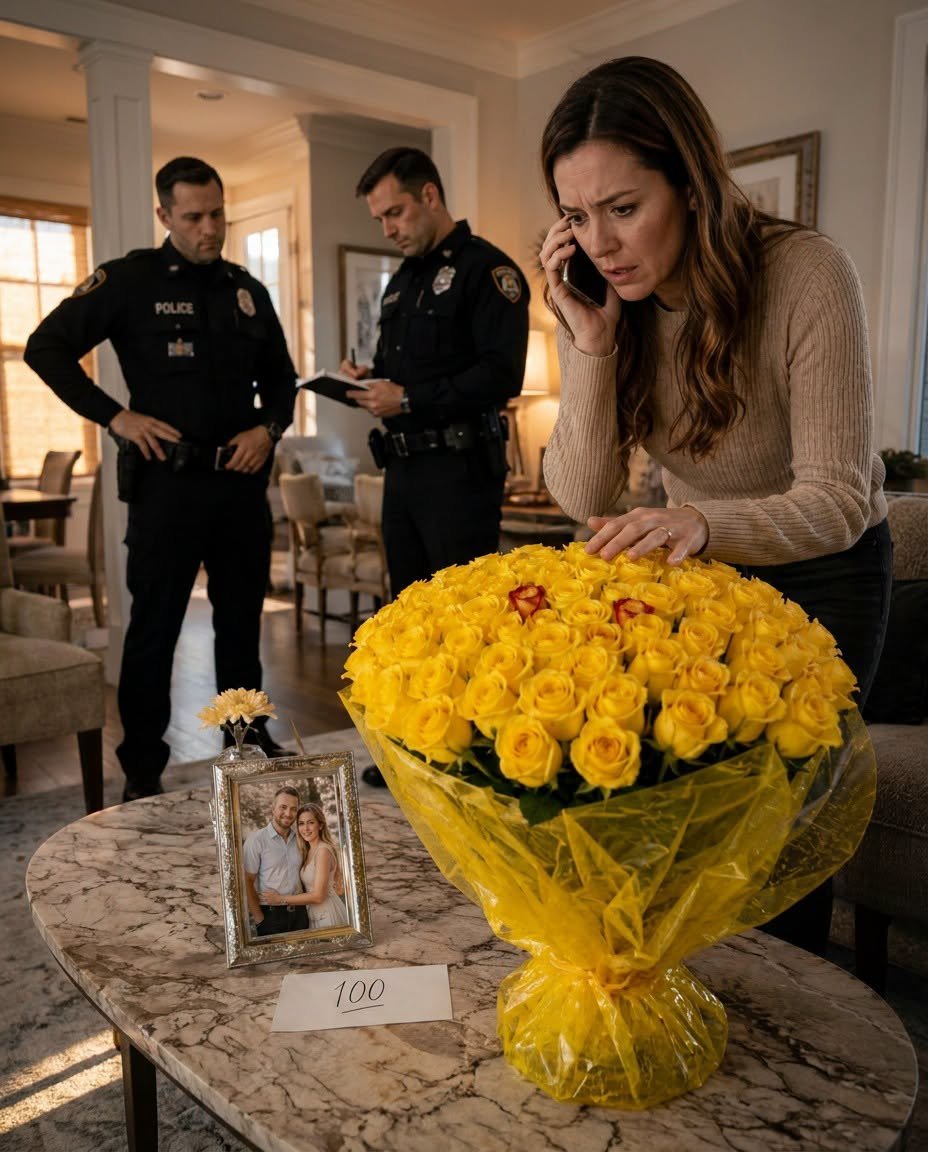
The bouquet arrived just after noon, filling my doorway with yellow so bright it almost looked artificial. One hundred roses, packed tight and perfect, with no card, no signature, and only my name printed on the florist’s tag. At first, I smiled because my husband, Daniel, was away on business and surprises were not unusual for him. Then I remembered he knew I loved white roses, not yellow ones. I also noticed the number was exact — one hundred — as if whoever sent them wanted me to count. When I leaned closer, three roses near the center had tiny red marks hidden beneath their petals. My smile vanished, because those flowers were not a gift from my husband. They were a signal from a woman I had not spoken to in nine years.
My name is Iris Calloway, and before my quiet consulting life, I worked as a cryptologist for a private security firm run by Vera Konstantinova. Vera was brilliant, careful, and almost impossible to read, the kind of woman who could teach you more with one raised eyebrow than most people could with an hour-long lecture. Years earlier, our team used coded signals hidden inside ordinary objects when normal communication was unsafe. Three marked points in a ten-by-ten pattern meant one thing: “I need you. Do not come to me. Wait for contact.” Vera had retired years before, at least officially, and Daniel only knew the general outline of my past because most of that work was locked behind confidentiality agreements. So when the roses appeared while he was five hundred miles away, I tried to call him, got no answer, and sat at my kitchen table staring at $600 worth of flowers that suddenly felt less like beauty and more like warning.
The contact came as a knock at my back door. A woman named Dasha stood there, calm, unfamiliar, and trained enough that she could not fully hide it. She said Vera had sent the roses because her communications were being watched and because she needed help with a time-sensitive pattern analysis tied to a financial institution. For seven years, someone inside that institution had allegedly falsified transaction records in a way that survived normal audits, and the annual review scheduled for Thursday could bury the data trail deeper than anyone wanted. Vera had pieces of the truth but needed someone who could see the pattern across the entire timeline, not just one suspicious entry. Daniel finally called back that afternoon, listened to everything, and asked only whether I felt I was the right person for the job. When I said yes, he told me, “Then do what you need to do.”
At five o’clock, I met Vera in a downtown hotel room where the records were already spread across the table. For six hours, I worked through entries, dates, transaction clusters, audit windows, and internal timing until the hidden rhythm finally showed itself. The fraud had been built to disappear inside individual review periods, but across seven years it formed a pattern too deliberate to be random. Vera took the analysis to the institution’s board through the right legal channels, and their forensic team verified what I had found. The attorney advising the board later tied the findings to internal controls, insurance exposure, regulatory filings, investment risk, audit failures, and potential court action if the matter expanded. The person responsible was removed, the records were corrected, and the institution began a wider review of its financial estate before the damage could grow beyond repair.
Daniel came home Friday, and I told him the whole story over dinner while the roses sat in a wide glass vase between us. He asked if I had known that part of my mind was still there, waiting, and I told him it felt like speaking an old language I had not used in years. The roses lasted ten days, but I dried the three marked ones and kept them in a small glass on the windowsill. Later, Dasha told me Vera had once called me the best pattern analyst she ever trained, which felt more valuable than any formal award. The bouquet had frightened me at first, then pulled me back toward a skill I had quietly buried. One hundred yellow roses were not romance, and they were not farewell. They were a reminder that some parts of us do not disappear; they simply wait for the right signal.
Website Disclaimer
The information provided on this website is for general informational and educational purposes only. While we strive to ensure that all content is accurate and up to date, we make no guarantees regarding the completeness, reliability, or accuracy of any information published.
The views and opinions expressed in articles belong to their respective authors and do not necessarily reflect the views of this website. Any action you take based on the information found on this website is strictly at your own risk. We will not be liable for any losses, damages, or inconveniences arising from the use of our content.
Some articles may contain opinions, third-party information, or external links. We do not endorse or guarantee the accuracy of content on external websites and are not responsible for their practices or policies.
All content on this website is provided in good faith and is intended for informational purposes only. Readers are encouraged to verify information independently and seek professional advice where appropriate.