“You Abandoned Her. I Didn’t.” A CEO Married His Mistress While His Pregnant Wife Fought to Save Their Twins—Then a Billionaire Walked Into the Hospital and Exposed the Fortune He Tried to Steal
Part 1: The Text Message That Arrived While I Was Bleeding
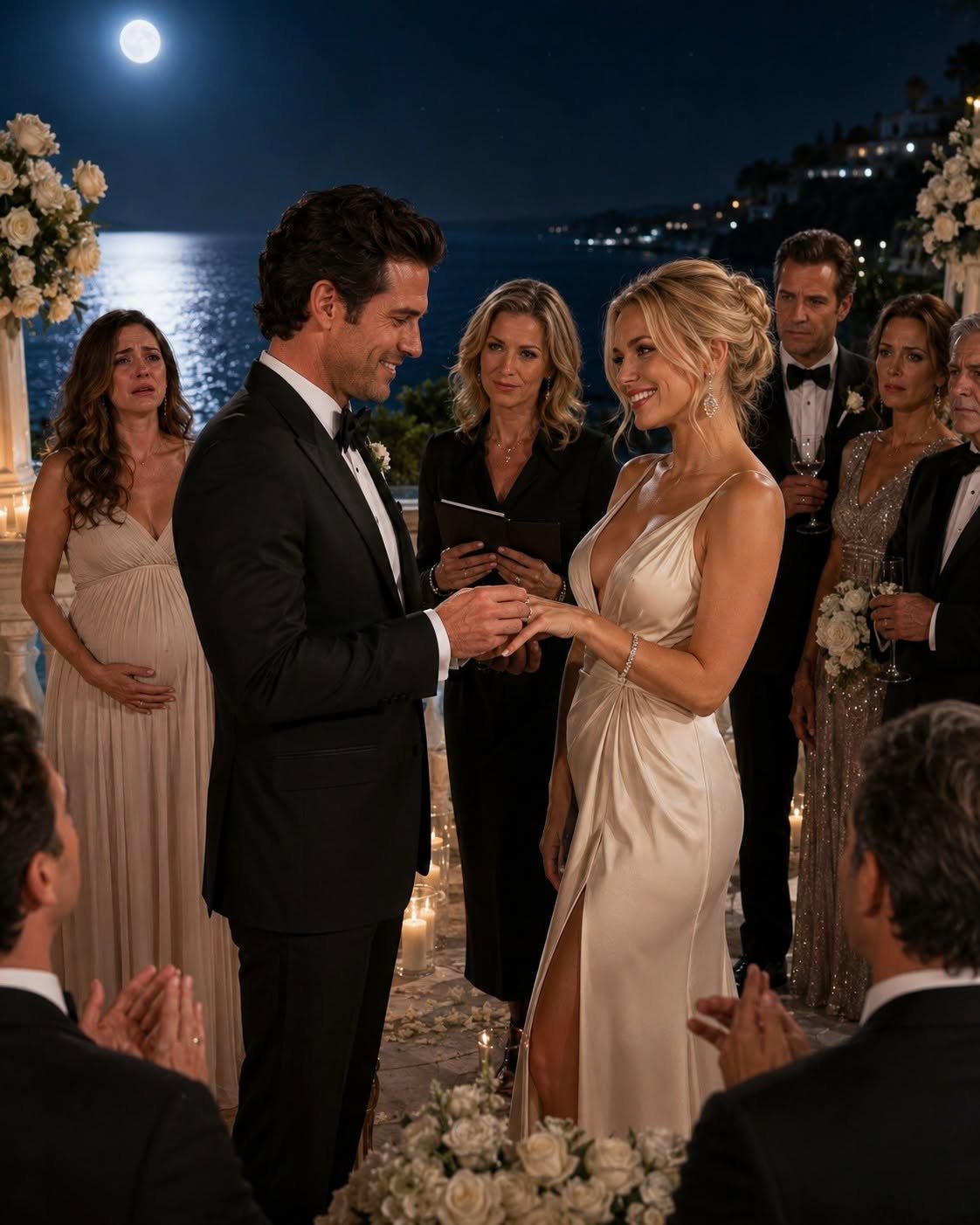
At 1:48 in the morning, my husband was exchanging vows on a white stone terrace above the Aegean Sea while I was bleeding through a hospital gown in Chicago.
I did not know the exact moment Owen Carlisle slid a ring onto Sloane Whitaker’s finger. I would learn later that there had been white roses, a violinist, a photographer, a wedding planner, and a private dinner for twelve people who had all agreed to pretend that a man still legally married to an eight-month pregnant woman was simply beginning a beautiful new chapter. But that night, I knew only what appeared on my phone screen while a nurse pushed me through the emergency entrance at Riverside Women’s Hospital.
The divorce documents are in your email. The house is no longer available to you. Please do not turn this into a public scene.
For a second, I stared at the message without understanding the words. Then another contraction ripped through me so violently that my knees buckled beneath the weight of my body. I pressed both hands against the intake desk, gasped for air, and watched a thin line of blood slide down one bare leg.
“My babies,” I managed to say. “Something is wrong with my babies.”
The receptionist looked up, then down, then immediately hit the emergency button beneath the counter. Within seconds, the quiet lobby became a storm of movement. A wheelchair appeared. Someone took my bag. Someone else asked how far along I was. A nurse wrapped a blood pressure cuff around my arm while another tried to take my phone from my fingers because I was gripping it so tightly my knuckles had gone white.
“Thirty-one weeks?” a nurse asked.
“Yes.”
“Any complications before tonight?”
“No. I mean… I had swelling. Headaches. But Owen said I was overreacting. He said pregnancy makes women dramatic.”
The nurse looked at me, then at the phone screen still lit in my hand. Her face changed, though she tried to hide it.
“Where is your husband?”
I laughed once.
It did not sound like laughter.
“He is getting married.”
No one said anything after that.
The monitors began alarming before they had even finished wheeling me down the hall. My blood pressure was dangerously high. My vision blurred at the edges. My hands had started shaking. I could hear people using words like preeclampsia, hemorrhage, emergency C-section, fetal distress, and magnesium sulfate. They were clinical words, fast words, words that were supposed to guide people toward solutions. But all I heard was the terrible truth beneath them: something could happen to my daughters, and I might not be awake to stop it.
My phone buzzed again.
A bank alert.
Then another.
Then three more.
The joint account had been emptied. My debit card had been disabled. The credit card I used for groceries had been closed. The health insurance policy connected to Owen’s company had been canceled earlier that evening.
He had planned it.
That thought was colder than fear.
Owen had not run away in a moment of panic. He had not disappeared because we argued. He had not made one terrible decision and then regretted it. He had timed everything with the cold precision of a man who believed numbers mattered more than people. He had removed my access to money, medical care, our home, and legal support while I was carrying his children. He had waited until I was physically vulnerable, emotionally exhausted, and isolated enough to believe I had nowhere left to stand.
A doctor rushed beside the gurney as we reached the operating room doors. She had dark hair tucked beneath a surgical cap and sharp brown eyes that made me think of someone who did not waste words.
“I’m Dr. Mara Ward,” she said. “Maya, I need you to hear me. One baby is showing signs of distress, and your blood pressure is dangerously high. We may need to deliver both twins immediately.”
“Will they live?” I asked.
Dr. Ward did not offer me the easy comfort people sometimes give when they are too afraid to tell the truth.
“We are going to fight for all three of you,” she said. “But I need you to stay with us.”
I grabbed her wrist before they could move me through the doors.
“I cannot die,” I whispered. “There is no one for them.”
Her face hardened in a way that felt almost protective.
“Then do not give up,” she said. “Not tonight.”
The anesthesiologist lowered a mask toward my face. I tried to keep my eyes open. I tried to keep reading my phone because some broken part of me still believed Owen might send another message that explained everything. Maybe he would say it was a mistake. Maybe he would say he was coming. Maybe he would say he had not really married Sloane. Maybe I would wake up and find that the past three years had been a horrible misunderstanding.
Instead, the screen lit up again.
Property title transfer complete. Thirty days to remove personal effects. Sloane says she hopes you will be mature about this.
I remember thinking that I should hate her.
I remember thinking that I should hate him more.
Then the pain became too large for hatred.
The operating room doors opened behind Dr. Ward. I heard footsteps that did not belong to nurses or surgeons. Slow, controlled footsteps. A man’s voice spoke quietly with hospital staff. I turned my head, half-conscious, and saw someone standing in the doorway.
He was tall, silver-haired at the temples, dressed in a charcoal suit that looked too expensive for a room filled with blood, metal, and fear. He had a face I recognized from business magazines, although it took my drug-clouded mind several seconds to place him.
Gabriel Ward.
Founder of Ward Meridian Holdings. Investor. Billionaire. The man whose name appeared on hospitals, research centers, scholarship funds, and public projects across the city. I had seen him on television once, answering questions about labor reform with the same calm expression he wore now.
He looked at me.
Then he looked at the blood soaking the sheets beneath me.
Then he looked at my phone.
Dr. Mara Ward turned toward him. “Gabriel, you cannot be in here.”
He did not move.
“Is she alone?” he asked.
Dr. Ward looked at the messages on my screen.
“Yes.”
Something changed in his expression. It was not pity. It was not curiosity. It was anger, but not the loud kind. It was the kind that had been stored for years and had learned patience.
Another contraction hit me. I cried out.
Gabriel stepped back immediately, as if the room belonged to me and he knew better than to take up more space than necessary.
“What does she need?” he asked his sister.
“Blood, surgery, neonatal support, and someone to sign emergency paperwork if she becomes unable to communicate.”
“I’ll make sure she has what she needs,” he said.
“That is not how consent works,” a nurse began.
“I know,” he replied. “Get patient advocacy. Get legal support. Get whoever she needs to understand her options when she wakes up. But no one denies care because a man decided his wife was inconvenient.”
He looked at me one more time.
“You are not alone anymore,” he said.
The mask covered my face.
The last thing I heard before the world went black was Dr. Ward giving instructions to the surgical team, a nurse calling for more blood, and Gabriel’s low voice behind me.
“If Owen Carlisle comes near her tonight,” he said, “he does not come alone.”

Part 2: The Two Girls Who Made Me Choose Life
I woke in fragments.
First there was pain, deep and burning beneath my ribs. Then the dry ache in my throat. Then the unfamiliar weight of blankets tucked around my legs. When I opened my eyes, I was in a private recovery room with soft gray walls, a small arrangement of white flowers near the window, and machines beeping beside my bed.
For one terrifying second, I thought I had died.
Then I felt the ache in my body and knew I was still alive.
Gabriel Ward was sitting in a chair beside the window.
He had removed his suit jacket and loosened his tie. There was a cup of cold coffee on the side table and several folders stacked neatly beside it. He looked like a man who had been awake far too long, but he stood the moment my eyes focused.
“Good,” he said softly. “You are awake.”
I tried to sit up. Pain cut through me so fast I gasped.
“Do not do that,” he said, moving closer but stopping before he touched me. “Your body has been through more than enough.”
“My babies,” I whispered.
His face changed immediately.
“They are alive.”
The words did not sound real.
“Both?”
“Both.”
Tears came before I could stop them.
Gabriel reached for a tissue and placed it gently in my hand rather than wiping my face himself. It was such a small gesture, but it mattered. I had spent years with a man who took things from me without asking—my money, my friendships, my confidence, my time, my silence. Gabriel did not take even a tear without permission.
“One is stronger,” he said. “The other gave the team a scare at first, but she is breathing. They are in the neonatal intensive care unit. Dr. Ward says you can see them soon if you feel strong enough.”
I closed my eyes.
For the first time since the ambulance ride, I let myself breathe.
“They are girls,” he added.
The words broke me completely.
I covered my face and cried into the tissue, not quietly, not elegantly, not with the controlled sadness people expect from women in difficult situations. I cried like someone who had been cut open by betrayal and stitched back together around two lives she had not yet been allowed to hold.
Gabriel did not interrupt.
He remained in the chair beside me until I could speak again.
“Who are you to me?” I asked finally.
The question sounded strange, but it was the only honest one I had.
He looked down at his hands.
“No one,” he said. “Not yet.”
I frowned.
“My sister called me because she knew there was a patient who had arrived alone under dangerous circumstances. I was at the hospital for a foundation meeting. I saw your phone. I heard enough.”
“That does not explain why you are here.”
He was silent for several seconds.
Then he said, “When I was seven, my father left my mother while she was sick. He took the savings, sold part of the business, and moved in with someone he had been seeing for years. My mother did not die, but she nearly did. I remember standing outside a hospital room with my sister, listening to adults decide whether we had relatives who could take us if things got worse.”
His voice stayed calm, but the calm was built over something old.
“I learned early that abandonment is not always loud,” he continued. “Sometimes it arrives in legal documents. Sometimes it arrives in canceled insurance. Sometimes it arrives in bank accounts closed while a woman is too weak to stand up.”
I stared at him.
“I am sorry,” I whispered.
He gave a small, sad smile.
“Do not be sorry for my childhood. It made me pay attention.”
The nurse came in soon after and told me I could see my daughters.
Nothing prepared me for how small they were.
The first baby was pinker, angrier, and already offended by every inconvenience life had placed in her path. Her fists were curled beside her face as if she were preparing to argue with the world. The second was quieter. Her skin was softer in color. Her tiny fingers rested beside her cheek, and her breathing looked like something too delicate to trust.
I placed one hand against the incubator wall and felt my knees weaken.
“What are their names?” the nurse asked gently.
I had not chosen names.
I had once made a list with Owen. We had joked about names over dinner, then argued about them in the bedroom, then stopped talking about them altogether when the pregnancy became another thing he resented. The future had always been something he described as if it belonged to him.
I looked at the fierce twin.
“Her name is Briar,” I said.
Then I looked at the quiet one.
“And that is Nora.”
Briar Ellison.
Nora Ellison.
Not Carlisle.
The decision came out of me before I could debate it.
The nurse smiled.
“Beautiful names.”
Gabriel stood several feet behind me, far enough away that I did not feel watched. But when I looked back, his eyes were wet.
That was the first moment I realized he was not invincible.
He was simply a man who had learned to hide his wounds more effectively than most.
Over the next several days, I learned more about what Owen had done while I was in surgery. The hospital social worker explained that my insurance cancellation had been flagged. Patient advocacy had documented the timing of his messages. A financial counselor helped me review the accounts. The numbers made no sense at first because I kept assuming there had been an error.
There was no error.
Owen had emptied our joint savings. He had transferred money from our household accounts into a new company called Whitaker Ventures. He had attempted to remove me from the title of our home using documents I had never signed. He had even redirected payments from my own design studio, Ellison Spaces, into accounts controlled by people connected to him.
He had not merely abandoned me.
He had tried to erase every piece of evidence that I had ever contributed to his life.
I did not tell Gabriel everything right away.
Trust was not something I could hand another powerful man simply because he appeared kind in a hospital room. I had loved Owen once. I had trusted him when he said he admired my independence. I had believed him when he told me my talent was beautiful. I had believed him when he said he wanted us to build something together.
I had been wrong.
Before Owen became the CEO of Aureon Systems, before he appeared on conference panels and business covers and started talking about innovation as if he had invented the word, he had been a man with an idea and no way to fund it. I had met him when I was running a small spatial design studio focused on accessible workspaces. He was charismatic, driven, and brilliant at convincing people to see the future through his eyes.
What he did not have was a prototype that worked.
I helped him build one.
Not the software itself. That was never my field. But I created the user-experience architecture that made his platform understandable to hospitals, clinics, and public institutions. I designed the original accessibility interface. I introduced him to a small investor network. I used money from my late mother’s estate to keep the company alive during its second round of financing. I signed a licensing agreement through my studio that allowed Aureon to use my design system in exchange for a protected ownership interest if the company reached a valuation milestone.
Owen used to tell me that I had saved him.
Later, he began acting as if I had imagined it.
Part 3: The Marriage That Slowly Became a Cage
The first time Owen made me feel small, he did it with a smile.
We were at a dinner with investors, and someone asked about Aureon’s early interface design. I started explaining how the platform had been developed for people with impaired vision, limited mobility, and low digital literacy. Owen reached across the table, covered my hand with his, and laughed.
“Maya gets emotional about the details,” he said. “But that is why we love her.”
Everyone smiled.
I smiled too.
Afterward, I told him it bothered me.
He kissed my forehead and said I was too sensitive. He said investors did not need a complicated explanation. He said he was trying to make me seem charming. He said I had a habit of sounding too serious in rooms where serious women made men uncomfortable.
At the time, I believed him.
That was how it started.
Not with screaming.
Not with threats.
With small corrections.
He told me one friend was jealous. Then another friend was inappropriate. He said my father’s old business contacts were using me. He said I did not need to work so hard because he could support us now. He convinced me to move more money into shared accounts because “marriage should not feel like a negotiation.” He criticized my clothing at events, my tone in meetings, my habit of reading contracts carefully. When I questioned something, he told me pregnancy had made me anxious.
By the time I found messages between him and Sloane, I had become a woman who apologized before asking whether her husband was lying.
The affair itself was not even the worst part.
The worst part was how little he cared once I knew.
I had found the messages six weeks before my emergency delivery. A travel itinerary. Hotel receipts. Photos of Owen and Sloane at a resort in Greece. A private email thread in which they referred to my pregnancy as “the complication.”
When I confronted him, he did not panic.
He did not deny it.
He stood in the kitchen of the house I had helped furnish, one hand resting against the marble counter, and told me Sloane understood him in a way I never had.
“You have become consumed by motherhood before the babies are even here,” he said. “Everything is feelings and appointments and fear.”
“I am carrying twins,” I said.
“You are making that sound like a moral accomplishment.”
The words stayed inside me for weeks.
Then he added something worse.
“You would not have any of this without me.”
I looked around the kitchen—the custom cabinets, the art, the view, the carefully selected materials—and understood that he truly believed it. He believed he had created me. He believed the business I built before him had become irrelevant the moment he stood beside me. He believed my money was shared only when he needed it and mine only when I tried to protect it.
He left that night.
Three days later, I was in the hospital.
When Gabriel’s legal team arrived, I almost refused to meet them. I was still exhausted. My body hurt. My daughters were fighting for every ounce in the NICU. The idea of reading documents felt impossible.
But Gabriel did not push.
He came into the waiting area one morning carrying coffee and stood outside the pod where Briar slept beneath a blue blanket.
“Inez Calder is downstairs,” he said. “She is a lawyer. She works with my foundation, but she does not work for me in the way you are worried about.”
I looked at him.
He understood.
“She will explain your rights,” he continued. “You can hire her. You can decline. You can speak to five other lawyers. You can tell me to leave and never mention it again. I will not make the decision for you.”
The words mattered because they were true.
I met Inez.
She was a woman in her early forties with silver streaks in her black hair and an expression that suggested she had spent her career becoming unimpressed by rich men. She listened without interrupting while I explained what Owen had done. When I finished, she asked for documents.
Then she asked something no one else had asked me.
“What do you want?”
I stared at her.
“I want my daughters safe,” I said.
“That is the first answer,” she replied. “What is the second?”
I thought for a long moment.
“I want to stop feeling like I have to beg for what was already mine.”
Inez nodded.
“Then we begin there.”
The legal investigation uncovered more than I expected.
The ownership interest Owen claimed had been canceled was still valid. The licensing agreement I signed before our marriage had never been properly terminated. Worse, he had attempted to submit a digital amendment using a fabricated certificate and a forged signature. The original agreement gave me twelve percent of Aureon Systems if certain revenue milestones were reached. Those milestones had been reached two years earlier.
Owen had known.
He had hidden it.
My mother’s money, my design system, my early work, and my licensing rights had helped create the company he now treated as entirely his own. He had spent years telling the world he built Aureon from nothing, while quietly working to remove the woman whose labor had made his vision usable.
When Inez explained the numbers, I felt sick.
“Do you understand what this means?” she asked.
“No,” I said honestly.
“It means he did not leave you with nothing. He left you assuming you had nothing. There is a difference.”
For the first time since the hospital admission, I felt something besides fear.
I felt anger.
Not wild anger.
Not the kind that burns everything down.
A clean anger.
The kind that tells a woman to sit up, read the papers, call the lawyer back, and remember her own name.
Part 4: The Husband Who Arrived Too Late
Owen came to the hospital twelve days after the twins were born.
By then, Briar had gained a few ounces. Nora was still fragile, but she had started taking tiny amounts from a bottle without tiring too quickly. I had learned the rhythm of NICU life: feeding charts, alarms, hand sanitizer, whispered hope, exhausted parents sleeping in chairs, nurses who became temporary family because they understood the difference between fear and vigilance.
I was sitting beside Nora’s incubator when I saw him through the glass doors.
Owen entered wearing a navy cashmere coat, polished shoes, and the expression of a man who had been told his public image was in danger. Sloane followed behind him in a cream dress and a diamond ring that was too bright for a hospital hallway.
For a second, I could not move.
My body remembered him before my mind did.
The sound of his keys in the door.
The way he used to stand behind me while I cooked.
The warmth of his hand against my back at public events.
Then I remembered the texts.
The blood.
The canceled insurance.
The operating room.
I looked at him again.
He did not look like the love of my life.
He looked like a stranger wearing my past.
“What is this?” he demanded when he saw Gabriel standing near the window.
Gabriel had been reading a report from the neonatologist. He folded it slowly and turned toward Owen.
“This is a hospital,” he said.
Owen’s jaw tightened.
“I meant why are you here?”
Gabriel glanced at me first.
That small pause mattered.
He was asking whether I wanted him to answer.
I nodded.
“I am here because Maya asked me to be,” he said.
Owen laughed bitterly.
“Maya has been manipulated. She is emotional. She just had a traumatic delivery.”
“You canceled her insurance during a high-risk pregnancy,” Gabriel said. “You do not get to use the word emotional in this room.”
Sloane shifted uncomfortably.
Owen ignored Gabriel and looked at me.
“You are making this bigger than it needs to be.”
I almost laughed.
“You got married while I was in surgery.”
“It was symbolic.”
“It was illegal,” a woman’s voice said from the doorway.
Inez Calder entered with two attorneys and a forensic accountant. Behind them stood hospital security, not aggressively, but close enough that Owen understood this was not a private marital disagreement.
Inez opened a folder.
“Mr. Carlisle, your marriage to Sloane Whitaker was performed while your legal marriage to Maya Ellison remained active. The ceremony may be void. More importantly, we have filed emergency motions for asset preservation, financial fraud review, restoration of improperly transferred property, and immediate protection of funds tied to Maya’s ownership interest in Aureon Systems.”
Sloane turned toward Owen.
“You said the divorce was finished.”
“It is being handled,” he snapped.
“No,” Inez said. “It is not.”
Owen’s face darkened.
He stepped closer to me.
“You are doing this because you are angry.”
I looked at Briar, sleeping in the incubator beside us.
“No,” I said. “I am doing this because I am awake.”
He stared at me.
For years, he had expected tears. Apologies. Doubt. He had trained me to question my own perception so carefully that he probably believed I would remain confused forever.
Then Inez handed him a document.
“The design licensing agreement Maya signed before marriage is still in force,” she said. “The amendment you submitted is invalid. The company’s records show that she has a substantial ownership interest, which you concealed. We also found evidence that you attempted to move company funds into a holding entity connected to Ms. Whitaker.”
Sloane’s face drained.
Owen said nothing.
Then Gabriel spoke.
“You walked away when she needed you most,” he said quietly. “You do not get to walk back in now and call yourself a father because the consequences have become expensive.”
Owen’s eyes flashed.
“They are my daughters.”
I held Nora’s tiny hand through the opening in the incubator.
“Daughters you called a distraction,” I said. “Daughters you did not ask about while I was in surgery. Daughters whose mother you left without medical care.”
For the first time, Owen looked at the babies.
Something flickered across his face.
Not love.
Not remorse.
Recognition.
He finally understood that the children he had dismissed as inconvenient had become the center of a story he could no longer control.
He took one step forward.
Hospital security stepped closer.
Owen stopped.
“You think you have won?” he asked me.
I looked at him calmly.
“No,” I said. “I think I survived.”
Part 5: The Courtroom Where He Lost the Story
The custody hearing took place seven weeks later.
By then, both girls had come home from the NICU. Briar was louder, fiercer, and determined to make every feeding a negotiation. Nora remained quiet, watchful, and strangely serious, as though she had entered the world already suspicious of its promises. I loved them with a fear so sharp it sometimes felt physical.
I also loved them with purpose.
Inez had prepared me for court. She told me Owen’s attorneys would likely try to make me look unstable. They would mention postpartum trauma. They would question my reliance on Gabriel. They would suggest that I had become vindictive because I was hurt by the affair.
They did all of it.
Owen sat across the courtroom in a gray suit, looking thinner than he had at the hospital. His company board had already removed him temporarily while forensic auditors reviewed the accounts. Sloane was not there. I later learned she had hired her own attorney and begun cooperating with investigators after discovering that Owen had lied to her about the divorce, the company funds, and the ownership documents.
I did not forgive her.
But I stopped making her the villain of my story.
Owen had made the choices.
He had built the lies.
He had used people like tools and expected them to remain grateful for the privilege.
When it was my turn to speak, I stood at the witness stand with my hands resting on the rail and told the truth plainly.
I explained how the control began.
The passwords.
The isolation.
The accounts.
The way he made me doubt my own instincts.
The messages from the night I went into labor.
The insurance cancellation.
The house transfer.
The fact that I had entered the hospital believing my daughters might be placed in foster care if I died because their father had chosen a beach wedding over an operating room.
The courtroom became very quiet.
Then the judge asked me something I had not expected.
“What are you asking this court to do, Ms. Ellison?”
I looked across the room at Owen.
He stared back at me with that same expression he had worn for years—the expression of a man calculating whether I could still be pressured into shrinking.
I turned back to the judge.
“I want full legal and physical custody of my daughters,” I said. “I want supervised visitation only if he complies with medical, psychological, and financial evaluations. I want the court to protect their assets. I want the fraudulent transfers investigated. And I want the record to show that abandonment is abuse, even when it is delivered through lawyers and bank statements.”
The judge removed her glasses.
“Anything else?”
My throat tightened.
“Yes,” I said quietly. “I want my daughters to grow up knowing that someone leaving them does not mean they were unlovable.”
That was the only moment my voice shook.
The judge granted full custody.
Owen received only supervised visitation, contingent on evaluations, financial compliance, and medical clearance. He was prohibited from taking the girls out of state or making decisions about their care without my consent. The property transfers were frozen pending investigation. The case involving Aureon Systems moved forward separately, but the ruling was enough to give me air again.
Outside the courthouse, Owen stopped me near the steps.
Gabriel had been standing beside Inez, but he did not move first. He watched me.
He waited.
That was the difference.
Owen came closer, his face pale with rage.
“You wanted to destroy me,” he said.
I looked at him.
“No.”
“You did all this because I left you.”
“No.”
“Because you could not stand being replaced.”
For years, that accusation would have shattered me.
But not anymore.
I thought about the operating room. The NICU lights. Nora’s first cry. Briar’s tiny fist. The nights I had been too tired to stand but still woke up when they needed me. The endless paperwork. The lawyers. The nurses. The people who had shown up.
Then I smiled.
“I did not destroy you, Owen,” I said. “I stayed alive long enough for people to see who you were.”
He looked confused.
I stepped closer, not in anger, but in certainty.
“You left when things got hard. I stayed. I stayed for my daughters. I stayed for myself. I stayed long enough to remember I had a life before you ever convinced me I was nothing without you.”
He said nothing.
I walked past him.
Gabriel waited until I had taken several steps before he fell into stride beside me.
He did not take my hand.
He did not make the moment about himself.
He simply walked with me down the courthouse steps while I carried Nora and a nurse carried Briar behind us.
And for the first time in years, I did not feel like I was walking away from something.
I felt like I was walking toward my own life.
Part 6: The Difference Between Rescue and Love
The weeks after court were not easy.
People like to imagine that once the judge speaks, everything becomes peaceful. It does not. Healing is not a ruling. It is not a settlement. It is not a headline. It is the slow work of waking up every day and choosing not to let fear decide what kind of person you become.
Some mornings, I was strong.
I took Briar and Nora for walks in the park. I answered emails. I spoke with architects about restarting Ellison Spaces. I read contracts without flinching. I allowed myself to imagine a future that did not include Owen’s name.
Other mornings, I cried because a package arrived at the temporary apartment and I remembered I no longer had a home that belonged to me. I cried when the twins got sick. I cried when I saw a man holding his wife’s hand in a grocery store. I cried when Nora fell asleep against my chest because I realized how close I had come to never knowing her.
Gabriel never treated those days like failure.
He did not tell me to be strong when I was exhausted.
He did not say everything happened for a reason.
He did not make promises he could not keep.
Instead, he asked practical questions.
“Do you need sleep?”
“Do you need food?”
“Do you want me to hold Briar while you shower?”
“Do you want silence?”
He became part of our routine slowly.
Not because he forced himself into our lives.
Because he was there.
He learned that Nora hated being swaddled too tightly. He learned that Briar stopped crying if someone hummed low, even off-key. He learned how to sterilize bottles, how to carry two car seats at once without complaining, how to sit in a pediatrician’s waiting room without checking his phone every thirty seconds.
He also began therapy.
That mattered to me.
One evening, after the girls had finally fallen asleep, Gabriel sat at my kitchen table with his sleeves rolled up and a legal file open beside a stack of clean bottles.
“I saw my therapist today,” he said.
I looked up.
“How was it?”
“Annoying.”
I smiled.
“That means useful.”
He looked at me for a moment.
“She said I confuse protecting people with controlling outcomes.”
“That sounds familiar.”
“It does.”
He leaned back in the chair.
“I do not want to become another man who decides what is best for you because I am afraid of what might happen if I do not.”
The honesty in that sentence made my chest ache.
For months, I had been terrified that accepting help would make me dependent again. That I would wake up one day and realize I had traded one powerful man for another.
Gabriel seemed to understand that fear better than anyone.
“I do not need you to save me,” I said.
“I know.”
“I need to know I can stand on my own.”
“I know that too.”
“Then why are you still here?”
He looked toward the nursery door where our daughters slept.
Then he looked back at me.
“Because I want to be,” he said. “And because I am learning that love is not what you offer when someone is easy to love. It is what you practice when showing up costs you something.”
I did not answer.
I could not.
The first time he kissed me was months later.
Not in the hospital.
Not during a legal victory.
Not after some dramatic declaration beneath city lights.
It happened in the kitchen while rain tapped against the windows and both girls slept upstairs.
I was washing bottles. Gabriel was drying them.
I looked at him and said, “Why have you never kissed me?”
He stopped.
For a long moment, he said nothing.
Then he placed the towel down carefully.
“Because you have spent too much of your life having things taken from you,” he said. “I did not want my affection to feel like another demand.”
My eyes filled with tears.
“What if I want it?” I asked.
He looked at me as though he needed to be certain.
“What if I am ready?”
His hand lifted slowly to my face.
He waited.
I moved closer.
Then he kissed me.
It was not a kiss that promised a perfect life. It did not erase betrayal or fear or exhaustion. It did not repair every memory Owen had damaged.
But it was gentle.
It was honest.
And for the first time, being loved did not make me feel smaller.
It made me feel seen.
Part 7: The Family Built by the People Who Stay
Two years later, I reopened my business under a new name: Ellison Renewal Studio.
I no longer designed luxury offices for companies that wanted expensive walls and polished lobbies. I focused on recovery spaces for mothers, neonatal family rooms, emergency housing, and community clinics. I knew how much lighting mattered when someone had been awake for three nights. I knew what kind of chair helped after surgery. I knew that a mother leaving an abusive home needed more than an empty room; she needed locks, warmth, space for a crib, food in the refrigerator, and the dignity of not being treated like a problem.
With support from the Ward Foundation—but under my own leadership and contracts—we created the Open Door Initiative. It funded legal support, temporary housing, childcare, medical advocacy, and career assistance for pregnant women facing abandonment, financial abuse, or domestic coercion.
Gabriel insisted that my name be on the program.
I refused at first.
Then he said something I never forgot.
“You do not need to hide your strength to prove you are humble.”
So I accepted.
Briar and Nora grew into girls who were different in every possible way. Briar ran before she walked properly and believed every rule was an invitation to negotiate. Nora watched people carefully, then surprised them with the sharpness of her observations. They called Gabriel “Gabe” for a long time, then one day, without planning it, Briar ran into the living room, climbed into his lap, and said, “Daddy, Nora stole my purple crayon.”
Gabriel froze.
Nora looked offended.
“I borrowed it.”
I stood in the doorway with tears in my eyes.
Gabriel looked at me, silently asking whether he had heard correctly.
I nodded.
He did not cry in front of the girls that day.
He waited until later, after they were asleep, when he stood in the nursery doorway and pressed one hand over his mouth like a man trying to hold his heart inside his chest.
Eventually, after Owen failed to complete the conditions required for meaningful contact and continued to avoid responsibility, Gabriel asked whether he could legally become the girls’ father.
He did not ask as though he deserved it.
He asked as though it was a privilege he hoped to earn.
“If there is ever a day when you believe it is right,” he said, “I would like to adopt them. Not to erase where they came from. Not to pretend their story began with me. But to stand beside them in every way the law allows.”
I cried before I could answer.
“Yes,” I said. “Yes.”
The adoption hearing was quiet.
There were no journalists. No cameras. No public statement.
Dr. Mara Ward attended. Inez Calder attended. Several NICU nurses who had cared for the girls came too. The judge smiled when Briar tried to hand Gabriel a cracker during the proceedings and Nora demanded to know whether adoption meant she could choose dessert.
When the papers were signed, Gabriel held both girls in his arms.
He looked at them as if he had been given something impossible.
Maybe he had.
A few months later, we got married in a small garden behind the courthouse.
There were no white roses on a cliff above the ocean. No violinist. No expensive guests pretending not to know what was wrong.
There were only friends, family, warm sunlight, two little girls in mismatched shoes, and vows that sounded nothing like the promises Owen once made.
Gabriel looked at me and said, “I choose you not because you were broken, but because you were brave. Not because you needed saving, but because you built a life worth joining.”
I cried.
Then I took his hands.
“I choose you because you ask instead of take,” I said. “Because you show up when things are difficult. Because you taught me that home is not a place someone gives you. It is something people build by staying.”
Years later, I saw Owen once more.
It was at a school concert.
Briar and Nora were six years old, standing on a stage in matching blue dresses, singing loudly and not entirely in tune. Gabriel stood beside me holding our youngest son, while I rested one hand against the curve of my pregnant belly.
Owen stood near the back doors.
He looked older. Smaller somehow.
Not physically.
Spiritually.
He watched the girls with an expression I could not name. It was not anger. It was not even hope. It was the stunned emptiness of a man realizing that some things cannot be recovered simply because he finally understands their value.
Gabriel noticed him.
“Do you want me to ask security to remove him?” he whispered.
I looked at Owen.
Then I looked at my daughters.
Briar was waving at us from the stage despite being told not to. Nora was trying to keep her sister from stepping out of line. Gabriel was smiling. Our son was tugging at his tie. My life was full in ways I had once believed impossible.
“No,” I said quietly. “Let him watch.”
That was not forgiveness.
It was not punishment either.
It was truth.
He had not lost his family because someone took them from him.
He lost them because he chose to leave when they needed him most.
After the concert, the girls ran toward us.
“Did you see us?” Briar shouted.
“Every second,” Gabriel said, lifting her into his arms.
Nora reached for my hand.
“Briar sang too loud,” she whispered.
“I know,” I said.
“But it was good loud.”
“It was.”
We walked out into the sunlight together.
And as Gabriel carried one daughter and held our son’s hand while Nora walked beside me, I thought back to that hospital room years earlier. I remembered lying beneath bright operating lights, terrified that my daughters would be alone if I did not survive.
I had been wrong about one thing.
I was never truly alone.
Not because fate sent a billionaire to save me.
Not because money solved pain.
But because, in the worst moment of my life, someone chose to stay.
And then I learned to stay too.
For my daughters.
For myself.
For the future I had almost forgotten was mine.
Moral of the Story
Abandonment is not always a slammed door or a cruel confession. Sometimes it arrives through canceled insurance, emptied accounts, forged documents, and carefully timed silence. But being left does not mean being unworthy. Real strength begins when a person stops measuring their value by the person who failed to see it.
The story also reminds us that love is not ownership, rescue, money, or grand promises. Real love is behavior. It is showing up during the difficult hours, asking instead of taking, respecting boundaries, and staying when life becomes inconvenient. The strongest families are not always created by blood or ceremony. Sometimes they are built by the people who choose, every day, to remain.
Website Disclaimer
The information provided on this website is for general informational and educational purposes only. While we strive to ensure that all content is accurate and up to date, we make no guarantees regarding the completeness, reliability, or accuracy of any information published.
The views and opinions expressed in articles belong to their respective authors and do not necessarily reflect the views of this website. Any action you take based on the information found on this website is strictly at your own risk. We will not be liable for any losses, damages, or inconveniences arising from the use of our content.
Some articles may contain opinions, third-party information, or external links. We do not endorse or guarantee the accuracy of content on external websites and are not responsible for their practices or policies.
All content on this website is provided in good faith and is intended for informational purposes only. Readers are encouraged to verify information independently and seek professional advice where appropriate.