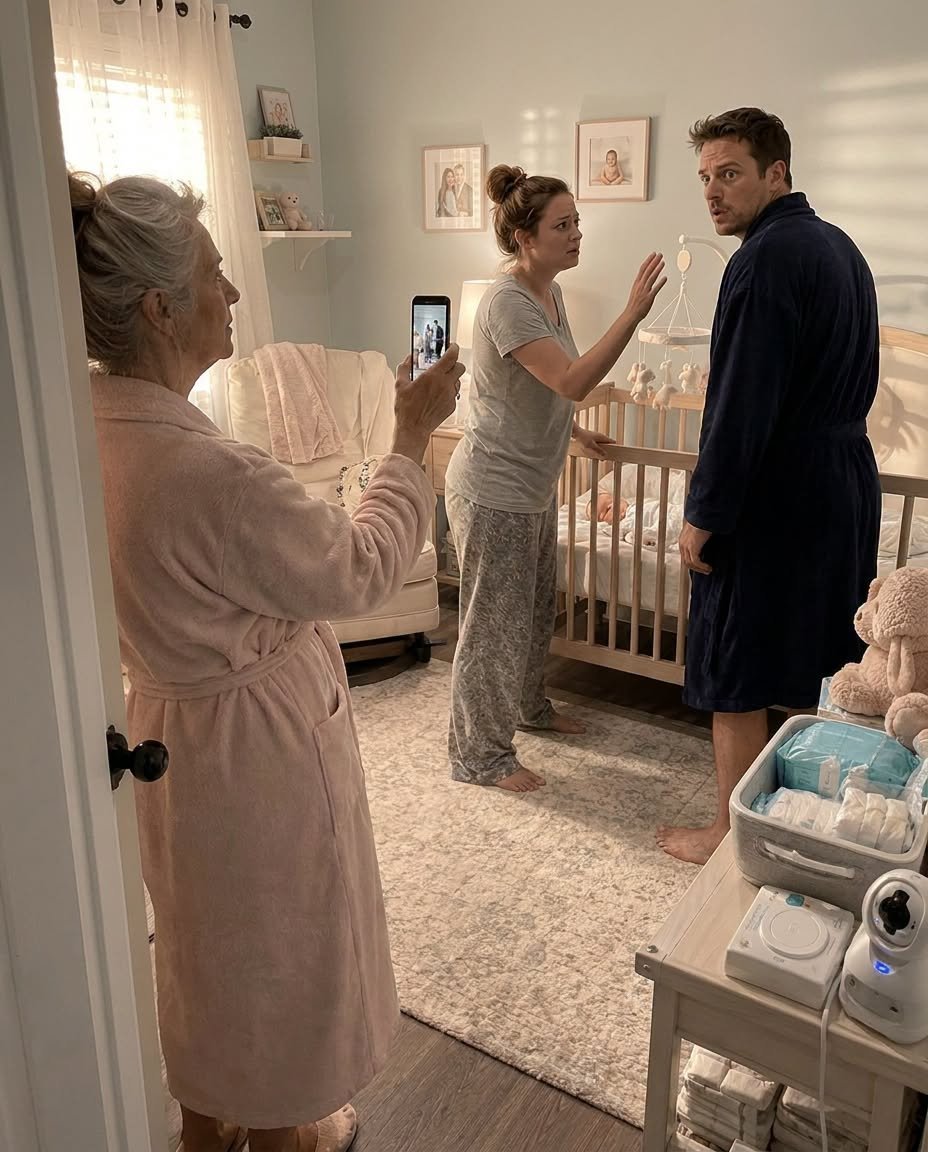
The baby’s cry woke me at 3 a.m., sharp enough to pull me from sleep before I even opened my eyes. I had been staying in my daughter Mia’s guest room for two months, helping with her little boy, Noah, but that night felt different. When I reached the nursery, I found Mia on her knees beside the rocking chair, begging to feed her hungry baby while her husband, Caleb, stood between her and the crib. His voice was calm, but cruel. “Let him cry,” he said. “Maybe next time you’ll remember not to ruin my dinner.” In that moment, I understood the truth I had been trying not to see.
I quietly recorded what was happening, because I knew people like Caleb could twist any story if there was no proof. The second he noticed me, his entire expression changed. He became polite, charming, and reasonable, the version of himself everyone else believed in. But I had already seen enough. Mia stayed silent, eyes lowered, while I lifted Noah from the crib and held him close. When Caleb told me to delete the video, I refused. He warned me that I was only a retired widow living in his guest room, but he had made one mistake: he assumed quiet meant powerless.
By morning, Caleb and his parents tried to turn everything around on me. They called me emotional, unstable, and intrusive. They even offered me money to leave and stay silent. What they did not know was that my late husband and I had built a private foundation, and I had spent years helping organizations that supported women in dangerous homes. I called my attorney, a family advocate, and a detective I trusted. Then I backed up the video and waited, because real accountability needs evidence, timing, and witnesses.
The next day, I gathered Caleb, Mia, and his parents in the living room. Caleb thought I was finally leaving. Instead, my attorney walked in, followed by police officers. We played the recording from the nursery, then another video from the hallway where Caleb threatened Mia and told her she would lose everything if she tried to leave. For the first time, his polished confidence disappeared. Mia stood up with Noah in her arms and finally said one word: “No.” That word broke the hold he had over her. Caleb was taken away, and his family’s influence could no longer protect him.
Mia filed for divorce soon after, and the court granted her emergency custody. Healing was not instant, but slowly, my daughter came back to herself. She moved into our lake house, started painting again, and learned that love should never feel like fear. Noah grew up surrounded by comfort instead of control, and our home became peaceful in a way Caleb’s never was. Looking back, the real victory was not the arrest or the ruined reputation. It was hearing Noah cry in the night and knowing that, from then on, every cry in our house would be answered with love.
Website Disclaimer
The information provided on this website is for general informational and educational purposes only. While we strive to ensure that all content is accurate and up to date, we make no guarantees regarding the completeness, reliability, or accuracy of any information published.
The views and opinions expressed in articles belong to their respective authors and do not necessarily reflect the views of this website. Any action you take based on the information found on this website is strictly at your own risk. We will not be liable for any losses, damages, or inconveniences arising from the use of our content.
Some articles may contain opinions, third-party information, or external links. We do not endorse or guarantee the accuracy of content on external websites and are not responsible for their practices or policies.
All content on this website is provided in good faith and is intended for informational purposes only. Readers are encouraged to verify information independently and seek professional advice where appropriate.

