The night Emily Walker showed up at Jake Harper’s door, he had a half-cold plate of beans on the kitchen table, mud drying on his jeans, and no idea that by morning his life would be legally tied to hers.
It was close to midnight. Rain came down hard enough to rattle the farmhouse windows, and the wind pushed against the old place as if it wanted in. Jake had only just come inside after checking on a calf that had been acting off all evening. His boots sat by the back door, leaving a dirty puddle on the floor he had not yet bothered to wipe up. He was too tired for company, too hungry to care about the mess, and too used to eating alone to expect anything from the night but silence.
Then someone started pounding on the front door.
Not knocking.
Pounding.
Jake froze with his fork still in his hand. Nobody came out to his place that late unless something had gone wrong. Around there, late-night visitors meant a loose cow, a truck in a ditch, a fire, or bad news delivered by someone too shaken to wait until morning.
He pushed back from the table and crossed the house.
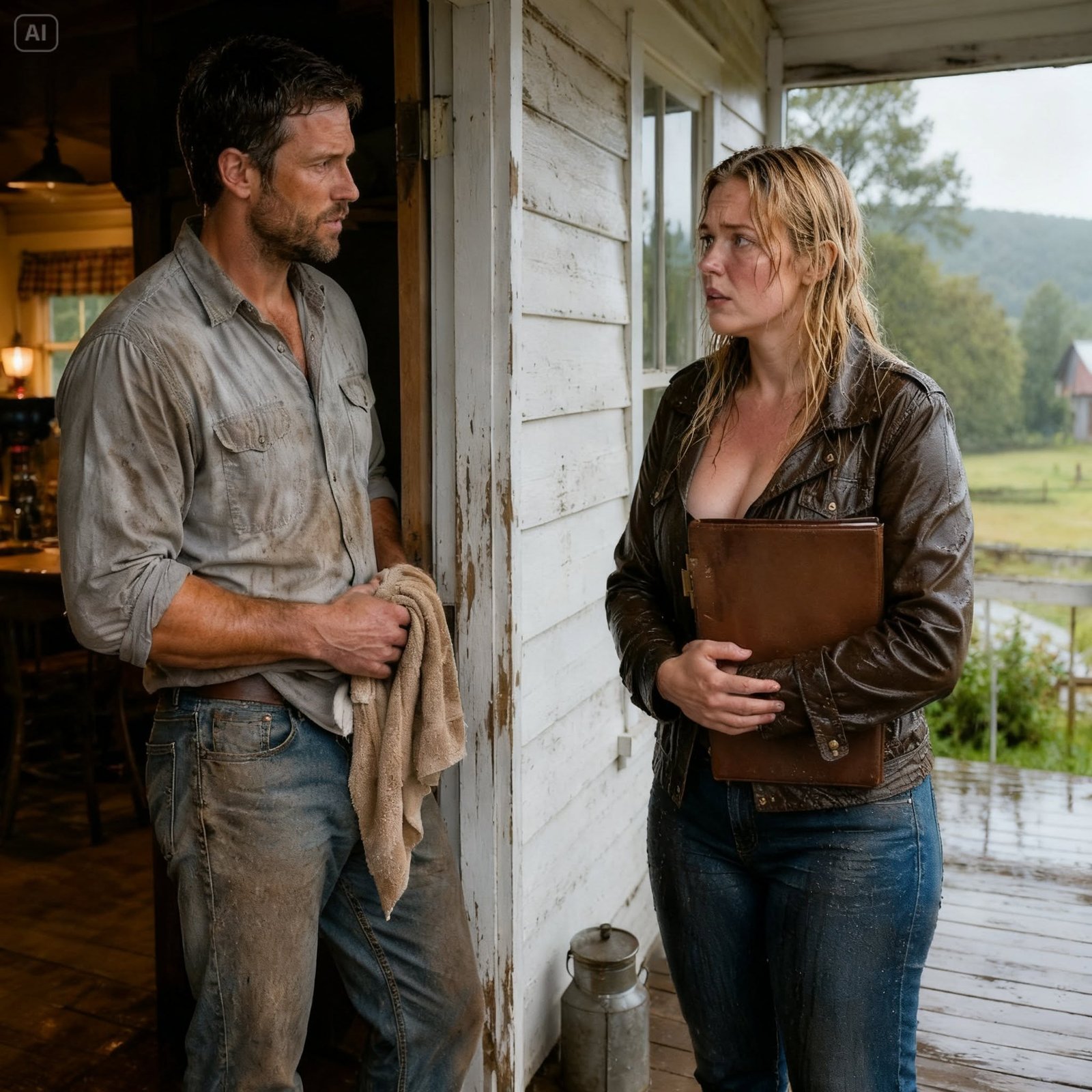
When he opened the door, Emily Walker stood on his porch.
For a second, he nearly failed to recognize her. Her hair was soaked flat against her cheeks, her jacket dripped rainwater onto the boards, and both hands clutched a brown folder as if it were the only thing keeping her upright.
“Jake,” she said, and her voice cracked on his name.
He looked past her into the dark yard and the rain beyond it.
“You drive here?”
She shook her head.
“I walked from the road. Grant took my keys.”
That woke him faster than coffee ever could.
“Come inside.”
Emily stepped over the threshold, and Jake shut the door against the storm. She stood in his front room shaking so hard the papers in her folder made a dry rattling sound. He grabbed a towel from the laundry chair and handed it to her.
“What happened?”
She pressed the towel to her wet hair but did not sit.
Emily had always carried herself that way when Jake saw her around her father’s place, like someone moving between worlds. Some weekends she looked like a college girl visiting home, neat clothes and clean hair and uncertainty tucked behind polite smiles. Other days, she wore work boots and tried to fit herself into the rhythm of the farm, though it was clear she had never quite decided where she belonged. Jake knew her, but not closely.
It was her father, David Walker, he had known.
David had helped Jake’s father patch fence when Jake was a kid. Later, after Jake’s parents were gone, David became the neighbor who checked in without making a show of it. He would stop by with an excuse about a wandering heifer or a borrowed tool, then linger long enough to make sure Jake was eating and the place had not fallen down around him.
Now David was gone too.
And his daughter looked as though the ground had opened beneath her.
“It’s the will,” Emily said.
Jake nodded toward the kitchen.
“Sit down first.”
“I can’t.”
“Emily.”
That did it. She looked at him as if she had briefly forgotten where she was, then walked into the kitchen and sat at the table. Jake put the kettle on because he did not know what else to do with his hands.
Emily opened the folder and spread papers across the table. The edges were damp. Legal pages. Signatures. A copy of something stamped by a county office. Jake did not pretend to understand all of it. He knew cattle records, feed invoices, loan notices, vet bills, and the kind of numbers that told a man whether he could make it another month. Lawyer words always seemed designed to make honest people feel stupid.
“My dad added a condition,” Emily said. “I didn’t know. Nobody told me until today.”
“What kind of condition?”
She swallowed and looked down.
“If I’m not married by the deadline, I don’t get full control of the farm. Grant does.”
Jake stared at her.
Behind him, the kettle began to whine softly, then louder.
“Married?” he said.
She nodded, embarrassed and angry at the same time.
“Dad thought it would protect me. I guess he thought if I had someone steady beside me, Grant couldn’t push me around. I don’t know. Maybe he wrote it when he was sick. Maybe he was scared. The lawyer says it’s valid.”
Jake turned off the burner.
“When’s the deadline?”
“Friday.”
It was Monday night.
He poured hot water into 2 mugs, though neither of them had asked for tea.
“And Grant?”
“He came back this morning.” Emily gave a short laugh without any humor in it. “New truck, clean shoes, talking like Dad’s farm was already cleared out. He has buyers coming this week, Jake. A development company. He said the land is worth more without cattle on it.”
That put a hard feeling in Jake’s chest.
He knew men like that. Men who looked at pasture and saw house lots, who looked at barns and saw scrap lumber, who spoke of practicality with smooth voices and clean hands. They always said the same things. Take the money. Move on. Be realistic. As though land was only land, not years of work buried into every posthole, ditch, gate, and fence line.
Emily pushed one paper toward him.
“Dad wrote your name in a note. Not in the will, but with it. He said if anything happened, you were the one neighbor who would understand.”
Jake did not touch the paper.
“What are you asking me?”
Emily looked at him then. Really looked. Her eyes were red, but she held his stare.
“I’m asking you to marry me.”
The kitchen went so quiet Jake could hear rain dripping from her jacket onto the chair.
He leaned back.
“Emily.”
“I know how it sounds.”
“I don’t think you do.”
“I do,” she said quickly. “I know it’s strange. I know it’s unfair. But I don’t have anyone else. Grant is already telling people I’m too emotional to run the farm. The workers don’t know who to listen to. The lawyer keeps saying the deadline like I can change it by worrying harder.”
Jake rubbed both hands over his face.
He was tired. Too tired for something that big. Too tired for a woman at his table asking him to put his name beside hers on a marriage license like they were signing papers for a used trailer.
“Are you trying to use me?” he asked.
Her mouth opened, then closed. For the first time since she had arrived, she went still.
“Yes,” she said softly. “But not like that. I’m asking for help. I won’t lie to you and say it’s anything else.”
That answer struck him harder than a polished one would have.
Jake looked around his kitchen. The same yellow walls his mother had painted years before. The same table where his father used to spread bills and pretend they were not as bad as they were. Since they passed, Jake had kept the farm going because stopping felt worse than working himself halfway into the ground. He knew what it meant to be left with land before you felt ready. He knew what it meant to have people waiting for you to fail.
Emily’s hands tightened around the mug he had set before her.
“I don’t want to lose this farm,” she said.
“I believe that.”
He heard it plain enough.
Still, he shook his head.
“Marriage means something, Emily.”
“I know.”
“No. I mean it. It’s not just a box to check.”
“I know,” she said again, and this time her voice was smaller. “But losing the farm means something too.”
That was the problem.
She was right.
Jake stood and walked to the back door. Through the glass, he could see nothing but rain and the weak reflection of his own kitchen. His place and Walker land shared a fence line that had been there longer than either of them. David Walker had run good cattle. Paid late sometimes, like everyone did, but he kept things decent. If Grant sold, that fence line would turn into survey flags and machines.
Jake turned back.
“If I say yes, there’s one rule.”
Emily sat straighter.
“No lies between us,” Jake said. “Not in this house. Not at this table. To the outside, we do what has to be done. But between you and me, we stay clean. You don’t pretend this is love, and I don’t pretend I’m some kind of hero. We both know what it is.”
She nodded quickly, then slower, as if she wanted him to see that she understood.
“Okay.”
“And if this gets ugly, you don’t hide things from me.”
“I won’t.”
He looked at her wet hair, the folder, the scared way she was trying not to look scared.
“All right,” he said. “We’ll go to the courthouse in the morning.”
Emily’s face changed, but not into relief exactly. It was more as if the weight had shifted and she almost fell beneath the new shape of it.
“Thank you,” she whispered.
Jake nodded once because he did not trust himself to say much.
The next morning, they drove into town in his old pickup with the heater blowing too hot and neither of them talking. Emily wore a blue dress under a brown coat, as if she had tried to make the day look normal and failed. Jake wore his cleanest shirt, which still had a stubborn grease mark near one cuff.
At the courthouse, the clerk looked from Emily to Jake and back again, curious but polite. They signed where she told them to sign. A judge with tired eyes said the words. Emily’s hand was cold when Jake held it. His probably felt rough and awkward.
There were no flowers. No family. No music. Only rainwater drying on Jake’s truck outside and 2 people standing under fluorescent lights, making a promise neither had expected to make.
When it was done, Emily looked at the paper as if it might vanish.
Jake looked at her.
“Now we keep your farm standing.”
She nodded, but her eyes were on him, not the paper.
That was the first moment Jake understood this was not going to stay simple.
Emily moved into his farmhouse that afternoon with 2 bags, 1 raincoat, and a cardboard box full of papers she did not trust Grant to leave alone. Jake gave her the spare room at the end of the hall. It had his mother’s old quilt folded on the bed and a dresser that stuck if anyone pulled the top drawer too hard.
Emily stood in the doorway with her bags still in her hands, looking as though she was waiting for him to say something normal.
He had nothing normal.
“Bathroom’s across the hall,” he said. “Closet door squeaks. I’ll oil it later.”
She nodded.
“Thank you.”
“You don’t have to thank me every time I point at furniture.”
That almost made her smile.
The first few days felt like they were both walking around a skittish horse.
They drank coffee at the same table but did not know where to look. Emily kept asking if she could use things in the kitchen—the mugs, the stove, the salt. Jake kept telling her she lived there now, then feeling strange every time he said it.
At night, she went to the spare room and shut the door softly. Jake went to his and lay awake longer than usual, listening to the old house make its small noises: pipes ticking, wind in the eaves, the faint shift of boards cooling in the dark. Once, he heard Emily step into the hallway, pause near the kitchen, then go back again.
He did not ask.
By the end of the week, the whole county knew.
That was how small towns worked. A man could buy fence staples at 8 in the morning, and by noon somebody’s aunt knew what brand he picked.
At the feed store, Marlene behind the counter looked at Emily’s ring, then at Jake. She did not say anything rude. She only raised one eyebrow.
“Well,” she said. “That happened quick.”
Emily went red.
Jake set a bag of mineral blocks on the counter.
“Need 2 more of those.”
Marlene looked at him as if that was not the answer she wanted, but she rang them up anyway.
“Congratulations, I suppose.”
“Thank you,” Emily said quietly.
Outside, while Jake loaded the truck, Emily stood beside the passenger door with her arms folded.
“Everybody thinks I’m ridiculous.”
“No,” Jake said. “Everybody’s curious. Different thing.”
“It feels the same.”
“It isn’t.”
She looked across the parking lot toward 2 men who had stopped talking when they came out.
“Do you regret it yet?”
Jake threw the last bag into the truck bed.
“It’s been 2 days.”
“That’s not an answer.”
“No,” he said. “I don’t regret it.”
She nodded, but she did not look fully convinced.
Grant came by the Walker farm the next morning.
Jake saw the truck before he saw Grant. A new black pickup, polished like it had never hauled anything heavier than golf clubs. Grant stood near the main barn in a dark coat and clean boots, talking to 2 hired men as if he already owned their ears.
Emily stiffened beside Jake.
“Keep walking,” he said.
She did, though he saw her fingers tighten around the clipboard she carried.
Grant turned when they came up. He had the kind of smile men used when they wanted everyone else to know they were not worried.
“Well,” he said. “Here they are. The happy couple.”
Emily lifted her chin.
“Why are you here?”
“This is still my father’s property. It’s my responsibility now.”
Grant laughed once.
“You got married overnight to a neighbor with more debt than sense, and now you think you’re ready to run a cattle operation?”
The 2 workers looked down.
That bothered Jake more than Grant’s words. They were good men, but they were waiting to see who had power.
Emily opened her mouth, then stopped.
Grant saw it and stepped closer.
“You’re making this harder than it needs to be. Take the money. Go build a life somewhere that doesn’t smell like wet hay.”
Jake moved half a step forward before he thought about it.
Emily noticed.
So did Grant.
Grant smiled at him.
“And you. Nice move, Harper. Marry the younger sister, and suddenly you’re standing on Walker land like you belong here.”
Jake’s hands curled once, then relaxed. He had learned long ago that anger did not fix a gate, pay a bill, or win an argument in front of witnesses.
“I’m standing beside my wife,” he said. “That’s all.”
Emily glanced at him when he said it.
Wife.
The word landed between them heavier than it had at the courthouse.
Grant rolled his eyes.
“Sure.” Then he turned back to the workers. “Nobody makes major changes until this mess is settled.”
Emily found her voice.
“That’s not your call.”
“Isn’t it?”
“No,” she said, a little shaky. “It isn’t.”
Grant looked amused, but Jake saw one of the workers, Ray, look at Emily differently. Not convinced yet, but listening.
After Grant left, Emily walked into the barn and gripped the edge of a stall door.
“I froze.”
“You answered.”
“Barely.”
“Barely counts the first time.”
She let out a breath and looked over at him.
“You could have shut him down.”
“I could have.”
“Why didn’t you?”
“Because then they’d all learn to look at me instead of you.”
She did not like that answer at first. Jake saw it in her face. But she did not argue.
That afternoon, he took her through the feed accounts in the small office off the milking room. She sat beside him chewing the end of a pen while he explained which supplier gave David more time when cash got tight and which one smiled while adding fees.
“This one,” Jake said, tapping an invoice, “you call before the due date. Don’t wait for them to call you. Makes you look in control.”
“I’m not in control.”
“Looking like it is half the job until you are.”
She wrote that down.
Jake laughed.
“What?”
“I didn’t mean literally.”
“I’m not wasting good advice.”
For the first time all week, the air between them loosened.
The real test came 2 days later with a broken stretch of fence along the west pasture. Three posts had leaned after the rain, and one wire was slack enough to invite trouble. Jake brought Emily because she needed to see how small problems turned expensive when ignored.
Ray was already there with tools.
When Emily told him she wanted the corner brace replaced, he looked straight past her at Jake.
“You want it done today?” Ray asked him.
Jake did not answer.
Ray waited.
Emily looked at Jake too, panic flashing across her face.
Jake bent and picked mud off his boot with a stick.
Finally, Emily cleared her throat.
“Ray, I said replace the brace today. If we patch it, we’ll be back here next week after the next rain.”
Ray shifted his weight.
“It’ll cost more.”
“I know,” she said. “Do it right.”
There was a long second where nobody moved.
Then Ray nodded.
“Yes, ma’am.”
Emily’s face brightened with embarrassment, but she held still until he walked away. Then she turned on Jake.
“You could have helped.”
“I did.”
“You stared at your boot.”
“Exactly.”
She looked angry for about 3 seconds.
Then the corner of her mouth moved.
“That was awful.”
“Yep.”
“I hated every second.”
“Yep.”
“But he listened.”
“He did.”
Later, when they got back to Jake’s house, Emily made dinner without asking where anything was. Eggs, toast, leftover potatoes fried in a skillet. Nothing fancy, but she set a plate in front of him as if she had done it a hundred times.
“You didn’t eat lunch,” she said.
“I was busy.”
“You always say that.”
“Usually true.”
She sat across from him, sleeves pushed up, hair tied back, a smudge of dirt near her jaw she had missed. She looked tired in a different way than she had the first night. Less lost. More used up from actually fighting.
After dinner, Jake found her at the kitchen table with bills spread into neat piles. She had labeled them with sticky notes: urgent, call, ask Jake.
The last pile made him shake his head.
“You don’t have to ask me everything.”
“I know,” she said, not looking up. “But I don’t know what I don’t know yet.”
He leaned against the counter.
“That’s fair.”
She glanced toward the hall.
“This is strange, isn’t it?”
“What part?”
She gave him a look.
Jake nodded.
“All of it.”
“I keep thinking I’ll wake up back at Dad’s house, and Grant won’t be there, and I won’t have a husband sleeping down the hall.”
“Technically, you have a husband trying to sleep down the hall. Big difference.”
That got a real smile from her.
Jake looked away first and rinsed his plate because something in his chest had shifted, and he was not ready to name it.
They still had separate rooms. They still had rules. On paper, the marriage had a purpose and a deadline.
But by the end of that week, Emily knew how Jake took his coffee, and Jake knew she tapped her pen twice against the table when she was scared to make a call.
That did not feel like paperwork.
It felt like the beginning of something neither of them had planned.
Part 2
Grant waited almost a week before making his next move, which told Jake he had been thinking.
That worried him more than shouting would have.
Jake was behind his barn fixing a cracked water line when Emily came across the yard fast, phone in one hand, hat in the other. She did not slow down when she reached the gate.
“He’s at the farm,” she said.
Jake shut off the valve.
“Grant?”
“With 2 men I don’t know. Ray called me. He said they’re walking the south pasture.”
Jake wiped his hands on a rag.
“Buyers.”
“That’s what it sounds like.”
Her face was tight, but beneath that he saw the fear from the night she had come to his door. Not as wild now, not as raw, but still there.
He grabbed his keys.
“Let’s go.”
Emily climbed into the truck before he did.
All the way over, she stared through the windshield, breathing as if she were trying to keep herself from saying too much. When they pulled into the Walker yard, Grant stood near the cattle pens with 2 men in clean jackets. One wore shiny shoes. That was the first thing Jake noticed. Shiny shoes in a yard still soft from last night’s rain.
Grant turned and smiled when he saw them.
“Emily,” he called. “Good. Saves me a phone call.”
She got out of the truck and slammed the door harder than she meant to.
“What are you doing?”
“Showing interested parties the property.”
“It’s not for sale.”
One of the men shifted uncomfortably. The other looked at Grant as if waiting for him to smooth it over.
Grant walked toward them slowly.
“It will be once the estate stops entertaining this little courthouse performance.”
Emily’s fingers curled around the edge of her coat. Jake stepped beside her, but not ahead of her.
Everybody looked at him anyway.
Grant. The buyers. Ray by the barn.
Even Emily, for half a second.
Jake kept his voice low.
“It’s your land. Say it.”
Her eyes stayed on his, wide and scared. Then she turned back.
“This farm is not for sale.”
Grant laughed like she had made a joke at dinner.
“You hear that? She’s been married 5 minutes and already thinks she’s an owner.”
“I am the owner,” Emily said.
Her voice shook, but she kept going.
“And you don’t get to bring strangers through my pastures without asking me.”
Grant’s smile thinned.
“Your confidence is fake. Your marriage is fake. And when Jake gets tired of playing hero, you’ll be standing here alone with bills you can’t pay and men you can’t manage.”
The words landed exactly where Grant wanted them to. Jake saw Emily take the hit. Her shoulders dropped just a little.
He wanted to answer. He wanted to tell Grant exactly what kind of man he was, standing in clean boots talking about land he had not worked in years.
But Emily lifted her chin before Jake could speak.
“Then I guess you’d better leave before you waste any more of their time.”
The yard went quiet.
One buyer cleared his throat.
“Grant, maybe we should—”
Grant threw him a look, then turned back to Emily.
“You’ll regret this.”
“Maybe,” she said. “But I’ll regret selling it more.”
That was the first time Jake saw Ray smile at her.
Grant left angry, tires throwing mud near the cattle guard. The buyers followed him, slower and less certain. Emily stood still until their trucks disappeared down the road. Then she walked straight into the barn.
Jake found her in the tack room with one hand pressed against the wall.
“I thought I was going to be sick,” she said.
“But you weren’t.”
“That’s your comfort?”
“It’s the truth.”
She let out a weak laugh and covered her face with both hands.
“He’s right about some of it.”
“No, he isn’t.”
“I don’t know how to run all this, Jake.”
“You don’t know how to run all of it today.”
She lowered her hands.
He leaned against the doorframe.
“That’s different. Tomorrow, you learn another piece. Then another. That’s how everybody does it.”
“You make it sound simple.”
“It isn’t simple. It’s just possible.”
Emily looked at him for a long second, and something in her face softened. Not relief exactly. More like she had been waiting for someone to say she did not have to become her father overnight.
That night, she stayed up late at Jake’s kitchen table with a stack of repair estimates. He came in from checking the north pasture and found a plate covered with foil near the stove.
“You made dinner?” he asked.
“Barely. Don’t get impressed.”
He lifted the foil.
“Too late.”
She rolled her eyes, but he saw the smile she tried to hide.
Things changed after that, not loudly.
Emily stopped asking Jake before every phone call. She started calling suppliers herself. She messed up once and agreed to a delivery date that would not work, then called back and fixed it without telling Jake until later. She got sunburned across her nose. She tore the sleeve of her jacket on a nail and kept working.
One morning, Ray asked her a question before he asked Jake.
She acted calm about it then, but in the truck afterward she whispered, “Did you hear that?”
“I heard.”
“He asked me.”
“He did.”
She looked out the window, smiling at the fields as if she was trying not to make too much of it.
Then the gate got left open.
It happened on a windy evening, the kind where everything rattled and no sound seemed to come from the right direction. A latch on the lower road pasture had been damaged. Maybe it was an accident. Maybe someone had been careless. Jake did not know, and he did not say what he suspected because suspicion did not get cattle out of the road.
Ray called first.
Emily and Jake were loading feed buckets at his place when her phone rang. She answered, listened, and went pale.
“Cattle are out by Miller Road.”
Jake was already moving.
By the time they got there, half a dozen head had pushed through the opening and scattered along the ditch. One stood too close to the road, while a delivery van idled nearby with its hazards blinking. Rain had started again, cold and mean.
Emily jumped out before Jake could tell her what to do.
“Stay wide,” he called. “Don’t run straight at them.”
“I know,” she snapped.
Then she slipped in the mud and caught herself on one hand. She got up covered to the wrist, angry enough to keep going.
For the next 2 hours, they worked with Ray and 2 neighbors to push the cattle back through the gate. Emily was everywhere at once, muddy, soaked, hair stuck to her neck, yelling when she had to and listening when she needed to. Once, a steer turned hard toward her, and Jake’s heart kicked against his ribs, but she held her ground just long enough for him to swing around and move it back.
When the last animal was inside and the temporary chain was set, Emily bent over with both hands on her knees.
“You all right?” Jake asked.
“No,” she said, breathing hard. “But they’re in.”
Ray came over, rain dripping from his hat.
“You did good, Emily.”
She straightened as if those 4 words weighed more than any speech Grant had ever made.
On the drive home, she was quiet. Mud covered her jeans. Her hands were scratched. She looked exhausted but not defeated.
Back at the farmhouse, Jake put clean towels by the bathroom and made coffee even though it was too late for it. Emily came into the kitchen wearing one of his old sweatshirts because her clothes were ruined, the sleeves falling over her hands.
“I look ridiculous,” she said.
“You look like you worked.”
She sat at the table.
“Do you still see me like that first night?”
Jake looked at her.
The scared woman with the wet folder was still part of her, yes. But now there was more. The woman who stood up to Grant. The woman who got back up in the mud. The woman who stayed when quitting would have been easier.
“No,” he said. “I don’t.”
Her eyes held his.
The old house was quiet around them. No rain pounding now, only the steady dripping from the roof.
Emily stood first.
Jake stood too.
Neither said anything smart or careful.
When she stepped closer, he did not move away.
What happened between them that night did not feel like part of the arrangement. It did not feel like a story they were putting on for Grant, or the town, or some lawyer reading papers in an office. It was quiet, honest, and theirs.
In the morning, Emily was still beside him, her hand resting against his chest as if it belonged there.
For the first time since Jake had signed the paper at the courthouse, he was afraid of what would happen once the farm was safe.
Because by then, he knew it was not only the farm he wanted to keep.
The final meeting happened on a Thursday morning.
Grant arrived like a man who had practiced his winning face in the mirror.
Jake saw him through the office window before he came inside. Dark coat. Pressed pants. Polished shoes again. He parked beside Jake’s truck and looked at it with the same expression he used for bad weather, old barns, and people who worked with their hands.
Emily stood beside Jake in the hall, holding a folder twice as thick as the one she had carried to his house that first night.
“You ready?” he asked.
“No,” she said.
He looked at her.
She took a breath and straightened her shoulders.
“But I’m walking in anyway.”
That was enough.
The estate lawyer’s office sat above the bank, reached by narrow stairs and carpet that smelled of dust. Grant was already seated when they entered, one ankle resting on his knee as if he owned the chair, the office, and every acre being discussed.
He glanced at Emily’s folder, then at Jake.
“Brought your farmhand guard.”
Emily sat before Jake could answer.
“I brought my husband.”
Grant smiled.
“That word is doing a lot of work lately.”
The lawyer, Mr. Callahan, cleared his throat. He was an older man with wire glasses and a careful way of moving papers around. He had known David Walker for years, which made him harder for Grant to push than most people.
“We’re here to review compliance with the condition in Mr. Walker’s estate documents,” he said, “and to address concerns regarding operational control.”
Grant leaned forward.
“Good. Then let’s address the obvious. This marriage is a stunt. She panicked, grabbed the nearest broke neighbor, and now we’re all pretending this is normal.”
Emily’s hand tightened around the folder.
Jake wanted to reach for her hand under the table, but he did not.
Not yet.
Grant continued.
“She is 24. She has no serious management experience. She does not understand the financial burden, the maintenance, the liability, or the long-term value of the property. Selling is the responsible choice.”
Mr. Callahan looked at Emily.
“Would you like to respond?”
The room went still.
A month earlier, Emily might have looked at Jake first.
She did not this time.
She opened her folder.
“Yes,” she said. “I would.”
She laid out paid invoices first: feed, vet, fuel, 2 equipment repairs, 3 fencing orders. Then supplier agreements she had renegotiated herself. Worker schedules with names, hours, and duties. A repair plan for the south barn roof. A note from Ray and the other men confirming that they accepted her as the person in charge of daily decisions.
Grant laughed under his breath.
“You got the hired hands to sign a paper. Congratulations.”
Emily did not look at him.
“I also brought statements from Marlene at the feed store, Mr. Ortiz from the repair shop, and 2 neighboring farms confirming ongoing operations and support.”
Jake saw Mr. Callahan’s eyebrows lift slightly.
Emily kept her voice steady.
“I’m not saying I know everything. I am saying the farm is operating. Bills are being handled. Repairs are scheduled. The cattle are accounted for. The workers know who makes decisions, and the property is not for sale.”
Grant’s face changed just a little. His confidence remained, but it tightened around the edges.
“You rehearsed that well.”
Emily finally turned to him.
“Don’t interrupt me again.”
The words were not loud.
That made them better.
Grant blinked once.
Jake looked down at the table because he nearly smiled, and it was not the time.
Mr. Callahan reviewed the papers slowly. Grant grew more irritated with every page. He shifted in his chair, checked his watch, then stopped pretending to be patient.
“This is insane,” he said. “Dad never meant for her to trap the land in some fantasy. He knew she needed guidance. That’s why he wrote the condition.”
“No,” Emily said. “He knew you’d sell the second you could.”
Grant pointed at Jake.
“And what about him? You think he’s here out of kindness? Jake Harper has been one bad season away from losing his own place for years. You expect me to believe he married you out of loyalty?”
Emily looked at Jake then.
So did the lawyer.
Jake sat forward.
“I don’t need Emily’s farm. I’ve already got one I can barely keep standing.”
Grant smirked.
“That’s my point.”
“No,” Jake said. “Your point is that everything has a price. Mine doesn’t.”
The room went quiet.
Jake looked at Mr. Callahan, then at Emily.
“I married her because David Walker was right about one thing. She needed someone beside her while she learned how to stand here without everybody pushing her over.”
Emily’s eyes softened, but Jake kept going because Grant needed to hear the rest.
“But she’s standing now. You can dress it up however you want, Grant. Responsible choice, land value, future planning. You don’t want the farm because it’s a burden to you. She wants it because it was home before it was worth money.”
Grant’s jaw worked, but no words came right away.
Mr. Callahan stacked the papers neatly and removed his glasses.
“The marriage license satisfies the stated condition,” he said. “And based on the provided records, Mrs. Harper has demonstrated active operational control. The estate will proceed with Emily Harper retaining control of the Walker farm.”
For a second, nobody moved.
Emily closed her eyes just once.
Then she opened them and nodded as if accepting work, not a prize.
Grant stood so fast his chair scraped the floor.
“You’ll regret this. Both of you.”
Emily looked up at him.
“Maybe. But it’ll be my regret.”
He stared at her, waiting for her to shrink.
She did not.
Then he grabbed his coat and walked out.
Through the window, Jake watched him cross the lot, clean shoes stepping around puddles as if the ground itself offended him. He got into his truck and left without looking back.
Emily did not chase him.
She did not cry.
She sat with her hands flat on the folder, breathing slowly.
Part 3
Outside, the air felt different.
Cold, but open.
Jake and Emily walked down the narrow stairs from Mr. Callahan’s office and stepped out beside the trucks. The town moved around them as if nothing had happened. A delivery man carried boxes into the pharmacy. A woman crossed the street with a paper bag of groceries tucked against her side. Somewhere down the block, a dog barked, and a passing car hissed through water left from the morning rain.
Emily stood by Jake’s passenger door and looked at the ring on her hand.
“The farm’s safe,” she said.
“Looks that way.”
She nodded, still looking down.
“So you don’t have to do this anymore.”
Jake knew what she meant, but he waited.
Emily lifted her eyes to his.
“You helped me more than I had any right to ask. But the promise was made under pressure. If you want out, I won’t hold you to it.”
For a moment, all Jake heard was traffic on the wet street and the low hum of the bank sign above them.
A month earlier, he would have known what to say. He would have said they had made a deal and the deal was done. He would have gone back to his house, his quiet kitchen, his cold dinners, his fences, his bills, and his life exactly as it had been before Emily Walker came pounding on his door in the rain.
But now he thought of Emily at his table with sticky notes spread over the bills.
Emily in his old sweatshirt after the cattle got loose.
Emily telling Grant not to interrupt her.
Emily learning the weight of the land and choosing to carry it anyway.
“I didn’t stay because of the paper,” he said.
Her mouth parted slightly.
“And I’m not leaving because the paper did its job.”
She looked at him like she wanted to believe him but was afraid to reach too quickly.
So Jake made it plain.
“I thought I was helping you save your home,” he said. “I didn’t realize I was finding mine.”
Emily’s eyes filled, but she smiled at the same time.
Then she reached for his hand.
They drove back without saying much. They did not need to. The silence between them had changed. It was no longer the careful, awkward quiet of 2 strangers trying not to bump into the arrangement between them. It was fuller now, steadier, the kind of quiet that did not need to explain itself.
When they reached the fence line between Jake’s place and hers, the evening sun had broken through the clouds and laid gold across the wet pasture. The 2 farms sat side by side, worn and imperfect and still standing. Old posts leaned in places. The barns needed repairs. The road held puddles deep enough to reflect the sky. Nothing about it was easy, and nothing about it promised to become easy.
But Emily stepped up beside him, not behind him.
Her hand stayed in his.
For the first time in years, when Jake looked across that land, he did not feel alone.
The days after the meeting did not unfold like a fairy tale.
Grant did not apologize. He did not come back humbled, did not admit that Emily had earned her place, did not confess that their father’s land meant more than money. He sent one letter through a lawyer, sharp-edged and useless, hinting that he still believed the marriage could be challenged. Mr. Callahan dismissed it with the dry irritation of a man tired of reading nonsense in expensive language.
Emily read the letter once at the kitchen table, then folded it carefully and placed it in a file.
Jake watched her.
“You all right?”
She tapped the folder twice with one finger, then smiled when she realized he had noticed.
“I’m angry,” she said. “But I’m all right.”
“That’s allowed.”
“Good. Because I think I’ll be angry for a while.”
“Plenty of work for angry people around here.”
That made her laugh, and he realized he liked that sound more than he knew what to do with.
Work did not pause simply because the legal fight had ended. Cattle still needed feed. Fences still sagged. The south barn roof still leaked in 3 places, and 1 of the tractors refused to start unless spoken to with patience and profanity in equal measure. Emily kept learning. Sometimes she learned by asking. Sometimes by doing. Sometimes by doing wrong and fixing it before anyone could tell her she had failed.
The men adjusted to her, each in his own time. Ray was the first to change fully, not in words but in habits. He began waiting for Emily’s answer when questions came up. He brought problems to her before they became disasters. When a supplier tried to charge extra for a delivery that had arrived late, Ray told Emily, not Jake.
“She’ll handle it,” he said.
Emily did handle it.
Jake listened from the doorway as she called the supplier, voice polite but firm, and explained the invoice would be paid when corrected. No shouting. No pleading. No apology for taking up space. When she hung up, she looked at Jake, eyes bright.
“Too much?”
“No.”
“Not enough?”
“Just right.”
She breathed out and leaned back in the chair.
“I hate that I still need to ask.”
“You won’t always.”
“I know.” She touched the stack of invoices. “But for now, I do.”
“For now is fine.”
At night, they still returned to Jake’s farmhouse. The spare room remained made up, though Emily used it less and less. At first, neither mentioned that. The shift happened gradually, in the quiet way real things often did. A forgotten sweater in Jake’s room. Her book on his nightstand. His extra blanket folded over her knees when she stayed up late with records.
One evening, Emily stopped in the hallway outside the spare room and looked at the closed door.
“I should move the rest of my things,” she said.
Jake stood behind her with 2 mugs of coffee.
“To my room?”
She glanced back at him.
“Our room, I think.”
Something in his chest tightened.
“All right.”
She smiled faintly.
“That’s all you’re going to say?”
“I’m trying not to say something foolish.”
“Since when?”
“Since I married a woman who notices everything.”
Emily took one of the mugs from him.
“Smart man.”
He was not always smart. He knew that. He had spent years surviving by keeping his world small enough to manage: his farm, his bills, his chores, his grief. After his parents died, he had folded into the land because the land made sense. It needed work. Work had answers. If a fence broke, you fixed it. If an animal was sick, you called the vet. If a bill came due, you found the money or made the phone call and took the shame like weather.
People were harder.
Emily was harder.
Not because she demanded much, but because she made the quiet parts of his life visible. She noticed when he skipped lunch. She noticed when his shoulder hurt after hauling feed. She noticed the empty places in the house he had stopped seeing because he had lived with them too long.
One Sunday, she found a box of his mother’s old recipes in the pantry and asked if he minded her looking through them.
Jake said he did not.
Then he went outside and fixed a gate that did not need fixing because hearing Emily turn those cards over in the kitchen made something ache in him. When he came back in, she had flour on her sleeve and an apology ready on her face.
“I shouldn’t have—”
“It’s fine.”
“It didn’t feel fine when you left.”
Jake stood by the door, hat in his hands.
“My mother used to make biscuits from that box,” he said. “Every Sunday, whether we needed them or not. After she died, I put it away.”
Emily looked down at the recipe card in her hand.
“I can put it back.”
“No.” He swallowed. “Maybe they should be made again.”
So they tried.
The first batch came out flat and pale and hard enough that Jake tapped one against the counter and said they might be useful if the cattle got loose again and needed discouraging.
Emily laughed until she had to sit down.
The second batch was better.
By the fourth Sunday, the kitchen smelled like Jake’s childhood without feeling haunted by it.
Spring edged closer. Mud thickened. Calves dropped. The days grew longer, and the workload expanded with the light. Emily spent mornings at Walker farm, afternoons split between accounts and fieldwork, and evenings at Jake’s table with ledgers, coffee, and a determination that sometimes outlasted his own.
One night, after a brutal day pulling a stuck calf and repairing another section of fence, Jake found her asleep at the kitchen table with her cheek pressed against an open notebook. The pen was still in her hand. Numbers marched down the page in tidy columns.
He stood there a moment, looking at her.
The first night she had come to him, she had been soaked, frightened, and desperate, clutching papers like a drowning person clutches driftwood. Now she slept in his kitchen with mud on her boots and a farm’s worth of decisions waiting for her in the morning.
He eased the pen from her hand.
She stirred.
“Did I fall asleep?”
“No.”
She opened one eye.
“Liar.”
“Terrible habit.”
He helped her up, and she leaned against him without thinking. That trust, small and ordinary as it looked, undid him more than anything dramatic could have. He had been trusted before in the way people trusted a useful man—with broken equipment, borrowed tools, a late-night call about an animal down in a field. But Emily trusted him with her fear and her fatigue and her half-finished becoming.
That felt different.
That felt like a vow deeper than the one they had spoken under courthouse lights.
In April, Grant returned one last time.
He did not come to Walker farm. He came to Jake’s.
Jake found him parked by the gate, leaning against the black pickup. The truck was less polished now, streaked with road dust. Grant still wore good shoes.
Emily was at the Walker place that morning, meeting with Mr. Ortiz about equipment repairs. Jake considered calling her, then decided not to. Not because he meant to hide anything, but because Grant had come there for him.
Jake walked to the gate.
“You lost?”
Grant smiled without warmth.
“Thought I’d see how the proud husband was enjoying married life.”
Jake rested one hand on the fence post.
“Busy. You?”
Grant’s jaw tightened.
“You think you won something.”
“No.”
“You did. You got the farm, the girl, the saintly neighbor act. Must feel good.”
Jake looked past him at the road.
“I didn’t get the farm. Emily kept it.”
Grant laughed.
“Is that what you tell yourself?”
“That’s what happened.”
Grant pushed away from the truck.
“She’ll get tired. People always do. That place eats money. It ate Dad alive. It’ll eat her too.”
“Maybe.”
Grant looked surprised by the answer.
Jake continued, “But if it does, she’ll decide what to do. Not you. Not me.”
“And you’ll just stand there?”
“I’ll stand beside her.”
Grant studied him for a long moment, searching for something to cut. Jake gave him nothing.
At last, Grant opened the truck door.
“You’re a fool, Harper.”
“Been called worse.”
Grant got in and drove away.
Jake watched until the truck disappeared, then went back to work.
He told Emily that night because of the rule: no lies between them.
She listened quietly, then nodded.
“Thank you for telling me.”
“He wanted me to think this was still between him and me.”
“It isn’t.”
“No,” Jake said. “It isn’t.”
She set down her fork and reached across the table.
“I used to think standing up to him meant not being afraid. But I’m still afraid sometimes.”
“Everybody’s afraid sometimes.”
“You don’t look it.”
“I’ve had more practice looking useful than honest.”
Emily smiled softly.
“That sounds lonely.”
“It was.”
The word came out before he had time to make it smaller.
Emily’s hand tightened around his.
“Was?” she asked.
Jake looked at her across the table, at the woman who had entered his life as an emergency and stayed as something far more dangerous and necessary.
“Was,” he said.
By early summer, the 2 farms had found a rhythm between them. Jake still had his own land to manage, but the fence line between his place and Emily’s no longer felt like a boundary. It felt like a seam. They shared equipment when it made sense. Shared labor when storms knocked down limbs or cattle pushed too hard against weak wire. Shared meals most nights, sometimes at his farmhouse, sometimes in the kitchen of the Walker place, where Emily had slowly begun opening cupboards and drawers that still smelled faintly of her father’s habits.
One evening, she found David’s old hat hanging behind the mudroom door.
She stood with it in her hands for a long time.
Jake stayed quiet.
“I was angry at him,” she said finally.
“For the condition?”
“For thinking I needed a husband to protect me.” She ran her thumb along the worn brim. “For not trusting me outright.”
Jake leaned against the wall.
“Maybe he was wrong.”
“He was.”
Jake nodded.
“And maybe he was scared.”
Her eyes filled, though she did not cry.
“I know.”
She hung the hat back on its peg.
“I wish he could see it now.”
Jake looked through the window at the pasture beyond the house, where cattle moved slowly through the dusk.
“I think he knew more than he wrote down.”
Emily turned.
“What do you mean?”
“I think he knew Grant would push. I think he knew you’d need time. Maybe the condition was a clumsy way of buying you that time.”
“With you?”
“Maybe with whoever stood beside you.” Jake paused. “I’m glad it was me.”
Emily crossed the room and kissed him, gently at first, then with the quiet certainty of a woman who had stopped apologizing for wanting what she wanted.
Later that summer, the county fair came around. Emily entered 2 calves under the Walker name and nearly backed out twice before Jake talked her into staying. Ray pretended not to watch her too closely. Marlene from the feed store came by the pen with lemonade and said, “Your dad would’ve liked seeing this.”
Emily had to turn away for a moment.
Jake stood beside her until she could turn back.
They did not win first place. They took third. Emily carried the ribbon home like it mattered, because it did.
That night, she pinned it to the corkboard in Jake’s kitchen beside feed schedules and a list of repairs.
“Our first ribbon,” she said.
“Third-place ribbon.”
“Our third-place ribbon.”
Jake looked at it, then at her.
“Our,” he said.
She heard the weight he put into the word. Her smile softened.
“Our,” she repeated.
Months later, when people in town told the story, they told it wrong in all the ways people tended to. Some said Emily Walker had trapped Jake Harper into marriage to save her inheritance. Some said Jake had seen a chance at land and taken it. Some said David Walker’s will had been romantic. Others called it foolish. Grant, when anyone still asked him, called the whole thing temporary.
But people who worked the farms knew better.
They saw Emily in the fields before dawn. They saw Jake walking beside her, not ahead. They saw Ray bring questions to her and wait for the answer. They saw the barns repaired, the accounts steadied, the cattle kept, the pastures worked. They saw 2 worn places, side by side, refusing to fall.
One late evening, after the heat had broken and the sky had turned the color of embers, Jake and Emily walked the fence line between the 2 properties. The same fence line that had once divided Walker land from Harper land now looked different in the low sun. Not erased. Not meaningless. Just no longer lonely.
Emily stopped at the place where a corner post leaned slightly.
“This one needs replacing before winter,” she said.
Jake examined it.
“Yep.”
“You were going to tell me that?”
“Eventually.”
She gave him a look.
“I was waiting to see if you noticed.”
“I noticed.”
“Then you’re learning.”
She laughed, and the sound carried across the pasture.
They stood together as cattle moved in the distance, dark shapes against gold grass. The air smelled of earth, hay, and cooling rain. Jake took Emily’s hand, the same hand that had been cold at the courthouse, the same hand that had gripped a folder on a stormy night, the same hand that now held calluses of its own.
“You ever think about that first night?” she asked.
“Often.”
“What do you remember most?”
Jake considered saying the rain. Or the pounding on the door. Or the look on her face when she asked him to marry her.
Instead, he told the truth.
“I remember you didn’t lie. I asked if you were using me, and you said yes. But not like that.”
Emily looked down.
“I hated saying it.”
“It’s why I believed you.”
She leaned her shoulder against his.
“I was so scared.”
“I know.”
“I thought saving the farm would be the end of it.”
Jake looked across the fields.
“So did I.”
“But it wasn’t.”
“No.”
She turned her face toward him.
“What was it?”
Jake squeezed her hand.
“The beginning.”
The sun dropped lower, spilling gold across both farms until the worn roofs, patched fences, muddy tracks, and open pasture all seemed touched by the same light. Nothing had been made perfect. Nothing had been made easy. The work remained. The debts remained. The weather would turn. Cattle would get sick. Fences would fail. People would talk.
But Emily stood beside him, not behind him.
And Jake, who had spent years keeping his land standing because stopping felt worse than being tired, finally understood that home was not only a place a person inherited or saved.
Sometimes home arrived soaked from the rain, carrying a folder full of trouble, asking for an impossible favor.
Sometimes home began as a bargain made under pressure.
Sometimes, if 2 people were honest enough and stubborn enough, it became something neither of them had dared to ask for.
When Jake looked across the joined horizon of Harper and Walker land, he no longer saw only work waiting for him.
He saw a future.
And this time, he was not standing in it alone.
Website Disclaimer
The information provided on this website is for general informational and educational purposes only. While we strive to ensure that all content is accurate and up to date, we make no guarantees regarding the completeness, reliability, or accuracy of any information published.
The views and opinions expressed in articles belong to their respective authors and do not necessarily reflect the views of this website. Any action you take based on the information found on this website is strictly at your own risk. We will not be liable for any losses, damages, or inconveniences arising from the use of our content.
Some articles may contain opinions, third-party information, or external links. We do not endorse or guarantee the accuracy of content on external websites and are not responsible for their practices or policies.
All content on this website is provided in good faith and is intended for informational purposes only. Readers are encouraged to verify information independently and seek professional advice where appropriate.