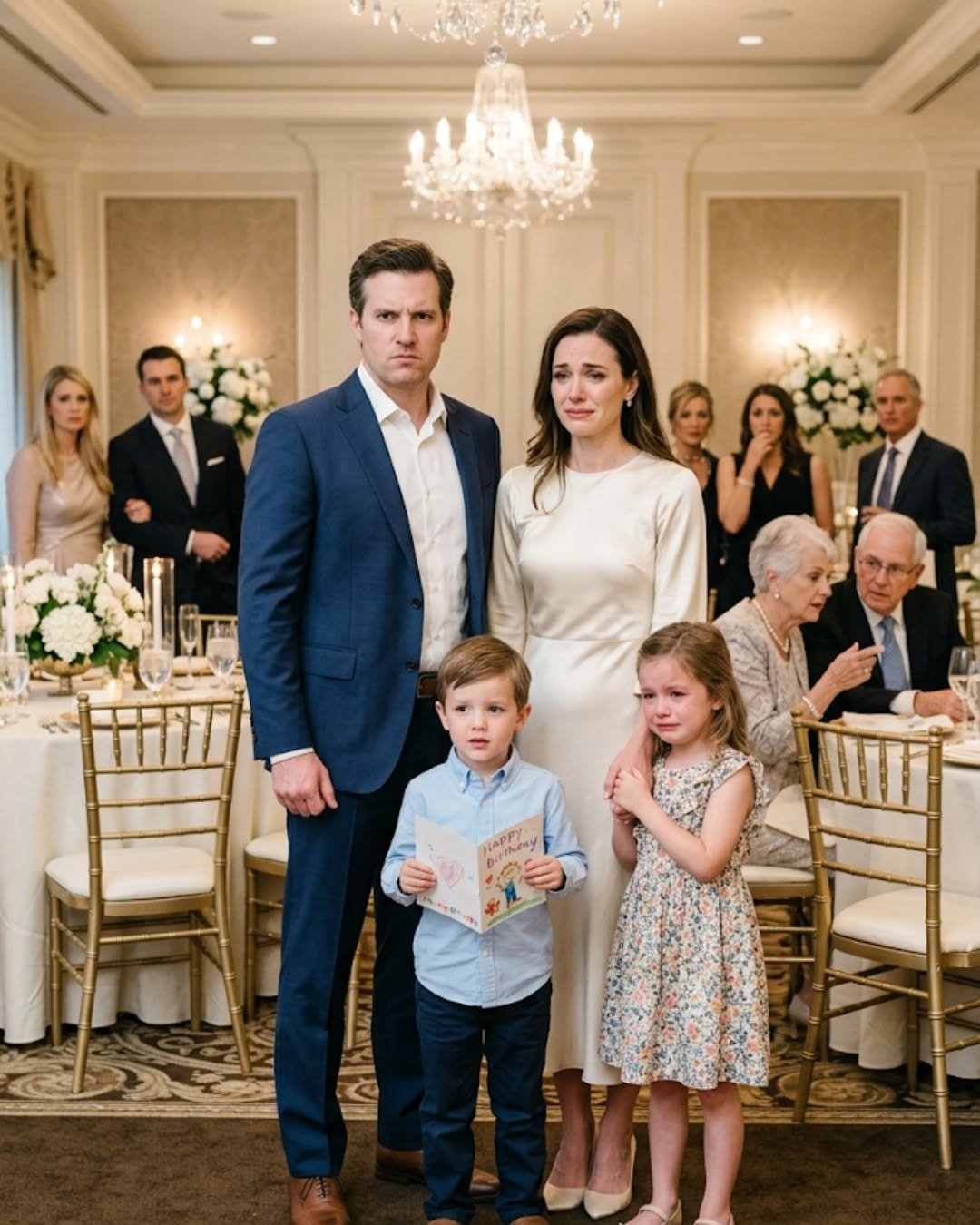
“Your kids can sit over there by the wall,” my father said, pointing toward a bare corner of the banquet room as if he were deciding where to place extra chairs instead of talking about his own grandchildren.
My daughter, Lily, tightened her small fingers around mine. She was seven, old enough to understand tone, but still young enough to look up at me with the kind of confused trust that can make a grown man feel smaller than a child.
Beside her, my son Owen stood quietly in his little blue button-down shirt, holding a homemade birthday card he had spent the entire afternoon making for his grandmother.
The frosting on the cake he had drawn leaned sideways, the balloons were different sizes, and across the top he had written, in crooked purple marker, “Happy Birthday, Nana.”
At the main table, my sister Brooke’s children were already seated in decorated chairs with white ribbons tied around the backs. Their place cards were written in gold ink.
Small gift boxes waited beside their plates. They had sparkling cider in tall glasses and little favor bags with their names on them.
My mother did not even glance at Lily or Owen when she added, “It’s good for children to learn that not every special thing is meant for them.”
She said it calmly. That was what made it land so hard. There was no heat in her voice, no raised hand, no dramatic scene. Just a quiet little sentence, delivered like a lesson.
My name is Nathan Mercer. I am forty years old, and for most of my adult life, I believed supporting my family was a form of love.
I thought if I gave enough, stayed patient enough, and kept showing up when everyone needed me, they would eventually see me as more than the person who handled the bill.
I was wrong.
The Son Who Always Paid
I worked in commercial insurance in Charlotte, North Carolina. I did well enough, but not well enough to act like money grew in my backyard. Still, somehow, over the years, my income became the family safety net.
My sister Brooke needed rent covered after leaving another job. My parents needed help with medical bills, car repairs, utilities, vacations they called “necessary rest,” and holiday gatherings they wanted to look impressive.
My nephews needed school fees, sports equipment, birthday parties, and summer camps.
Nobody ever asked, “Can you afford this?”
They asked, “When can you send it?”
My wife, Nora, a part-time pediatric nurse, saw it long before I did. More than once, after the kids had gone to bed and the house was finally quiet, she would sit across from me at the kitchen table and say, “Nathan, they don’t treat you like a son.
They treat you like a bank account with manners.”
I would sigh, rub my forehead, and tell her she was being too harsh.
“They’re family,” I would say.
And Nora, with that tired kindness she carried too often, would answer, “So are we.”
She was right, of course. She had been right for years.
Brooke was always the delicate one, according to my parents. If she quit a job, she was “finding herself.” If she needed money, she had “fallen on hard times.”
If she was rude, she was “under pressure.” I, on the other hand, was reliable, practical, mature, and therefore expected to absorb everything without complaint.
My mother’s sixty-fifth birthday was supposed to be elegant. That was the word she kept using. Elegant.
She wanted a private ballroom at a historic hotel downtown, white linens, fresh flowers, a live jazz trio, a professional photographer, a custom cake, a premium drink package, and a dinner menu that looked like something from a charity gala.
No one asked me to help.
They simply sent me the contract.
And like a fool who still believed goodness would be recognized if it was offered quietly enough, I paid the deposit, the catering, the flowers, the musicians, the cake, the favors, and the photographer.
The Birthday Dinner

That evening, I arrived early with Nora and the kids to make sure everything was ready. The room looked beautiful in that expensive, polished way my mother loved.
The windows overlooked the city, the tables glowed under clean white light, and tall vases of pale flowers stood in the center of every table.
My mother entered in a navy dress, smiling as if the evening itself had been created to prove her importance. My father walked beside her, proud and stiff in his gray suit.
Brooke arrived a few minutes later, her children dressed like catalog models, and my mother immediately opened her arms to them.
Lily tugged my sleeve and asked, “Daddy, where do we sit?”
I took her hand and led her toward the main table.
That was when my father spoke.
“Your kids can sit over there by the wall.”
For a second, I thought I had misheard him. I looked at my mother, expecting her to correct him. Maybe laugh awkwardly. Maybe say, “Richard, don’t be ridiculous.”
Instead, she gave that calm little lecture about children learning their place.
Nora went pale. Owen lowered his card. Lily looked from her cousins to the corner, then back at me, trying to understand why they had chairs and she did not.
Something inside me went very still.
I did not raise my voice. I did not cause a scene. I only nodded once and said, “Understood.”
Then I guided my wife and children to a small table near the windows, away from the center of the room, away from the gold place cards, away from the family I had spent fifteen years trying to earn my way into.
Five minutes later, the event coordinator approached me with a tablet in her hands.
“Mr. Mercer,” she said softly, “I just need your approval to finalize the premium service for the evening.”
I stood up.
And for the first time in years, I knew exactly what I was going to do.
The Bill Comes Due
The coordinator’s name was Emily. She had the careful smile of someone trained to keep every event smooth, no matter what was happening behind the flowers.
“This confirms the full dessert service, extended bar, upgraded dinner portions, and late-evening coffee station,” she explained.
I looked at the numbers on the screen. Every charge felt different now. Not expensive. Insulting.
I glanced across the room at my mother laughing with her friends, at Brooke adjusting her daughter’s ribbon, at my father standing by the bar as if he had paid for the entire evening himself. Then I looked back at Lily and Owen, who sat quietly beside Nora like guests who had arrived by mistake.
I took a slow breath.
“I want to make changes.”
Emily blinked. “Of course. What would you like adjusted?”
“Cancel the premium bar. Remove the specialty desserts. Stop the upgraded service. Anything that has not already been legally charged, take it off my account.”
Her smile faded. “Mr. Mercer, the event has already started. Some items may still be billable.”
“Charge what is required,” I said. “But not one extra dollar is authorized from this moment on.”
She glanced toward the ballroom. “People will notice.”
“I know.”
A few minutes later, servers began moving differently. Trays disappeared. The dessert table my mother had bragged about for weeks was quietly cleared. The three-tier cake was rolled back toward the kitchen. The premium bottles behind the bar stopped being poured.
My mother noticed first.
“Excuse me,” she said sharply to a young server. “Why are you taking the cake away?”
The server looked uncomfortable. “The service has been adjusted, ma’am.”
“Adjusted by whom?”
He did not answer. He only looked at me.
My mother followed his gaze. Her expression changed before she even reached me.
“Nathan,” she said, moving quickly across the room, “what is going on?”
“I changed the service.”
Website Disclaimer
The information provided on this website is for general informational and educational purposes only. While we strive to ensure that all content is accurate and up to date, we make no guarantees regarding the completeness, reliability, or accuracy of any information published.
The views and opinions expressed in articles belong to their respective authors and do not necessarily reflect the views of this website. Any action you take based on the information found on this website is strictly at your own risk. We will not be liable for any losses, damages, or inconveniences arising from the use of our content.
Some articles may contain opinions, third-party information, or external links. We do not endorse or guarantee the accuracy of content on external websites and are not responsible for their practices or policies.
All content on this website is provided in good faith and is intended for informational purposes only. Readers are encouraged to verify information independently and seek professional advice where appropriate.